The first time I really paid attention to the water coming out of my kitchen tap, I was filling a glass and watched a small cloud drift through it like smoke. It cleared in about ten seconds. Harmless, probably — dissolved air. But it nagged at me. What else was in there that I couldn’t see?
If you’ve ever had the same thought, you’re not crazy and you’re not alone. The EPA estimates that roughly 1 in 10 Americans get their tap water from a system that has reported a health-based violation in the past year. Even when the utility is doing its job, the half-mile of pipe between the main and your faucet is your problem, not theirs.
So let’s talk about how to actually test your water — what kits are worth buying, what the results mean, and when a home test isn’t enough.
Why Bother Testing at All
A few honest reasons people start testing:
- The water tastes or smells off (metallic, like a pool, swampy, “earthy”)
- Their building is older than 1986 — the year the U.S. banned new lead pipes
- They just moved and have no idea what’s upstream
- They’ve got a baby, a pregnant partner, or a kid who drinks gallons of it
- Their utility sent the annual Consumer Confidence Report (CCR) and it had a couple of asterisks they didn’t understand
Here in Southern California, there’s another reason: hardness. Most of Orange County, the LA Basin, and the Inland Empire pulls a mix of Colorado River and State Water Project water, both of which are notoriously hard. Hardness isn’t a health issue, but it ruins coffee, kills appliances, and makes a stainless-steel sink look chalky a week after you scrub it. A test will tell you exactly how bad yours is.
Step 1: Read your CCR first (free, 15 minutes)
Before you spend a dime, your water utility is legally required to publish a Consumer Confidence Report every year. Search “[your city] water quality report 2025” and you’ll find it.
It’ll list:
- Detected contaminants and their levels
- Whether anything exceeded the Maximum Contaminant Level (MCL)
- The source (groundwater, surface water, blend)
- Disinfection byproducts (THMs, HAA5s)
Two caveats. First, the report is for the water as it leaves the treatment plant — not what comes out of your tap. Second, anything that wasn’t tested doesn’t show up. PFAS, microplastics, and pharmaceutical residues are usually invisible in these reports unless your utility specifically opted in.
So read the CCR. Then test your own water anyway.
Step 2: Pick a home water test kit
This is where most people get stuck, because there are roughly a million products on Amazon and they’re not all the same thing.
Here’s the cleanest way to think about it:
Test strips ($15–$30) The cheap ones. Dip, wait 30 seconds, compare colors. They’ll give you a quick read on hardness, chlorine, pH, and sometimes lead, copper, and nitrates. Accuracy is okay for screening — not great for decisions. I’d use them to see if anything’s wildly off, then upgrade.
Liquid reagent kits ($30–$80) A small step up. Better for hardness and chlorine, still limited on the scary stuff. The classic Hach 5B is what a lot of pool guys use.
Digital TDS meter ($15–$40) This measures Total Dissolved Solids in parts per million. It’s not a “safety” test — TDS won’t tell you about bacteria or lead — but it’s a great proxy for “how much is the tap doing to your water.” Tap in LA usually runs 200–500 ppm. Bottled spring water is around 150. RO water is under 20. Aqualume’s 7-stage filtration drops it to single digits.
Mail-in lab kits ($80–$300) The real answer if you’re serious. You collect a sample, mail it back, and a certified lab runs anywhere from 30 to 200 analytes — heavy metals, VOCs, pesticides, bacteria, sometimes PFAS. Tap Score by SimpleLab is the one most water nerds recommend. The Essential Tap test is around $170 and covers the common stuff. If you suspect a specific issue (lead, well bacteria), there’s a targeted kit for it.
For most offices and homes, my honest recommendation: start with a $20 strip kit to confirm nothing’s catastrophically wrong, then send one mail-in sample to Tap Score per year. That’s it.
Step 3: How to actually take the sample (don’t skip this)
This is where people invalidate their own tests. A few rules:
- Use a “first draw” sample for lead. Don’t run the water first. Lead leaches when water sits in the pipe overnight, so the first water out of the cold tap in the morning is the most honest reading.
- For everything else, run cold water for 30 seconds. This flushes the pipe and tests the source rather than the plumbing.
- Never use the hot tap. Hot water dissolves more metals from your pipes and water heater, so the reading is unrepresentative.
- Use the bottle the lab sent. Some bottles are pre-treated with preservatives. Don’t rinse them.
- Don’t sample near a softener or filter unless that’s what you’re testing. If your goal is “what’s the city giving me,” test before any treatment.
A weirdly common mistake: people test the water from the fridge dispenser, then panic when something shows up that the fridge filter was supposed to remove. Test the source, the filtered output, or both — but know which one you’re looking at.
Step 4: Read your results without panicking
A few numbers worth memorizing:
- Lead: EPA action level is 15 ppb (parts per billion). The American Academy of Pediatrics says there’s no safe level for kids. If you get anything above 5 ppb, take action.
- Chlorine: Up to 4 ppm is considered safe. You’ll usually taste it above 0.5 ppm.
- Hardness: 0–60 ppm is soft, 60–120 is moderate, 120–180 is hard, 180+ is very hard. Most SoCal tap is 180–400. Mine in Irvine clocked in at 320 ppm.
- TDS: Up to 500 ppm is acceptable per EPA secondary standards. Taste typically degrades above 300 for most palates.
- pH: Drinking water should sit between 6.5 and 8.5. Outside that range, you have a corrosion or alkalinity issue.
- Nitrates: Over 10 ppm is dangerous for infants. Mostly a well-water concern.
If you find a real problem — measurable lead, coliform bacteria, nitrates over 10 — don’t just buy a filter and shrug. Call your local health department. They’ll often test for free and help you trace it.
Step 5: Decide what to do
This is the part the water-test marketing doesn’t talk about, so let me be blunt.
For most SoCal offices and homes, the realistic test result is:
- Chlorine you can smell
- Hardness over 180 ppm
- TDS between 250 and 500 ppm
- Trace amounts of disinfection byproducts
- Maybe a touch of copper from interior plumbing
None of that is poisonous. It’s also not the water I’d want to be brewing coffee with, filling a humidifier with, or pouring for clients in a meeting. So the decision becomes a value-of-time question more than a safety question.
A pitcher filter (Brita, ZeroWater) handles taste and chlorine for one or two people. A reverse-osmosis system under the sink handles everything for a household, but the install runs about $300 and the membranes have to come out every couple of years.
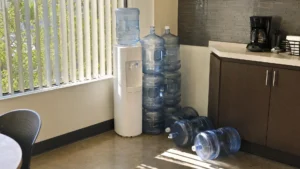
For an office of 15 to 80 people, neither of those works. Pitchers can’t keep up, RO is overkill for a kitchen, and the bottled-water alternative is somebody driving 40-pound jugs across the office every other Tuesday.
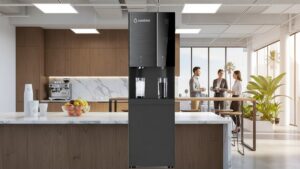
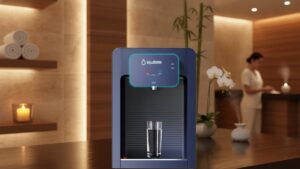
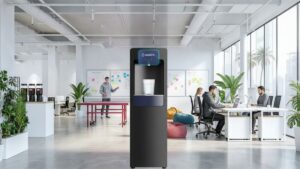
That’s the niche we built Aqualume around. A bottleless dispenser hooks straight to your existing water line, runs the supply through a 7-stage filter (sediment, two carbon stages, RO, UV, mineral re-addition, and a final polish), and delivers cold, ambient, hot, or sparkling on demand. The water that comes out is consistently under 10 ppm TDS, no chlorine, no hardness, no chasing the delivery guy.
You can test it yourself with the same kit you bought for the tap. That’s actually a fun exercise — most prospects we’ve installed for were genuinely surprised at how big the gap is.
Quick FAQ
How often should I test? Once a year for most situations. Twice a year if you’re on a well, have kids under six, or have noticed a change in taste/odor.
Can I drink tap water in Southern California? For the most part, yes — the regional utilities (LADWP, MWD, Irvine Ranch, etc.) are well-run. The hardness and chlorine are quality issues, not safety issues.
Are TikTok “boil the water and a film appears” tests real? That film is mostly calcium and magnesium — minerals, not contamination. Hard water, not poisoned water.
What about PFAS? The EPA finalized enforceable limits in April 2024. Most utilities are still phasing in monitoring. If you want to know your number, you need a PFAS-specific test ($65–$300 depending on the panel).
The bottom line
Test once, take it seriously, and make a decision. Most people stall at the testing step for years, then keep buying bottled water out of vague anxiety. A $20 strip kit and one mail-in sample will tell you exactly where you stand.
And if your results push you toward “I’d like clean, filtered water without managing it myself,” that’s what we do. Start your 7-day free trial and we’ll drop a dispenser in your office, no contract, no install fee. Test the water before and after — we’ll send you a kit if you want.
Call us at 833-426-5863 or book a free walkthrough at aqualume.com.