A water dispenser is one of those office appliances that everyone uses, nobody owns, and almost nobody cleans. Then one day someone reaches for a glass and notices that the spout has a faint pink tint, or the drip tray smells like a damp gym bag, and suddenly the dispenser becomes everybody’s problem.
Pink ring, by the way, isn’t algae. It’s Serratia marcescens — an airborne bacterium that loves damp plastic. It’s harmless to most healthy adults, but the optics are terrible, and the underlying issue (biofilm) is real.
Here’s how to clean a water dispenser properly, how often, and what not to do.
How often you actually need to clean water dispenser
The NSF and most manufacturers recommend a full sanitization every 6 months. Realistically, what an office water dispenser needs is:
- Daily: Wipe the spout/nozzle, empty and rinse the drip tray
- Weekly: Wash the drip tray with soap and water, wipe exterior with a food-safe surface cleaner
- Monthly: Sanitize the spouts and the catch area
- Every 6 months: Full deep sanitization — reservoir, internal lines, dispensing area
- Annually: Replace filters (if it’s a filtered/bottleless model)
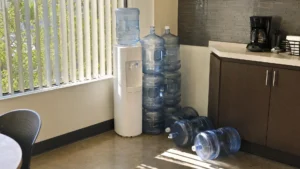
If you’re a bottled-water customer with a top-load dispenser, the bottle-change point is the highest risk for contamination. The neck of the bottle, your hands, and the dispenser receiver all touch each other. Every single time you change a jug.
What you’ll need
This is the boring but important part. The wrong cleaner will either fail to sanitize or eat the seals.
Approved: – Unscented household bleach (sodium hypochlorite, 5–6%) – Distilled white vinegar (5% acidity) – Citric acid powder – Food-grade hydrogen peroxide – Mild dish soap
Avoid: – Anything with ammonia, chlorine bleach + ammonia mixes, or “scented” bleaches with surfactants – Steel wool, abrasive pads, or harsh scrubbers — they scratch plastic, which gives bacteria more places to hide – Antibacterial wipes that leave a residue – “All-purpose” cleaners with quaternary ammonium compounds unless rated food-contact
A pair of clean nitrile gloves and a soft microfiber cloth round out the kit. Don’t use the office kitchen sponge — that sponge has its own ecosystem.
Step-by-step: cleaning a top-load (bottled) dispenser
This is the older, more common style — the one where a 5-gallon jug sits upside down on top.
- Unplug the unit. Always. Wait 15 minutes if it’s been running, so the hot-tank coils cool.
- Remove the bottle. Pour out anything left and set it aside.
- Drain the dispenser. Open both the hot and cold taps and let everything drain into a bucket. You’ll be surprised how much water sits in there.
- Remove and wash the no-spill collar/probe. Soak in warm soapy water, scrub gently, rinse with clean water.
- Make a sanitizing solution. One tablespoon of unscented bleach per gallon of warm water. Or for a non-bleach option, one cup of white vinegar per gallon.
- Pour the solution into the reservoir. Let it sit for 5 minutes. Don’t leave it overnight — the long contact time can pit plastic and degrade seals.
- Drain the solution through both taps. Hot and cold. Watch your hands.
- Rinse twice with clean water. Fill the reservoir, drain, fill again, drain. Run a gallon through each tap.
- Wipe everything down. Drip tray, taps, top collar, exterior.
- Replace the bottle and plug it back in.
- Wait 30 minutes before drawing any water. Let the hot tank get back up to temperature.
If you smell any bleach in the first pour, drain another gallon and try again. The smell should be completely gone before anyone drinks from it.
Step-by-step: cleaning a bottleless dispenser
A bottleless unit is plumbed into the building’s water line, so the procedure is different — and frankly, easier on the operator. Mostly because the internal sanitization happens automatically or during a service visit, not by the office manager.
What you can do safely yourself:
Weekly: – Wipe the dispensing nozzles with food-safe sanitizing wipes – Empty and rinse the drip tray (it’s removable on every model we make) – Wipe the touchpad/lever area
Monthly: – Pull out the drip tray and grate, soak in vinegar solution for 30 minutes, scrub, rinse, dry – Wipe behind the dispensing area with a microfiber cloth
Don’t open the internal cabinet or try to access the filter housing yourself. On every modern bottleless unit — ours included — the internal lines, reservoirs, and filters are designed to be serviced by a trained tech, not unscrewed by curious office staff. Modern systems also include internal sanitization cycles (UV, ozone, or hot-tank sterilization) that run automatically.
For Aqualume customers specifically, every install includes scheduled maintenance visits where our techs do a full internal sanitization, replace filters on the manufacturer’s schedule, and stress-test the unit. You shouldn’t be doing any of that yourself.
The pink stuff (and other things you might see)
Pink slime in the drip tray. Serratia marcescens. Vinegar and a scrub brush. Increase the drip tray cleaning frequency to twice a week. It’s an airborne bacterium, not a sign your water is dirty.
Black flecks coming out with the water. Usually carbon dust from a brand-new filter — runs clear after a few gallons. If it persists for more than a week, call service.
White scale around the spout. Hard-water minerals (calcium, magnesium). Common on unfiltered dispensers. Vinegar dissolves it. If you’re on a properly filtered unit, you shouldn’t see this at all.
A “metallic” or “off” taste. Usually a filter at end-of-life. On a bottleless unit, schedule the replacement. On a bottled cooler, check the bottle expiration and clean the unit.
Greenish tint. Don’t drink it. That’s algae, which means light got into the reservoir and the unit isn’t being sanitized often enough. Deep-clean immediately and consider moving the dispenser out of direct sunlight.
The hot-tank trap
A lot of people skip cleaning the hot tank because they assume the heat is sterilizing it. Mostly true — water held above 140°F is hostile to most microbes. But the hot tank has a chamber that doesn’t always reach that temp, and minerals do build up. Once a year, descale it: drain, fill with a citric acid or vinegar solution at the recommended ratio, let it sit (per the manufacturer’s instructions — usually 30 minutes), drain, rinse three times.
Sanitizing checklist (print this out)
- ☐ Unit unplugged
- ☐ Cooled for 15 minutes
- ☐ Reservoir drained
- ☐ Removable parts washed in soapy water
- ☐ Sanitizing solution mixed (1 tbsp bleach / 1 gal water OR 1 cup vinegar / 1 gal water)
- ☐ Solution circulated, 5 minutes contact time
- ☐ Drained through both taps
- ☐ Double-rinsed
- ☐ Exterior wiped
- ☐ Bottle replaced or unit restarted
- ☐ 30-minute wait before first pour
- ☐ No bleach smell or taste in the first glass
A few honest tradeoffs
If you’re in an office that’s never cleaning the cooler, the realistic options are: assign someone, hire someone, or switch to a system that maintains itself. Most office managers in Orange County and LA who’ve moved off bottled to one of our bottleless units cite this as a top-three reason — the cleaning headache disappears, because we handle it on a service schedule.
That said: even with a bottleless system, the external parts (drip tray, spout, touchpads) are still on you to keep tidy. Nobody’s coming to your office every week to wipe a drip tray. We’re good, but we’re not that good.
TL;DR
- Daily/weekly: wipe and rinse what you can see
- Monthly: drip tray deep-clean, spout sanitization
- Every 6 months: full reservoir sanitization (top-load) or scheduled service visit (bottleless)
- Use bleach or vinegar — never the random “antibacterial” stuff
- Don’t open the inside of a bottleless unit; that’s a service tech’s job
If keeping a top-load cooler sanitized in your office feels like one chore too many, start a 7-day free trial of an Aqualume bottleless dispenser. We deliver, install, and service it on a real schedule — no jugs, no cleaning weekend, no pink ring.
Call 833-426-5863 or book a free walkthrough at aqualume.com.