When your water cooler provider quotes you a monthly rate, that number is rarely what you’ll actually pay. Across the water delivery and water cooler industry, a web of additional charges—some disclosed in fine print, many not—can easily double your effective monthly cost. For Orange County businesses locked into multi-year contracts, these fees can add up to thousands of dollars in unexpected spending.
This guide pulls back the curtain on water cooler contract costs: what the common fees are, how providers justify them, and what a genuinely transparent alternative looks like.
The Advertised Rate vs. The Real Rate
National water cooler providers have become skilled at advertising attractive headline rates. A $29/month cooler rental sounds reasonable. A $0.99/gallon water delivery rate looks competitive. What these numbers don’t capture is the full cost of the relationship.
When businesses review their actual monthly invoices, the real cost is often 40-70% higher than what was originally quoted. The gap comes from a category of charges that providers either bury in contract terms or add later without clear advance notice.
The Hidden Fee Playbook: What Providers Aren’t Telling You
1. Trip Charges
One of the most egregious fees in the water cooler industry is the trip charge. If a delivery driver arrives at your building and can’t access your suite—because the dock is occupied, the contact person is out, or there’s a temporary access issue—you may be billed $144 or more for the attempt. No water delivered. Full charge.
The charge is typically buried in the service agreement under “failed delivery” language. It’s legal. It’s also a significant risk for larger office buildings where delivery windows and dock access can be unpredictable.
2. Fuel and Environmental Surcharges
Added during the fuel price spikes of the early 2000s, fuel surcharges became standard industry practice and never went away. The surcharge is typically calculated as a percentage of your delivery total and revised quarterly.
Here’s the problem: providers add these surcharges when fuel prices rise, but few routinely remove them when prices fall. It becomes a permanent line item with a variable justification. Some providers have rebranded this as an “environmental fee” or “sustainability surcharge,” which is particularly ironic given the environmental footprint of single-use water bottles.
Expect to see fuel/environmental surcharges ranging from $3-$12 per delivery.
3. Minimum Order Requirements and Penalties
Many bottled water contracts include a minimum monthly order requirement—a minimum number of bottles or gallons you agree to purchase each month. If your office usage is lower than expected (holiday weeks, remote work periods, seasonal slowdowns), you still pay for the minimum.
For a 20-person office on a 10-bottle monthly minimum at $8/bottle, a slow month where you only need 6 bottles still costs you $80—for four bottles of water sitting in a warehouse.
4. Delivery Frequency Fees
Some contracts lock you into a specific delivery schedule. Want weekly delivery? Monthly? That choice may come with different per-delivery fees. And if your needs change—your team grows, you move to a new floor, you want more or fewer deliveries—changing the frequency often triggers a contract modification fee or a rate adjustment that resets your term.
5. Early Termination Fees (ETFs)
Early termination fees are where the real exposure lies. Most major water cooler and bottled water delivery contracts include ETFs ranging from $1,000 to $4,000+ depending on your contract length, monthly spend, and how many months remain.
One common formula: ETF = (remaining months) × (average monthly spend) × 50%. For a business with 18 months left on a $200/month contract, that’s a $1,800 penalty to walk away—even if the provider has consistently underperformed.
6. Auto-Renewal Clauses
Perhaps the most insidious cost driver isn’t a fee at all—it’s the auto-renewal. Standard industry practice is a narrow cancellation window (often 30-60 days) before the contract renewal date. Miss it by a day and you’re automatically locked in for another full term.
For a 3-year contract with an auto-renewal provision, a missed cancellation window means three more years of accumulated fees. Given that many businesses don’t track these dates proactively, providers benefit substantially from the default.
7. Equipment Maintenance and Repair Charges
When a bottled water cooler breaks—and they do, especially older units—the repair bill often falls on the customer. Service calls can run $145/hour or more for labor, plus parts. For a unit that’s been in place for three years, a pump replacement or thermostat failure can produce a $300-$500 repair bill on top of your regular monthly costs.
8. Bottle Deposits and Lost Bottle Fees
Providers who use the traditional 5-gallon jug model often charge bottle deposits ($1-$2/bottle) and bill for bottles that aren’t returned within a specific window. For a busy office with a back closet full of empties waiting for the next delivery, these “lost bottle” fees can accumulate quietly for months.
The Real Cost Comparison: National Provider vs. Aqualume
Let’s run a realistic 3-year cost comparison for a mid-sized Orange County office (25 employees, moderate usage). See the breakdown below:
| Cost Item | National Provider (3 Years) | Aqualume (3 Years) |
|---|---|---|
| Base monthly rate | $120/mo ($4,320) | $80/mo ($2,880) |
| Delivery surcharges | $10/delivery × 48 = $480 | $0 |
| Fuel surcharges | ~$360 | $0 |
| Trip charges (2 missed) | $288 | $0 |
| Equipment repairs | ~$400 | $0 (included) |
| Installation | $150 | $0 (free) |
| 3-Year Total | ~$5,998 | $2,700 |
The difference is over $3,200 across three years—for equivalent or better water quality and significantly better service reliability. Explore our full water cooler pricing breakdown to see the complete picture.
The Hidden Fee Checklist
Before signing any water cooler contract, ask your provider directly about each of these:
- ☐ Trip charge policy — What happens if your driver can’t access the building? What’s the fee?
- ☐ Fuel/environmental surcharges — Are these included in the quoted rate or added separately?
- ☐ Minimum order requirements — What’s the minimum, and what happens in low-usage months?
- ☐ Early termination fee — What is the exact formula? What’s the maximum exposure?
- ☐ Auto-renewal terms — How many days before renewal do you need to cancel? Is it in writing?
- ☐ Equipment repair responsibility — Who pays for service calls and parts?
- ☐ Rate lock guarantee — Can the provider raise rates during your contract term?
- ☐ Delivery schedule flexibility — Can you change frequency without a fee?
If a provider can’t or won’t answer any of these questions clearly before you sign, that’s a signal about how they’ll behave once you’re under contract.
Why Bottleless Eliminates Most of These Fees
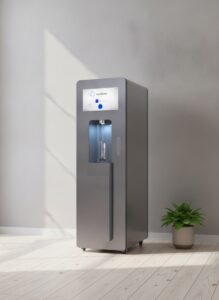
The reason bottleless water coolers have grown dramatically in popularity among OC businesses isn’t just about water quality—it’s about the billing model.
Because a bottleless cooler connects directly to your water line, there are no deliveries, no bottles, and therefore:
- No delivery surcharges
- No fuel fees
- No trip charges
- No minimum order penalties
- No bottle deposits
You pay one flat monthly fee. That’s it. Aqualume’s $80/month covers the unit, installation, maintenance, and 24/7 support, with filter replacements billed separately. No line items. No surprises.
This is especially meaningful for Orange County businesses in high-traffic areas like Irvine’s Spectrum district or Anaheim’s Convention Center corridor, where building access can create recurring delivery complications.
What to Do If You’re Already Under Contract
If you’re currently locked into a national provider contract and experiencing hidden fees, here’s what to do:
- Review your contract for performance guarantees. Most contracts include service level commitments. Documented failures (missed deliveries, billing errors) may give you grounds for early termination without penalty.
- Document everything. Keep records of every missed delivery, billing discrepancy, and failed service call. This creates a paper trail if you need to dispute the ETF.
- Calculate your true total cost. Add up all your recent invoices and compare the effective monthly rate to the advertised rate. The gap is often eye-opening.
- Run a trial now. Aqualume offers a free 7-day trial. You can evaluate the product before your current contract ends, so you’re ready to make an immediate switch at renewal—or sooner if you have grounds.
Questions? Call (833) 426-5863 — our team can walk you through what a transition would look like for your specific situation and help you evaluate your current contract terms.
The Bottom Line
Water cooler contracts are designed to benefit providers, not customers. The advertised rate rarely reflects the true cost once fees, surcharges, and penalties are factored in. For Orange County businesses spending $150-$200/month on what should be a $80 service, the savings from switching aren’t marginal—they’re substantial.
Transparent, Flat-Rate Pricing isn’t some rare premium offering. It’s the standard that local providers like Aqualume hold themselves to. Start your free 7-day trial and experience the difference.
Where to next? Explore the Glacier freestanding ice and water dispenser or see bottleless water dispensers for Southern California offices.