By the Aqualume team, Southern California · Updated October 21, 2026
An ENERGY STAR water cooler is a model that has been tested and certified to stay under EPA’s daily standby energy limit for its type: 0.16 kWh a day for cold-only units and 0.68 to 0.80 kWh a day for hot-and-cold units with storage tanks, under the Version 3.0 rules in effect since March 23, 2022. That number is measured with nobody pouring a glass, which is exactly the point.
Every figure below comes from ENERGY STAR’s own water cooler page, California’s appliance regulations and the U.S. Energy Information Administration, read on October 21, 2026. Aqualume rents plumbed bottleless water coolers to businesses in Los Angeles County, Orange County and the Inland Empire, so the last section is about how the label fits a real office quote, including the parts of our own lineup the program does not cover.
Key Takeaways
- ENERGY STAR rates water coolers on one test, “On Mode with No Water Draw”: the energy a plugged-in cooler burns in a day just keeping its water hot and cold.
- Version 3.0 limits: 0.16 kWh/day for cold-only, 0.68 (low capacity) or 0.80 (high capacity) kWh/day for hot-and-cold storage units, and 0.18 kWh/day for hot-and-cold on-demand units.
- EPA says certified water coolers use about 22 percent less energy than conventional models.
- Coolers that make, store or dispense ice are outside the program entirely, so a water-and-ice machine cannot carry this label under the current rules.
- California has required hot-and-cold bottle and point-of-use dispensers made since January 1, 2006 to stay at or under 1.2 kWh a day in standby. ENERGY STAR’s storage-unit limits sit 33 to 43 percent below that.
What ENERGY STAR measures on a water cooler
ENERGY STAR measures standby energy: the kilowatt-hours a cooler uses over a day when it is switched on and nobody draws water. The test is called “On Mode with No Water Draw,” and it is the only number that decides certification.
That sounds like an odd thing to grade. A cooler’s job is pouring water, after all. But most of the day, in most offices, nobody is at the tap. The machine sits in the corner holding a tank of cold water and, on a hot-and-cold unit, a tank of hot water, and both tanks drift toward room temperature until the compressor or the heater kicks back on. ENERGY STAR’s buying guidance puts it plainly:
“These tanks will lose energy over time and need to reheat (or re-cool) water every few hours, even if no one has drawn water during that period.”
ENERGY STAR, Water Coolers buying guidance, energystar.gov (read October 21, 2026)
So the standby figure is the floor of what a cooler costs to run. Real use adds to it. EPA knows this: under Version 3.0, every certified product must also report its On-Mode Performance for cold and, where it applies, hot draws, which is the energy used during and right after someone fills a cup. That second number does not decide the label, but it is published, and it is useful when you compare two certified models for a busy floor.
Why the hot side matters most
Look at the limits in the next section and one thing jumps out. A cold-only cooler is allowed 0.16 kWh a day. A hot-and-cold cooler with a storage tank is allowed four to five times that. Keeping water hot all day is the expensive part of a water cooler, not the chilling.
ENERGY STAR water cooler limits by type
The Version 3.0 limits run from 0.16 kWh a day for cold-only coolers to 0.80 kWh a day for high-capacity hot-and-cold storage coolers. Point-of-use and bottled coolers both fall in the storage category when they have hot and cold tanks.
The table adds two columns EPA does not publish: the yearly total, and the daily cost at California’s average commercial electricity price. The U.S. Energy Information Administration’s Electric Power Monthly, released September 24, 2026, puts that price at 30.56 cents per kWh for July 2026, up from 30.08 cents in July 2025 and higher than any other state in the contiguous U.S. in the same table.
| Cooler type | Capacity | Standby limit (kWh/day) | Per year (kWh) | Cost per day at 30.56¢/kWh |
|---|---|---|---|---|
| ENERGY STAR: cold-only or cook-and-cold | All | 0.16 | 58 | about 4.9¢ |
| ENERGY STAR: hot and cold, on demand | All | 0.18 | 66 | about 5.5¢ |
| ENERGY STAR: hot and cold, storage tanks | Low | 0.68 | 248 | about 20.8¢ |
| ENERGY STAR: hot and cold, storage tanks | High | 0.80 | 292 | about 24.5¢ |
| California Title 20 ceiling: hot and cold, bottle-type or point-of-use | All | 1.2 | 438 | about 36.7¢ |
Sources: ENERGY STAR Version 3.0 key product criteria; Cal. Code Regs. tit. 20, § 1605.3(a)(2); EIA Electric Power Monthly Table 5.6.A. Yearly totals are the daily limit times 365. These are ceilings for standby only, not what any particular machine uses.
Read the bottom two rows together. A high-capacity hot-and-cold cooler that only just meets California’s rule can use 0.4 kWh a day more than one that only just meets ENERGY STAR. That is 146 kWh a year, or roughly 12 cents a day per machine at July’s rate. Real money across a dozen units on a campus. Small money for a single break room. Both statements are true, and which one matters depends on how many coolers you run.
High capacity versus low capacity
EPA defines a high-capacity cooler as one that can deliver more than 10 cups of cold water an hour (0.5 gallons) and more than 41 cups of hot water an hour (1.9 gallons), counted in 6-ounce cups, and recommends high capacity for larger offices and commercial settings. Low-capacity units have smaller compressors and suit a handful of users. Choosing a low-capacity unit for a 40-person floor to save a fraction of a kWh is a false economy.
Storage tanks versus on-demand hot water
On-demand coolers heat water only when someone asks for it, which is why their limit is 0.18 kWh a day instead of 0.68 to 0.80. The trade-off, in EPA’s own words, is that there may be a wait of a few minutes for hot water. A team that drinks cold water and makes the occasional tea does fine on demand. A team that runs on hot tea and instant oatmeal at 8 a.m. is better served by a storage tank.
Which water coolers cannot carry the label
ENERGY STAR excludes three groups: building-integrated pressurized units, air-source units, and any cooler that makes, stores or dispenses ice. If a machine falls in one of these groups, a missing label tells you nothing about its efficiency.
The ENERGY STAR water cooler page lists the ineligible products as:
- Pressurized units that are not freestanding: wall-mounted, under-sink or otherwise built into the building.
- Air-source units, and any unit whose water comes from somewhere other than a bottle or the tap.
- Units that make, store and dispense small amounts of ice, plus ice makers that happen to dispense water.
The third exclusion is the one that catches offices out. A water-and-ice dispenser like our Glacier, which pours hot, cold and ambient water plus up to 44 pounds of ice a day, is simply not something the water cooler test covers. Neither is the countertop Blizzard, which makes nugget ice, or a dedicated ice machine like the Avalanche, which pours ice only. ENERGY STAR runs a separate specification for commercial ice makers, but that is a different program with different tests, and it is not what anyone means by an ENERGY STAR water cooler.

What is eligible may surprise people the other way. EPA explicitly includes coolers that pour sparkling, alkaline or flavored water alongside chilled water, and holds them to the same tests as a plain unit. Bottled and point-of-use coolers are both in scope, as are storage and on-demand designs.
ENERGY STAR versus California’s own water dispenser rule
California already caps standby energy for hot-and-cold bottle and point-of-use dispensers at 1.2 kWh a day, for units made on or after January 1, 2006. ENERGY STAR is a voluntary label that sits well below that legal ceiling.
The rule is in Title 20 of the California Code of Regulations, the state’s appliance efficiency standards, at section 1605.3(a)(2). It applies to bottle-type and point-of-use water dispensers that dispense both hot and cold water. So any hot-and-cold cooler made since 2006 and legally sold into a Pasadena office or an Irvine clinic already meets a ceiling. ENERGY STAR’s high-capacity storage limit of 0.80 kWh a day is a third lower than that ceiling; the low-capacity limit of 0.68 is 43 percent lower.
Two cautions keep this comparison honest. First, the two numbers come from different rulebooks, so treat the gap as a ballpark, not a lab result. Second, California’s price is what makes the gap visible at all. At 30.56 cents a kWh, the same 0.4 kWh a day costs noticeably more in Los Angeles than in a state paying half that.
What the hot SoCal break room adds
Standby numbers come from a lab. A west-facing kitchenette in Riverside in August is not a lab. ENERGY STAR’s guidance notes that changing a cooler’s temperature settings affects its energy use, and that a unit offering room-temperature water can cut energy costs overall by nudging people toward water that needs no heating or chilling. If half your team drinks ambient water anyway, a machine with an ambient tap is doing some of the efficiency work for you.
How to check whether a water cooler is ENERGY STAR certified
Get the manufacturer and exact model number, then look it up in ENERGY STAR’s product finder for certified water coolers. A sticker, a sales sheet or a provider’s word is not the same thing as a listing.
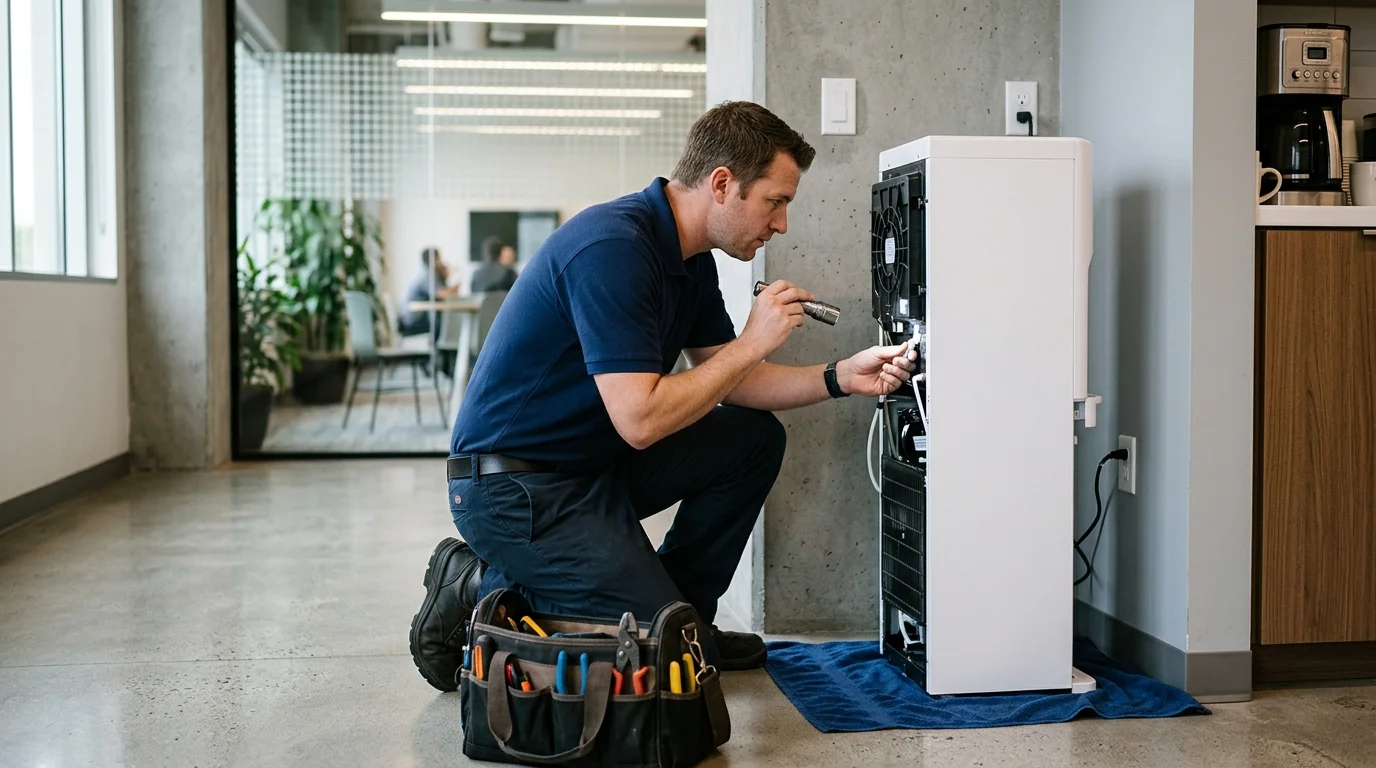
- Ask for the model number. Ask the provider, any provider, for the manufacturer name and the full model number of the machine they plan to install, not the marketing name on the front panel.
- Search the listing. Enter it in the ENERGY STAR certified water coolers finder. A certified model shows its category and its tested standby figure.
- Match the category to the machine. A hot-and-cold storage unit should be judged against 0.68 or 0.80 kWh a day, not against the 0.16 limit for cold-only units.
- Rule out the excluded types first. If the unit makes ice, or is a pressurized wall-mounted or built-in unit, there is no listing to find, and that is not a mark against it.
- Ask about settings. If nobody uses hot water, ask whether the hot side can be turned off. EPA notes that temperature settings change energy use.
Where the label fits in an Aqualume quote
None of our product pages claims an ENERGY STAR label, and you should check any specific model in the finder rather than take our word or anyone else’s. Here is how the lineup maps onto the program.
All seven Aqualume machines are plumbed into the building’s line and run on the same 7-stage filtration. What changes from one to the next is ice, bubbles, hot water and floor space, and those are exactly the features that decide where a machine sits in ENERGY STAR’s scope:
- Glacier, Blizzard and Avalanche make ice, so they sit outside the water cooler program, as explained above.
- Cascade, Gulfstream and Lightstream are hot-and-cold point-of-use machines: the Cascade with its 15.6-inch touchscreen, the slim 11.8-inch-wide freestanding Gulfstream, and the countertop Lightstream.
- Jetstream adds sparkling to hot, cold and ambient from a tabletop unit, and sparkling is a feature EPA allows.
If a certified label is a hard requirement, for example under a company sustainability policy, call us at (833) 426-5863, ask for the manufacturer model number of the hot-and-cold machine we would spec for your floor, and run it through the finder before you sign anything.
Keep the electricity line in proportion, too. On a single break room the gap between a cooler at California’s ceiling and one at ENERGY STAR’s limit is cents a day. The bigger swings in a water budget usually come from elsewhere: jug delivery, deposits, storage space and the time someone spends hauling bottles, which we break down in what SoCal offices actually pay for bottled versus bottleless water.
Plans start at $80 per month per dispenser*, with installation, scheduled service and repairs included; replacement filters are billed separately. The water cooler rental page covers what the plan includes, and the 7-day free trial lets you run a machine on your own floor for a week with no credit card.
*Starting price; final pricing depends on the machine and site.
Questions about ENERGY STAR water coolers
What is an ENERGY STAR water cooler?
It is a water cooler model that has been tested and certified to stay under EPA’s standby energy limit for its type, measured with the unit on and no water drawn. The current rules are Version 3.0, in effect since March 23, 2022. Water coolers first qualified for the label in September 2000.
How much energy does an ENERGY STAR water cooler use?
In standby, no more than 0.16 kWh a day for a cold-only unit, 0.18 kWh a day for a hot-and-cold on-demand unit, and 0.68 or 0.80 kWh a day for a low- or high-capacity hot-and-cold unit with storage tanks. Actual use adds more when people pour water.
How much less energy does an ENERGY STAR water cooler use?
EPA says certified water coolers use about 22 percent less energy than conventional models. The certification test itself measures standby: the hours when the cooler holds hot and cold water and nobody is pouring, which is most of an office day.
Are bottleless point-of-use water coolers eligible for ENERGY STAR?
Yes. ENERGY STAR lists bottled water and point-of-use units as eligible, and its criteria place point-of-use and bottled hot-and-cold coolers in the conditioned storage category. Pressurized units that are not freestanding (wall-mounted, under-sink or otherwise built into the building) are not eligible.
Can a water cooler with an ice maker be ENERGY STAR certified?
Not as a water cooler. ENERGY STAR excludes units with provisions for making, storing and dispensing ice, and ice makers that also dispense water. A water-and-ice dispenser has no water cooler listing to find, so a missing label says nothing about its efficiency.
What is California’s energy standard for water dispensers?
Title 20, section 1605.3(a)(2), caps the standby energy of bottle-type and point-of-use water dispensers that dispense both hot and cold water at 1.2 kWh a day for units manufactured on or after January 1, 2006. ENERGY STAR’s storage-unit limits are 33 to 43 percent lower.
How do I check if a water cooler is ENERGY STAR certified?
Ask for the manufacturer and full model number, then search ENERGY STAR’s certified water coolers product finder. A listed model shows its category and tested standby energy. If the unit makes ice or is a pressurized unit built into the wall, there will be no listing.