Comparing your options? Browse our program for warehouses and manufacturing facilities or check bottleless water service in Santa Monica — no jugs involved.
Warehouses and distribution centers across the Inland Empire — Ontario, Fontana, Rialto, Moreno Valley, Perris — run some of the most water-intensive workplaces in Southern California, and most of them are still running on plastic jugs. Here is what that actually costs, what California requires, and what changes when the water comes out of the wall instead of off a pallet.
The Inland Empire is not the coast, and your water plan should know it
An office in Irvine and a cross-dock in Perris are both “Southern California,” but they are not the same hydration environment. Inland valley facilities routinely see triple-digit afternoons from June through September, and a metal-roofed building with active dock doors holds that heat well past sunset. Workers on their feet moving freight drink dramatically more water than workers at desks — and they drink it in short, urgent bursts during breaks, not steadily across the day.
That demand curve is exactly what jug coolers handle worst. A 5-gallon jug cooler recovers slowly, holds a limited reservoir of chilled water, and empties fastest at the precise moment forty people hit break at once. The result is the thing every operations manager has seen: a warm trickle at 2:15 p.m. and a supervisor hauling a jug across the floor mid-shift.
What California actually requires you to provide
Cal/OSHA’s Heat Illness Prevention standard for outdoor work (Title 8, Section 3395) requires employers to provide drinking water that is fresh, pure, suitably cool, and free of charge — and to make available at least one quart per employee per hour for the entire shift. California also adopted an indoor heat illness prevention standard (Section 3396) that applies to indoor work areas once temperatures reach 82°F, which covers a great many warehouse floors between May and October. Requirements change, so confirm the current text with Cal/OSHA or your safety counsel before building your program around it.
Read the quart-per-hour figure as a provisioning target rather than a consumption estimate, and the logistics get uncomfortable fast. A 30-person shift working eight hours means having roughly 60 gallons available — twelve 5-gallon jugs, per shift, on a hot day. Nobody is stocking twelve jugs a day. What they are doing instead is running short, and hoping the inspector visits in February.
A plumbed bottleless dispenser sidesteps the arithmetic entirely. It does not have a reservoir you can run out of. It has a water line.
The real cost of jugs in a mid-size facility
Jug delivery pricing in Southern California is rarely the number on the quote. The number on the quote is the water. The number on the invoice includes everything else:
- Per-jug water cost, which climbs quietly at each contract renewal.
- Delivery and fuel surcharges, billed per stop regardless of how much you took.
- Bottle deposits and rental fees on the cooler itself.
- Storage square footage — full pallets and empties both occupy floor space that could hold inventory.
- Labor, the cost nobody invoices you for: someone on the clock swapping 42-pound jugs, chasing the delivery driver, and counting empties.
- Emergency top-up runs to the warehouse club when the delivery misses a hot week.
Across the Southern California businesses we serve, the swing from jug delivery to bottleless service typically lands between $1,000 and $3,000 a year — and that is before you price the injury risk of repeatedly lifting a 42-pound bottle to shoulder height, or the forklift aisle a delivery driver is walking down twice a month.
Aqualume service is an flat-rate flat monthly rate, starting from $80 per month per dispenser and running to about $150 per month for the Glacier freestanding ice and water dispenser, our flagship freestanding unit with ice. It is one predictable line on the P&L, on a 36-month service term, instead of a variable invoice that spikes every summer exactly when your labor costs do.
What actually changes on the floor
The financial case is the easy part. The operational case is what makes warehouse managers switch.
Placement stops being about delivery routes. Jug coolers live where a hand truck can reach them. A plumbed dispenser lives where your people actually are — near the pick modules, at the dock office, in the shipping mezzanine — so a hydration break costs ninety seconds instead of eight minutes. On a 35-person floor, that difference adds up to real recovered hours over a summer.
Nobody lifts anything. Jug swapping is an awkward overhead lift performed by whoever happens to be closest, usually without training and often on a wet floor. Removing it removes a small but genuine injury exposure from your facility.
Capacity matches the break bell. Our freestanding units are built for continuous draw, so the fortieth person in line gets the same cold water as the first. Ice on the Glacier matters more in Fontana in August than it does in a Santa Monica conference room.
The plastic goes away. A facility burning through a dozen jugs a week is cycling hundreds of hard-plastic bottles a year through a delivery truck that drives your aisle. Cutting that is the rare sustainability win that also cleans up your dock schedule.
Which Aqualume unit fits a warehouse
Most industrial facilities end up with a mix rather than a single model, because a dock office and a 300-person break room are different problems.
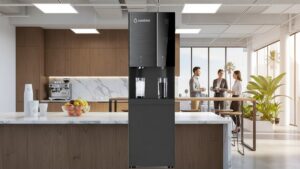
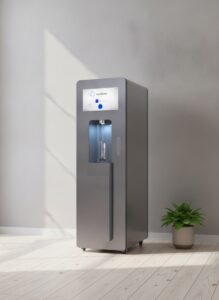
- Glacier — the flagship freestanding unit with ice. The right call for a main break room or a high-traffic floor position where cold water and ice at volume are the whole point.
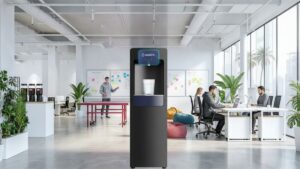
- Cascade — our best-seller, freestanding, and the workhorse for secondary break areas, shipping offices, and mezzanine landings.
- Jetstream — tabletop, for the dock office, the security desk, or a supervisor’s station where floor space is nonexistent.
- Avalanche, Gulfstream, and Blizzard round out the line for facilities with specific ice, footprint, or capacity requirements.
Filtration built for hard inland water
Inland Empire tap water is legally safe to drink and, in much of the region, genuinely hard — a blend of imported State Water Project supply and local groundwater that arrives with a mineral load you can taste and a chlorine finish most people notice immediately. Safe and palatable are not the same standard, and if the water tastes like a swimming pool, your team will keep buying single-serve bottles at the gas station on the way in.
Every Aqualume dispenser runs a 7-stage filtration process that addresses sediment, chlorine taste and odor, and dissolved contaminants before the water is chilled. Filter changes and servicing are handled by our technicians as part of the monthly rate — you are not tracking cartridge intervals on a whiteboard.
Frequently asked questions
How much does bottleless water service cost for a warehouse?
Aqualume service starts from $80 per month per dispenser and runs to roughly $150 per month for the Glacier flagship, on an flat-rate flat monthly rate over a 36-month service term. Most Southern California facilities save between $1,000 and $3,000 a year compared with 5-gallon jug delivery, before counting the labor spent swapping and storing bottles.
Can a bottleless dispenser keep up with a full shift on a hot day?
Yes. A bottleless unit is plumbed directly to your water line, so it has no reservoir to run dry — the constraint is chilling and ice production rate, not supply. Freestanding models like the Glacier and Cascade are specified for continuous high-volume draw, which is why they hold up when an entire shift hits break at the same minute.
Does a warehouse need a plumbing remodel to install one?
Almost never. Installation taps an existing cold water line and needs a nearby standard outlet and a drain path. Our technicians handle the install and walk the space with you first to place units where your people actually work rather than where the pipes happen to be convenient.
How does bottleless water help with California heat illness requirements?
Cal/OSHA requires employers to provide fresh, pure, suitably cool drinking water free of charge, with at least one quart per employee per hour available across the shift. A plumbed dispenser supplies continuously, so meeting the availability requirement stops depending on whether the delivery arrived. Confirm current requirements directly with Cal/OSHA — the standards have been updated in recent years, including for indoor work areas.
What areas of Southern California does Aqualume serve?
We serve Orange County, Los Angeles, and the Inland Empire, including the logistics corridors around Ontario, Fontana, Rialto, Moreno Valley, and Perris. Service, filter changes, and maintenance are performed by our own technicians rather than subcontracted out.
Can we try it before committing?
Yes — we offer a 7-day free trial. Put a unit on your floor during a hot week, which is the only test that tells you anything real, and see how it performs against your actual break traffic.
Put one on your floor during a heat wave
Every warehouse hydration plan looks fine on a 74-degree morning in March. The one that matters is the plan on the third consecutive 103-degree day in August, when the dock doors have been open for nine hours and everyone hits break at once. That is the week worth testing.
Start your 7-day free trial and we will walk your facility, recommend placement, and install a unit where your team actually needs it.