Walk into any big-box store, look at the water section, and the labels will lie to you. There’s a “filter” that does more than the “purifier” three shelves over. There’s a “purification system” that’s literally just a carbon block. Marketing teams have spent twenty years using these terms interchangeably, and the result is that nobody — including a lot of plumbers — can give you a clean answer.
Here’s the clean answer.
The U.S. EPA and NSF International draw a real line:
- A water filter removes physical contaminants — sediment, chlorine, lead, some chemicals — by trapping or chemically binding them.
- A water purifier has to remove or kill 99.99% of viruses, 99.9999% of bacteria, and 99.9% of cysts (like Giardia and Cryptosporidium).
By that standard, a Brita pitcher is a filter. A UV system that zaps the water with ultraviolet light is a purifier. Reverse osmosis (RO) sits in a weird middle space — it filters mechanically, but its pore size is small enough to block bacteria and most viruses, so depending on the brand, it gets sold as either.
That’s the textbook answer. The real-world answer is messier and more useful.
What people actually mean when they say “filter” vs “purifier”
In the U.S. market, the terms have drifted to mean something more like:
- Filter: A relatively simple, point-of-use device. Carbon block, pitcher, faucet attachment. Designed for taste, smell, and the most common contaminants in municipal water.
- Purifier: A more comprehensive system. Multi-stage. Often includes RO, UV, or both. Designed to handle source water that might have biological or chemical risks, or to deliver near-bottled-quality output.
If somebody at an office is asking, “should I get a filter or a purifier?”, what they usually mean is, “do I need the cheap thing or the expensive thing?”
The answer depends on three things: where your water comes from, what’s actually in it, and how many people you’re trying to serve.
Water Filter Types – a Quick Anatomy
There are five filter technologies you’ll encounter:
Activated carbon (granular or block)
The workhorse. Carbon is great at removing chlorine, chloramines, taste and odor compounds, some VOCs, and a portion of lead (if the carbon is NSF-certified for lead). It does not remove minerals, nitrates, fluoride, or microbes. Most Brita-style pitchers, fridge filters, and faucet attachments are carbon-based.
Sediment filters
Cheap, often the first stage in a multi-stage system. They trap rust, sand, scale, and anything visible. Rated by micron size — anything from 50 down to 1 micron. They protect the more expensive filters downstream.
Reverse osmosis (RO)
A semipermeable membrane with pores around 0.0001 microns. It rejects almost everything: dissolved solids, heavy metals, fluoride, nitrates, most pesticides, and most microorganisms. The trade-off: it strips out beneficial minerals too, so most decent RO systems re-mineralize at the end. Also wastes some water in the process (modern units are around 1:1 ratio, older ones up to 4:1).
UV (ultraviolet)
Light at 254 nanometers wrecks the DNA of bacteria, viruses, and protozoa. Doesn’t remove anything physically — it just sterilizes. Pairs well with a carbon or RO front end. Standard in well-water systems and in serious commercial dispensers.
Ion exchange (water softeners, certain specialty resins)
Swaps “hard” ions (calcium, magnesium) for “soft” ones (sodium or potassium). Useful for protecting appliances and skin. Not really about drinking water quality, despite what the door-to-door softener guy will tell you.
A real “water purification system” usually stacks three or more of these in sequence. Aqualume’s dispensers, for the record, run sediment → carbon → carbon → RO → UV → mineral re-addition → final polish. Seven stages.
So which one do you actually need?
Walk through this:
Scenario A: Municipal water, no specific concerns, 1-3 people drinking. A carbon pitcher or faucet filter is fine. You’re paying for taste and a little peace of mind. Skip the purifier.
Scenario B: Municipal water, but you’ve got a baby, a pregnant person, or somebody on chemo. Step up to a multi-stage system — either an under-sink RO or a counter-top RO + UV. The immune-compromised case is the textbook reason to “purify” rather than just “filter.”
Scenario C: Well water or rural supply. You absolutely want a purifier. Wells can carry coliform bacteria, nitrates, and seasonal contamination. The protocol is usually: sediment → carbon → softener (if hard) → RO or UV. Test the well first, then build to the test.
Scenario D: An office of 15+ people. This is where filters fall apart. Pitchers can’t keep up, faucet filters get torn off the sink, and a $300 under-sink RO doesn’t handle the volume. You either go bottled (heavy, expensive, plastic-heavy) or a commercial multi-stage dispenser. Functionally a “purifier” by any honest definition.
Scenario E: You travel internationally and want safe water in the hotel. You’re not in our market, but get a personal UV pen (Steripen) or a Grayl filter bottle. Different problem.
The cost gap is smaller than the marketing suggests
A solid pitcher filter system runs about $30 upfront and $60–$100/year in replacements. A whole-home or under-sink RO + UV is $400–$1,500 installed, plus $80–$200/year in membranes and bulbs.
A commercial bottleless dispenser (the office equivalent of a purifier) runs about $45–$85/month — filters, service, repair, the whole stack. We charge from $80/month* for the Glacier and Cascade models, filter swaps billed separately. *Starting price; final pricing depends on the machine and site.
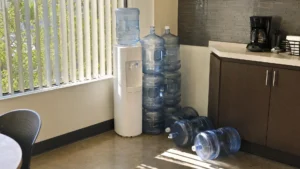
Compare that to bottled delivery for the same office: 25–40 jugs per month at $8–$12 a piece, plus the cooler rental, plus somebody’s back. We’ve audited offices that were spending $4,000+ a year on bottled and didn’t realize it because it was buried under “office supplies.”
Two myths worth killing
Myth 1: “Purifiers remove healthy minerals.” True only if the purifier doesn’t re-mineralize. Any commercial-grade RO system worth buying adds calcium and magnesium back in the final stage. Aqualume does. Most modern under-sink RO systems do. The cheap Amazon ones often don’t.
Myth 2: “Bottled water is purer than filtered.” The IBWA and NSF tested this — about 25% of bottled water is just tap water that’s been re-filtered. A well-run RO + UV system at point of use outperforms most retail bottled water on TDS and chlorine, and beats it on taste.
The decision tree, simplified
- One or two drinkers, city water → carbon filter
- Family, city water → multi-stage under-sink RO
- Well water → whole-home filter + UV purifier
- Office 10+ → bottleless commercial dispenser (this is us)
- Travel → personal UV pen or filter bottle
Where Aqualume fits
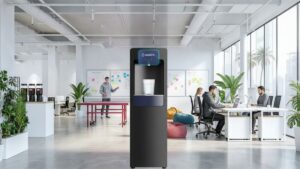
We exist for that office-scale gap. The reason we built a 7-stage system instead of a 3-stage one is that an office is unforgiving — it has to be clean enough for the new hire, hot enough for the tea drinker, cold enough at 2 p.m. on a 95-degree Inland Empire afternoon, and reliable enough that the office manager never thinks about it.
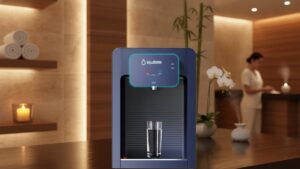
Our Glacier and Cascade freestanding units do all of that. The Jetstream is the tabletop version. The water that comes out clears every NSF/ANSI 42, 53, and 58 benchmark on chlorine, lead, cysts, and dissolved solids.
If you’re trying to figure out whether to keep buying jugs, install an under-sink RO and hope it scales, or just hand the whole thing off — we’re happy to walk through it. Free trial, no contract, no install fee. Call 833-426-5863 or book a free assessment at aqualume.com.