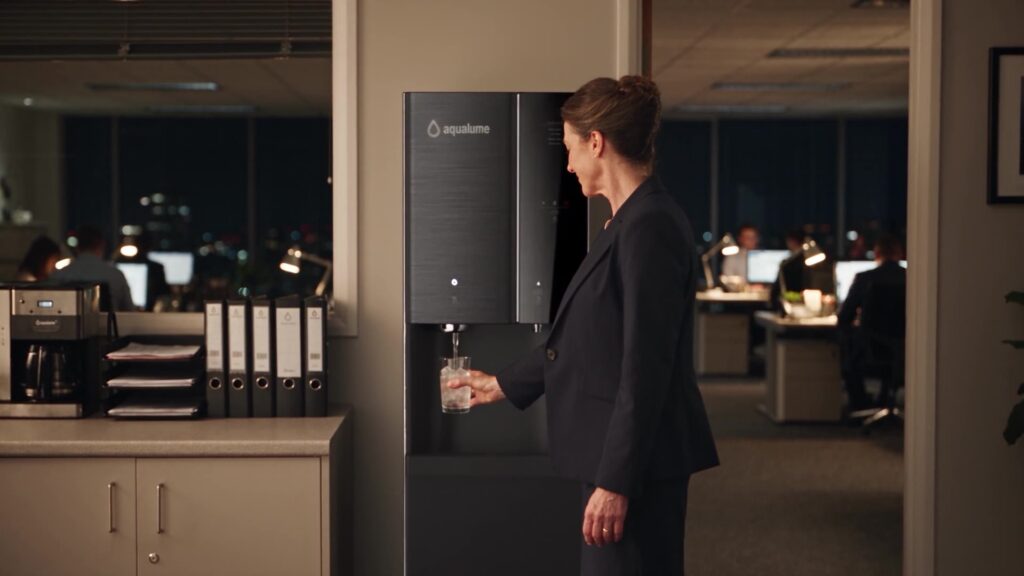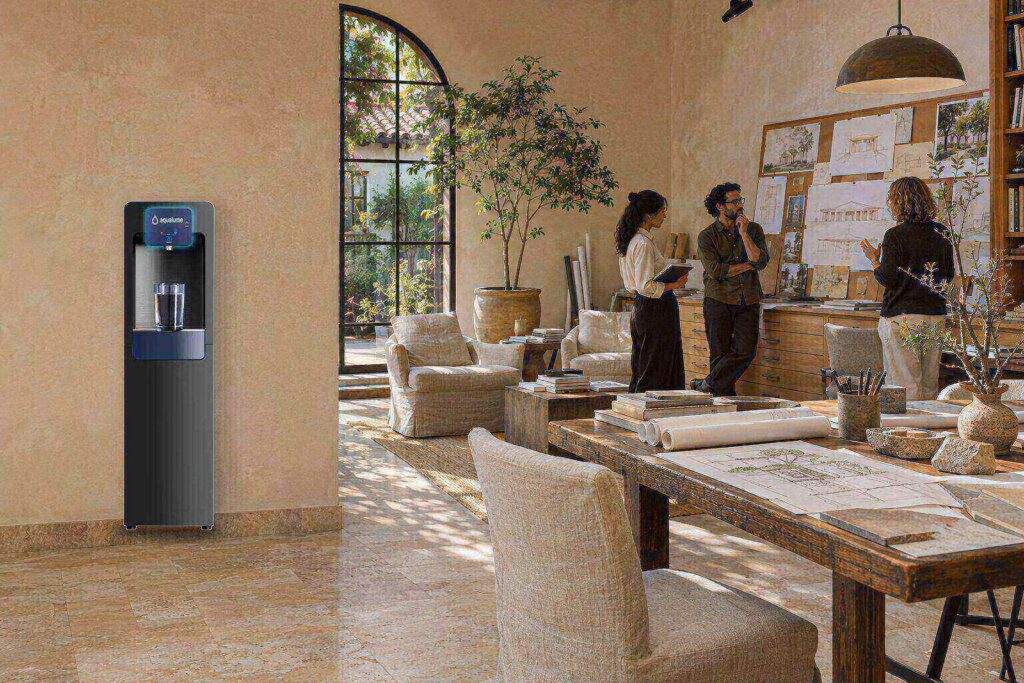
Discover bottleless water cooler Cost vs. Traditional Units
What a bottleless water cooler costs next to bottled delivery
A bottleless water cooler connects to your building’s water line and filters the tap water on site. Nobody orders jugs and nothing gets delivered.
Ours pour hot, cold or room-temperature water, depending on the model. The taps for each model are listed on its product page.
This page is about cost: what a bottleless rental costs you next to bottled delivery, and which numbers you can check yourself. The short answer is the bottleless water cooler cost comparison below, built around your own invoices instead of averages.
We rent to offices, clinics and studios in Los Angeles and across Southern California, so the examples stay with workplaces. Many offices pay for bottles, delivery and storage as three separate things, and the total is rarely added up.
A plumbed-in machine replaces all three with one monthly line. It adds a couple of items of its own, and we list those too.
You will find the direct costs compared with bottled delivery, the less obvious costs on both sides, and what to ask any company for in a quote.
There are three tables and a checklist of questions. They use no averages, because we have none we could stand behind. Bring your own invoice and the tables become a worksheet.
People search for bottleless water cooler cost and for the running costs of mains-fed machines. The honest answer is that it depends on the site, so we compare quotes with your bills for offices in Los Angeles and Southern California.
Experience the Difference: Start Your 7-Day Free Trial Today!
See how easy a bottleless water cooler can be. Seven days, no card required.
Taste the filtered water for a full week, free.
Where the direct savings come from
A bottleless machine replaces bottled water with filtered tap water, so you stop paying for bottles and for the trucks that bring them.
The idea is simple. A cooler on your water line filters tap water as it pours, so there is no per-bottle price and no delivery fee. What you pay instead is the rental.
On top of the rental you pay for replacement filters, billed separately about once a year. That is the whole list of recurring costs on our plan.
Whether that beats bottled water depends on how many bottles you buy now. We will not guess at your number, and no honest provider can.
Below is where the saving comes from, and where it does not. Send us your invoice and we will price it side by side.
Switching to bottleless systems removes the bottle charge and the delivery fee. It can also remove small items that show up on bottled invoices, like fuel or handling lines, if your supplier adds them. Check yours.
Next, what you stop paying per employee and per bottle when the jugs go.
What you stop buying
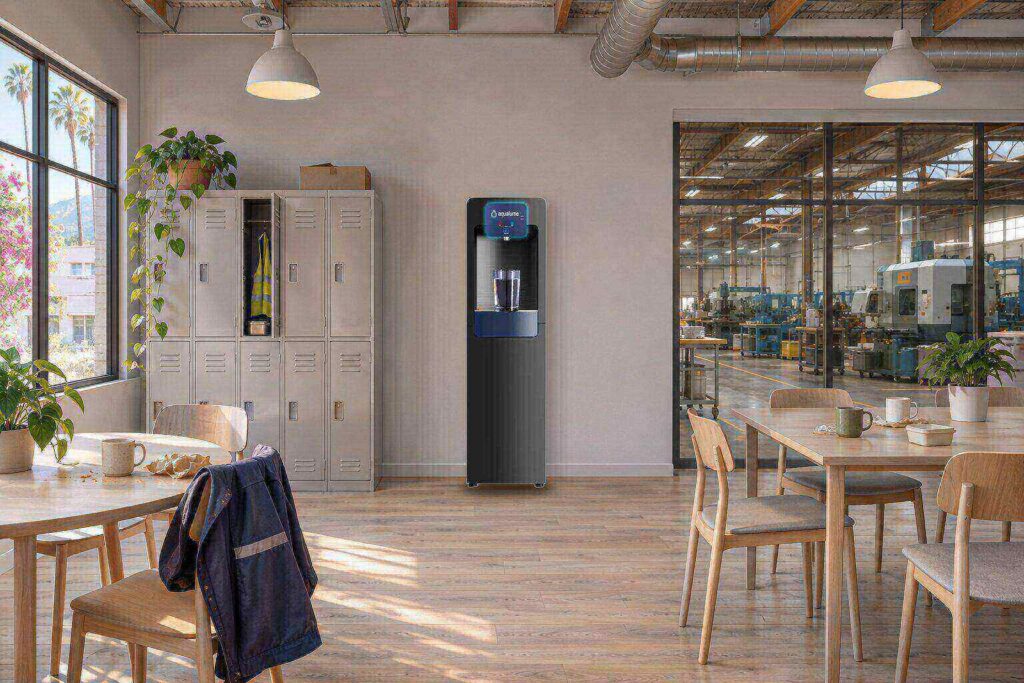
A jug of water is a purchase every time. With a bottleless machine the water comes from the tap you already pay for, filtered on site.
The running cost is the filters and the service on the plan, not the water itself. We do not publish a cost per litre, because it varies with usage.
What you can do is divide your monthly bottle spend by the number of people who drink it.
Take last quarter’s invoices and add the bottles, the delivery fees, any cooler rental and any deposit. Then compare the total with a written quote for the same headcount.
That comparison is how you find real savings for offices of any size. Without it a percentage is just a claim.
A rough plan is easy once you have the invoice total: set it next to the monthly plan and the yearly filter bill. The next section covers the extra charges that sit on top of the bottles.
Delivery fees and surcharges
Without deliveries there are no delivery fees. There are also no surcharges for a rush order or a small one.
Some suppliers charge a flat fee per drop, some a fee per bottle, and some add a handling line. Look at your own invoice to see which.
A bottleless machine needs no regular delivery. The only visits are service visits, and filters are replaced about once a year.
Staff also spend less time ordering and checking deliveries. For a finance team the invoices get shorter: a rental line, and the occasional filter charge.
Less dependence on a truck also means fewer missed drops and fewer stacks of bottles. Storage and staff time are the next cost to look at.
Storage and handling
With no jugs, there is nothing to store or count. The corner of the supply closet goes back to the office.
Whether that space is worth money depends on your lease and your layout, so we will not put a number on it. What you do get back is the floor space and the time spent moving heavy bottles.
Nobody lifts a five-gallon jug onto a cooler or walks the empties back out. That removes a chore, and a lifting task that some people dread.
How much time that saves depends on how often your team changes bottles and who does it. Manuk Manukyan, in a Google review, said that after years of carrying heavy gallons of water, “now I don’t need to lift a finger.”
That saved time and space is real, but it is a soft saving. Treat it as a bonus on top of the invoice comparison, not a number to book.
Fewer stored bottles also means one fewer thing for a facilities team to check. Safety and hygiene come up again later.
Comparing quotes?
Get Aqualume's price for your office in one call.
Plans from $80/mo*. Seven models, one 7-stage filtration system, service across LA, Orange County and the Inland Empire.
Bottleless and bottled compared on price and running cost
A bottleless rental costs nothing up front for the machine, since you rent it, and installation is free. Bottled coolers move the cost into bottles, delivery and storage month after month.
On our plan the costs are the monthly fee and the yearly filters. On a bottled system they are the cooler, the bottles, the deliveries and the space for storing them.
Which is cheaper depends on how much water you use. We will not claim a winner without your invoice.
After the table come purchase prices, renting versus buying, and maintenance. We rent only, so the buying column describes other vendors, not us.
Where a figure belongs to another company, the table says to check their quote. We did not make up numbers for them.
The table compares the cost shapes of a bottleless rental, a bottled cooler and a portable bottled dispenser.
| System type | Upfront cost | Ongoing cost |
|---|---|---|
| Aqualume bottleless rental | No machine to buy, and our installation is free, so nothing is paid before the machine is running | From $80/mo* per dispenser; filters billed separately, about once a year |
| Bottled water cooler (other providers) | Check the quote: the cooler, any bottle deposit and the first delivery vary by provider | Check the quote: bottles, delivery and storage can be separate lines on the bill |
| Portable bottled dispenser | Check the quote | Check the quote: per-bottle and delivery charges vary by provider and by order size |
In short, the cost shapes differ more than the totals can tell you. A bottleless rental is one steady fee and a yearly filter bill; bottles and trucks come in many small charges.
The sections below cover each cost. *Starting price; final pricing depends on the machine and site.
What a machine costs, and why we quote it per site
The price of a rental depends on the model and the site. Prices also differ between companies for the same size of machine, so compare quotes line by line.
Which model you pick affects the price. The Glacier makes ice and pours three water temperatures, while Lightstream pours hot and cold only.
Smaller teams often suit a countertop unit such as the Lightstream, which is 11.8 in wide. We quote after the site visit, because plumbing and placement are part of what we look at.
Touchless pouring is a feature some offices ask for, and the Lightstream is our touchless model. Ask on the first call about anything else you need.
Knowing the options helps you set a realistic budget before you ask for quotes.
Choosing only the features you will use keeps the monthly fee down. It also settles the rental-versus-purchase question, which is easy for us: Aqualume only rents.
Renting or buying (we only rent)
Renting a bottleless machine means nothing to pay for the machine itself. The plan includes installation, scheduled service and repairs.
Buying can work out cheaper over many years if you keep the machine running well and have someone to look after it. Renting spreads the cost into a monthly fee and gives you service in the bargain.
A rental gives you a predictable bill. Buying costs more at the start, and your monthly cost afterwards is lower. We have no figures for how long the break-even takes, since it depends on the machine you would buy and who services it.
Any break-even time depends on rental prices, how much water you use and what the service covers, so we do not quote one.
Whichever way you lean, ask for quotes that list what is included, then add up three years of each. Aqualume only rents, so a purchase quote has to come from someone else.
Comparing what is included matters more than comparing headline prices, because the gap often hides in the extras. Maintenance and filter costs come next.
Maintenance and filter costs
Bottleless coolers need scheduled service visits and new filters. With us the visits are in the plan, and replacement filters are billed separately about once a year.
Those two items are the recurring cost beyond the monthly fee. How long a filter lasts depends on its type and on your local water.
Filter life varies by model and by use, so we give no general interval beyond what we state: about once a year. Ask any provider for the stages and the change schedule in writing.
Maintenance cost depends on usage and the service level you choose. Compare it with bottled water’s total, bottles plus deliveries plus storage, rather than with nothing.
Plan filter changes and get clear service agreements in writing. Ask who pays when a part fails, how fast someone comes, and what counts as an emergency. Our support runs Monday to Friday, 8 AM to 5 PM.
A written filter schedule also makes any payback sum honest, because you know the yearly filter bill going in. The investment section uses it.
The indirect benefits, handled with care
A bottleless machine has less obvious effects too: less lifting, a cleaner setup, and one less supplier to manage. We cannot put reliable dollar values on them.
Easier access to filtered water can mean people drink more of it. Fewer heavy bottles to lift can mean fewer strains.
We do not claim a power-bill saving, because we have no measured figure for our machines. These gains are hard to measure.
Some offices see them as less time wasted on deliveries or fewer complaints about the water. Whether yours does is something to watch for during the trial.
Next: hydration, health and safety, and energy, each treated plainly.
If you count these benefits at all, count them separately from the invoice comparison, so a soft number does not hide a hard one.
Hydration and productivity: what we can and cannot say
When filtered water is easy to reach and tastes good, people tend to drink it instead of heading out for a drink. That is the reasonable case for a machine in the break room.
We will not cite hydration studies here. We cannot link them, and mood and focus claims are easy to overstate. Placement matters more: a tap that people pass often gets used.
Any productivity gain from water is small and hard to measure, so it should not carry the case for renting. The invoice comparison should.
A machine in a good spot is part of how a water cooler earns its place, but that belongs on the benefit side of the page, not the savings side.
Claims that water means fewer sick days or better morale are common in this industry. We have no data to back them, so we do not make them. Health and safety are next.
Lifting, cleanliness and safety
With no jugs to lift there are fewer strained backs. Van Av wrote on Google that he switched because his back kept aching from flipping 50 lb bottles.
The other hygiene point is touchless pouring, which only our Lightstream has, plus the cleaning that comes with scheduled service.
Scheduled service is part of our plan; ask any provider whether cleaning visits are included or extra. Fewer lifting injuries can also mean lower claims costs, though we cannot say how much.
We make no promise about fewer infections. What a written service agreement gives you is a visit schedule and a response time, which is something a facilities manager can check.
Less lifting also means less time spent changing and storing bottles, a gain we counted earlier. Energy is the last operating cost to cover.
Energy use
Machines that heat and chill water use electricity. We have no measured energy figure for our models, so we do not claim savings.
Comparisons with older hot-water bottled coolers exist, but we have not tested them. If energy cost matters to you, ask each provider for the power rating of the model.
Plug-in power is a small line next to bottles or a rental fee, and for most offices it is not what decides the choice. If you track utilities closely, ask for the wattage on the spec sheet and compare it with your current cooler.
Any energy point is minor, and we would not choose a model for it alone. Pick on taps, ice, size and service, then check the wattage.
Energy sits next to filter and service choices in the running cost, and it is the smallest of the three. The environmental side is next.
The environmental side
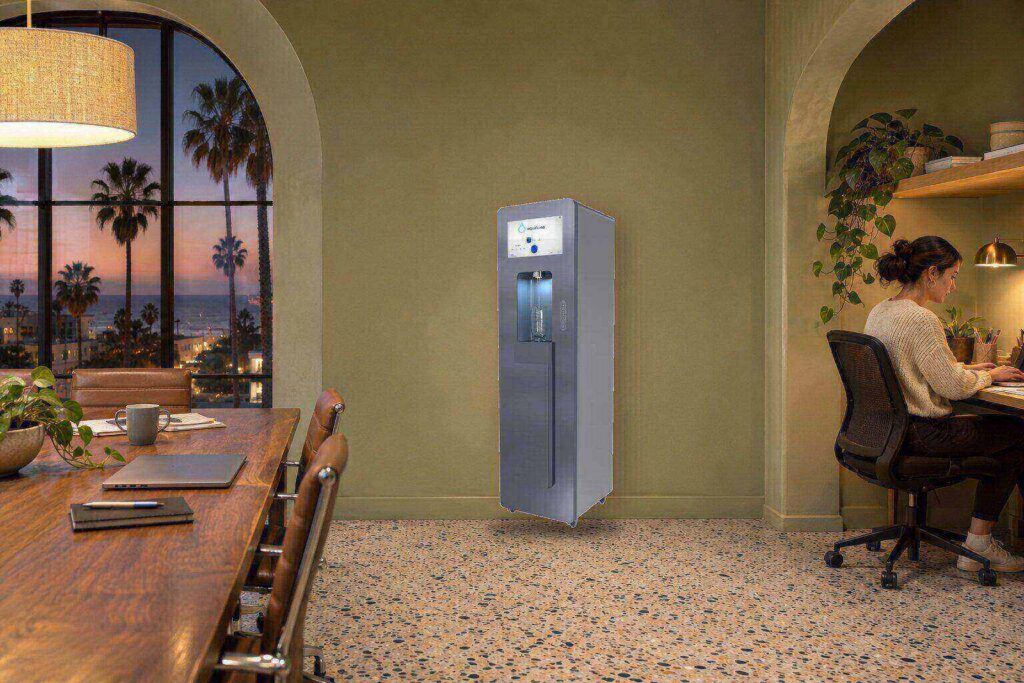
A bottleless machine cuts one big item: delivered single-use plastic bottles. Fewer deliveries also mean fewer delivery-truck trips to your building.
It also means less waste for you to dispose of. The water that was bottled elsewhere and trucked in is now filtered where you drink it.
That cuts plastic waste directly. We do not publish a carbon figure for it, because it depends on your current supplier’s routes.
Some companies use these gains in sustainability reports or purchasing decisions. If you do, work from your own bottle counts, not from industry averages.
The table lists what changes, without inventing numbers for your office.
This table summarizes the environmental changes for an office switching from jugs to a machine.
We left out bottle counts, emission totals and dollar values on purpose. Those depend on your volume and your current supplier, and a made-up average would not help you report anything.
| What changes | For your office | Effect |
|---|---|---|
| Bottles | Every bottle you buy today; count yours from the last invoice | Fewer bottles to buy, store and throw out |
| Delivery trips | No delivery truck for water | Fewer deliveries to your building |
| Money | Depends on your waste bill; we have no figure | Possibly a smaller waste bill |
That is the environmental case in short: less plastic and fewer trucks. Money follows only if your waste bill is itemized, and any reputation gain depends on what you do with it.
The next sections go through bottles and carbon, and what each is worth to a business.
Plastic bottles
Switching removes the delivered plastic bottles from your supply. How many that is depends on how many you buy now.
A small team and a large one will land at very different numbers, so count your own. Your last twelve invoices will tell you.
Fewer bottles can mean less waste to haul and fewer empties to store or send back, if your bill separates them.
If you run several locations, the effect is the sum of each site, so do the bottle count per site and add them up.
Less plastic waste can also support a purchasing policy that favors low-waste suppliers. That is a business reason as well as an environmental one, and it is yours to judge.
Carbon and delivery trips
Carbon comes from making bottles and driving them to you. A machine on your water line replaces both.
Those emissions are indirect ones in a company’s value chain, which carbon reports call scope 3. Removing delivery runs and bottle production removes that source.
How much depends on how far the supplier drives, how often, and what the packaging is. We have no number we could stand behind.
So any carbon claim, ours or anyone’s, should come with a method. Lowering your footprint can support your sustainability goals.
If you report emissions, record the change in your own records with your own bottle counts.
Those savings can matter in supplier tenders or procurement scoring, where they are asked for. They are not a cash saving on their own.
When environmental gains turn into money
Environmental changes show up in money in a few small ways: less waste to dispose of, and no bottle purchases.
Sustainability reporting can add value if clients or tenders ask for it. That value comes from what you report and is not something we can promise.
Softer benefits, like brand image, are real for some companies and close to impossible to price. Treat them as a tiebreaker once the invoice comparison is done, not as the reason to rent.
Taken together, waste avoidance and reputation add to the invoice comparison without replacing it. A finance team will want the invoice numbers first, and a sustainability team will want the plastic count. Both are easy to supply.
Next is the investment side: what it costs to start, how to work out a payback of your own, and how the environmental and operational points fit into it.
The investment, and how to work out your payback
Return on a bottleless machine depends on a few items: what you pay to start, the running costs of filters and service, and what you stop paying for bottles and delivery. For a rental there is no purchase price, so the sum is simpler.
The total cost of ownership is an addition and a subtraction. Add the monthly fees, the yearly filters and anything extra on the quote, then subtract what you pay today for bottles, delivery and storage.
The result is your net saving, or your net extra cost. Do this for each quote over three years so you can see the whole picture, not only the first month.
The table below lines up buying and renting on installation, filters, lifespan and three-year total, without invented dollar amounts.
Buying describes other vendors, since we only rent. The table covers the cost items for owned versus rented mains-fed dispensers, so you can ask the right questions.
| Investment item | Buying (other vendors) | Renting from Aqualume |
|---|---|---|
| Installation | Ask the vendor for a quote | Free |
| Filters | Check the quote | Billed separately, about once a year |
| Machine and term | You own it | Term set per site, in writing |
| Three-year total | Price, install, filters and repairs, added up | From $80/mo* per dispenser, filters billed separately |
Buying can come out cheaper over many years, and renting lowers the cash you need up front and includes service. Neither is right for everyone.
Ask for detailed quotes from each supplier so the options compare fairly.
Installation and start-up costs
Installation costs vary with the model and the plumbing. We do not charge for installation on a rental, but if you buy from someone else, ask what extras they add.
Cost depends on how ready your site is. A simple install, where the cooler taps an existing water line, needs little plumbing.
Sites that need new lines or separate connections can cost more with a vendor that charges for installation. Whoever quotes, ask them to list unit price, installation labor and any plumbing or electrical changes as separate lines.
Separate lines let you compare offers fairly. Clear planning up front means fewer surprises later.
Build room for installation surprises into the budget. It keeps your three-year sum honest and shows up on the quote when you ask for each line.
Payback over several years
Over a few years the saving in a plumbed machine comes from not buying bottles and not paying delivery fees. Whether it is a saving for you depends on what you spend today.
That holds even if there are start-up costs. We rent, so the start-up cost is not a lump sum, and the question is only whether the monthly total beats your current bill.
If it does, you are ahead from the first month. If it does not, the extra cost buys what jugs do not give you: no lifting, no storage and one service contact. A plain subtraction of the two yearly totals answers it. We will run it for you if you send your invoice.
Leave softer gains such as productivity out of the sums, and count them separately afterward, so they never rescue a weak comparison.
Next, a worked way to do the math with your own figures and quotes.
Doing the sums with your own invoice
We will not print a made-up example for a 15-person office, because it would only be an average. For businesses in Los Angeles and Southern California the real version takes ten minutes: your last invoice and our quote.
The inputs are bottles, delivery fees, storage time and cooler rental on one side. On the other: the monthly plan and the yearly filters.
Put each on a yearly basis and compare. Add the extras, like fewer lifting tasks, as separate notes beside the sum and not inside it.
If the numbers do not favor the machine for your office, we would rather tell you than sell you one.
Results vary a lot by office, so use your own quotes and your own water habits, not ours.
Free 7-day trial
Try a bottleless cooler in your office before you sign.
- 7-day free trial, we take it back if it isn't right
- Plumbed in: no jugs to lift, store or reorder
- A local technician, not a national call centre
Rather talk? (833) 426-5863
*Starting price; final pricing depends on the machine and site.
Common questions about cost and savings
This part answers the questions we hear about cost and savings: how much a business can save, whether it is worth it, how often filters change and what the hidden costs are. For the longer version, see how bottleless water cooler costs compare with traditional units.
The answers are short and direct, and they point back to the sections above where you can do your own sums.
They are written for facilities and purchasing teams that want the answer without reading the whole page.
A checklist at the end covers how to get the best value out of any quote.
How much could a business save?
We cannot give a percentage saving, because it depends on what you pay for bottles and delivery today.
The saving depends on headcount, current bottle spend and delivery fees. The only reliable figure is the one from your own invoice set against our quote.
The saving comes from dropping per-bottle prices, delivery fees and handling. We do not offer an example office here, since an invented one would be a guess dressed as a fact.
To get the net figure, subtract our monthly plan and the yearly filters from your current yearly total. Send us the invoices and we will do it with you.
That is the method, not a range. The decision checklist that follows shows when a bottleless machine makes sense.
Is a bottleless cooler worth it?
A bottleless machine is a good fit if you use water daily, have little space for bottles, or want less plastic and fewer deliveries.
If water use is steady and a water line is nearby, the machine is worth pricing. We check it against your numbers before recommending it, and we tell you when jugs would cost less for a team your size.
Things to weigh: headcount, what you spend on bottles now, whether there is a water line nearby, and whether you prefer a monthly fee to buying.
Ask each provider for a three-year total, so you can compare renting and buying on one basis. Aqualume only rents.
That leads to the next question most buyers ask, which is what filters cost.
How often do filters change, and what do they cost?
Filter changes depend on filter type and on how much water the machine handles. For our machines, replacement filters are billed separately, about once a year.
Higher-capacity filters last longer but cost more. Filter life depends on how much water passes through and on your local water quality.
Heavy use or water with a lot of sediment shortens filter life. The yearly filter bill depends on your site and the machine.
Filters are one line in your water budget. Ask for the yearly price in writing so budgeting stays simple, and ask whether any provider bundles them into the fee. Ours are billed separately.
Keep a record of filter changes and usage. It tells a facilities team when to expect the next bill.
What are the drawbacks and hidden costs?
The downsides are real. Installation can be awkward, filters need replacing, and the machine depends on your tap water. If your tap water is poor, ask what each filtration stage handles.
Hidden costs differ by site. A difficult plumbing run or poor tap water can raise installation or filter costs, and a contract without service visits can leave the machine uncleaned.
Deal with these before signing: test your water if you are worried, get detailed quotes, and get a service agreement in writing that names the filters, the replacement schedule and the visits.
Clear specifications and a line-by-line comparison of what each service includes keep surprises to a minimum.
Settling these points up front leads into the last section, on how to get the best value.
How to get the best value
To get the best value, pick the model that fits your use. Choose filters and features you will use, and skip the rest.
Then get a service agreement that covers the essential maintenance and the filters. Size, features and contract terms work together.
That keeps the lifetime cost down and avoids emergency repairs. Below are checklists for features, sizing, and the clauses to ask for when you collect quotes from suppliers.
Use them to compare offers fairly and to see where a quote is thin.
Using them gets you the direct and the indirect savings across the machine’s life.
These are the features that keep cost down, in the order we would check them on a quote.
- Filter schedule: Ask how often filters change and how the yearly bill is set, so there are no surprises later.
- Power rating: Ask for the wattage on the spec sheet if energy cost is a concern.
- Easy service access: Models where the filters and parts are easy to reach take less service time, and that helps keep visits short.
Focusing on these keeps the lifetime cost down and makes servicing easier. Sizing advice comes next.
Sizing guidance by kind of workplace:
- Small teams: A countertop unit such as the Lightstream or the Gulfstream tower, both 11.8 in wide, is the place to start.
- Mid-size floors: A freestanding Cascade or Glacier gives more room at the tap, which helps when several people pour at once.
- Large floors or several sites: Plan more than one machine so water is always within reach, and we confirm the count on the site visit.
These are starting points, not rules, and we size on the site visit during the trial. Over-buying costs you every month, so the goal is to match capacity to need. Finally, ask for these clauses in the service agreement to protect your total cost.
Service agreement checklist, for any supplier:
- Filters: How billing works, how long they are expected to last, and the cost per set if they are not included in the fee.
- Service and response: Scheduled visits and a stated response time for calls. Ours is on site within 2 business days.
- Pricing: A line-by-line breakdown for installation, parts and any extras, so you can compare quotes fairly.
- Support: Make sure the agreement covers reliability and who answers when something stops working.
With these clauses a purchase becomes a predictable operating cost, and you protect the long-run value.
This page set out how a bottleless rental is priced and how to compare it with bottled water. It is written for buyers in Los Angeles and Southern California. Use it to work out payback, running costs and total cost of ownership with your own invoices.
Call (833) 426-5863 or start the 7-day trial to see the water for yourself.
Environmental Assessment: Mains-Fed Versus Bottled Water Coolers
ENVIRONMENTAL ASSESSMENT OF PRODUCTS: CARBON FOOTPRINT BASED COMPARISON OF TWO WATER COOLING SYSTEMS, 2014