Where to next? See water service plans for Southern California medical offices or check water dispenser rental in Los Angeles.
Most Southern California clinics inherited that jug system from whoever set up the practice, and nobody has questioned it since. It is worth questioning. For a 10-to-40-person veterinary team in Orange County, Los Angeles, or the Inland Empire, switching to a bottleless dispenser typically frees up a closet, removes a recurring lifting hazard, and saves between $1,000 and $3,000 a year.
Veterinary Clinics Drink More Water Than They Budget For
Office water math usually assumes one thing: people sitting at desks. A veterinary clinic is not that. Your team is on its feet for ten-hour shifts, restraining animals, running between exam rooms, and working under surgical lights. Techs sweat. Techs get thirsty. And unlike an accounting firm, your lobby has a steady rotation of clients who arrived stressed, often after a drive up the 405 with a howling cat, and who register a water station as basic hospitality.
Then there is the animal side. Boarding guests need fresh bowls. Post-op patients need water available the moment they are cleared. Nobody wants to explain to a client that the clinic ran out of drinking water for their dog because the jug delivery was scheduled for Thursday.
The result is a practice that consistently under-orders, over-orders, or runs a rolling improvisation between the two. Bottleless dispensers remove the guessing entirely. The unit connects to your existing water line and produces filtered water on demand, whether today is quiet or you are three hours behind because of an emergency intake.
What 5-Gallon Jugs Actually Cost a Vet Practice
The invoice is only part of the story. A full 5-gallon jug weighs about 42 pounds, and in a veterinary setting, the person lifting it is frequently the same person who spent the morning lifting a 90-pound retriever onto a table. That is a repeat back-strain risk in a field that already has one of the higher injury rates in outpatient care.
Add up the pieces that never appear on the delivery bill:
- Storage square footage — a jug stack occupies space that could hold food inventory, pharmacy stock, or literally anything that generates revenue
- Staff time — receiving deliveries, rotating stock, and hauling empties out to the curb
- Delivery fees, fuel surcharges, and bottle deposits layered on top of the per-jug rate
- Injury exposure from repeated 42-pound lifts performed by already-fatigued staff
- The Thursday problem — running dry between scheduled drops during a heat wave
Aqualume service runs on an flat-rate flat monthly rate starting from $80 per dispenser, rising to about $150 per month for the Glacier flagship. That figure covers the equipment, installation, and ongoing maintenance, with filter changes billed separately. For most clinics, the swap lands somewhere between $1,000 and $3,000 in annual savings versus jug delivery, and the operational headaches disappear as a bonus.
What 7-Stage Filtration Handles in Southern California Water
Southern California tap water travels a long way before it reaches your clinic. A meaningful share of it starts in the Colorado River or the State Water Project, gets treated, and arrives hard, mineral-heavy, and carrying the chlorine taste that treatment requires. It is safe to drink. It also tastes like a swimming pool, which is why your staff keeps buying bottled water they expense back to you.
Every Aqualume dispenser runs a 7-stage filtration system that addresses sediment, particulates, and the chlorine taste and odor that make SoCal tap water unappealing. The practical outcome is water your team actually wants to drink, from a unit that never runs out, at a cost that does not scale with how thirsty everyone got during a July afternoon in Riverside.
Which Aqualume Dispenser Fits Your Clinic
Clinic layouts vary wildly. A two-doctor practice in Costa Mesa has different constraints than a multi-specialty hospital in Pasadena, so the right unit depends on your floor plan and traffic.
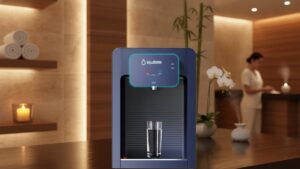
Jetstream is the tabletop unit, and it is the natural fit for veterinary front desks. It sits on a counter, takes no floor space, and puts filtered water within reach of the reception team and waiting clients without cluttering a lobby that already has a scale, a leash rack, and a display of dental chews.
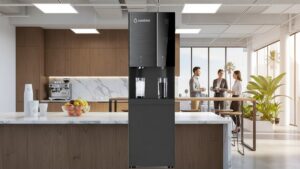
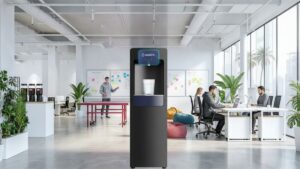
Cascade is our best-selling freestanding model and the workhorse for clinic break rooms and treatment areas. If your staff hydration happens in the back and you want a single unit that keeps up with a full shift rotation, this is usually the answer.
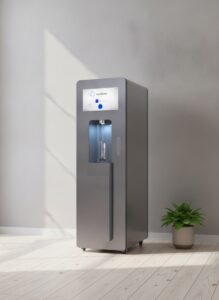
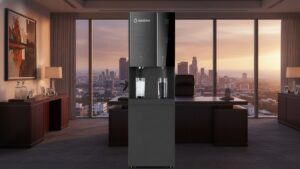
Glacier is the freestanding flagship, built for higher-volume sites — think a busy emergency hospital or a practice with a large boarding operation. Avalanche, Gulfstream, and Blizzard round out the line for clinics with specific footprint or capacity requirements.
Plenty of practices run two units: a Jetstream up front for clients and a Cascade in back for staff. Each dispenser is priced individually, so you scale to your actual layout rather than one compromise unit parked in a hallway.
The Waiting Room Impression Nobody Talks About
Veterinary clients are a specific kind of anxious. They are worried about a family member who cannot describe symptoms, and they are frequently bracing for an estimate. The lobby does real work in that moment.
A tidy countertop dispenser reads as a practice that has its systems in order. A jug cooler with a half-empty bottle and a spare wedged behind a chair reads as a practice improvising. That is not fair, but it is how people form judgments while waiting, and in a SoCal market where clients pick clinics off Google reviews and drive past three competitors to reach you, the small signals compound.
Cutting the Plastic Without Cutting Corners
A clinic going through four jugs a week moves roughly 200 of them a year. Those jugs get trucked to your door, hauled back empty, sanitized, refilled, and trucked out again — a loop that burns diesel across the LA basin every week for water that already arrives at your building through a pipe.
Veterinary medicine attracts people who think about the natural world for a living. A lot of practices have already cut single-use plastic in their retail area and switched to digital records. The water cooler is often the last obvious holdout, and it is one of the easier ones to fix. Bottleless removes the jugs, the delivery truck, and the storage problem in a single afternoon of installation.
Frequently asked questions
How much does a bottleless water dispenser cost for a veterinary clinic?
Aqualume dispensers start from $80 per month per unit and run up to about $150 per month for the Glacier flagship. The rate covers the equipment, installation, and maintenance, with filter replacements billed separately. Most Southern California clinics save $1,000 to $3,000 per year compared with 5-gallon jug delivery.
Can a bottleless dispenser keep up with a busy clinic?
Yes. Bottleless units connect directly to your building’s water line and filter on demand, so there is no reservoir to run dry and no delivery schedule to work around. Higher-volume practices typically choose a freestanding Cascade or Glacier, while smaller clinics do well with a countertop Jetstream at the front desk.
What does the 7-stage filtration remove?
Every Aqualume dispenser uses a 7-stage filtration system that targets sediment, particulates, and the chlorine taste and odor common in Southern California municipal water. The goal is water your staff and clients actually want to drink, produced on site rather than trucked in.
Which areas of Southern California does Aqualume serve?
Aqualume installs and services dispensers across Orange County, Los Angeles, and the Inland Empire. Service, filter changes, and maintenance are handled by our own local team rather than a subcontracted national network.
Can we try a dispenser before committing?
Yes. Aqualume offers a 7-day free trial so your team can put a unit in the actual clinic and see how it handles a real week. Ongoing service is set up on a 36-month term, and we will walk you through the details before anything is signed.
Who handles filter changes and maintenance?
We do. Filter replacements, routine servicing, and any repairs are included in the flat monthly rate, so there is nothing for your practice manager to schedule and no surprise invoice when a filter comes due.
Get the Jugs Out of Your Supply Closet
Your team already lifts enough. Between the closet space, the delivery fees, the staff hours, and the annual savings of $1,000 to $3,000, the jug system is quietly costing your practice more than it appears to on the invoice.
Aqualume works with veterinary clinics across Orange County, Los Angeles, and the Inland Empire — the 10-to-100-person practices where every square foot and every staff hour counts. Start your 7-day free trial and let your team decide during an actual week of appointments.