The Workplace Has Changed — Your Water Dispenser Should Too
Remember March 2020? When “touchless” went from luxury spa feature to absolute necessity overnight? The pandemic forced a reckoning with shared surfaces, and workplaces discovered that employees had standards—specifically, the standard that they shouldn’t have to touch something that 47 other people touched that day.
Three years later, that expectation hasn’t budged. According to a 2023 WorkOps survey, 68% of employees now expect their workplace to offer hands-free amenities, with water dispensers ranking in the top three facilities people notice first. The shift isn’t temporary. It’s permanent. And if your workplace is still asking employees to grip a lever that’s been sterilized approximately zero times since Tuesday, it’s time to upgrade.
Post-COVID Workplace Hygiene: The New Normal
Let’s start with the science. The CDC documented something uncomfortable about office environments: a single contaminated surface can spread illness to 50% of high-touch areas within four hours. That includes water coolers. A 2021 study from UC Davis found that shared water dispensers—specifically the lever handles and spigot areas—showed bacterial presence in 87% of samples taken from office buildings. Not exactly the refreshment people had in mind.
The pandemic didn’t create this problem; it simply made everyone aware of it. Remote work accelerated the trend, but now that people are back in offices, they’re bringing heightened hygiene expectations with them. Employers who acknowledge this reality aren’t just being courteous—they’re signaling competence and care. Conversely, companies that haven’t upgraded their water dispensers are essentially telling employees: “Yeah, we know about germs, but also, your health isn’t our top priority.”
That’s a terrible message to send when you’re trying to attract and retain talent in a tight labor market.
How Touchless Technology Works (And It’s Simpler Than You Think)
The technology behind touchless water dispensers sounds fancy, but it’s actually straightforward engineering. Here’s what you need to know:
Infrared Proximity Sensors: These are the workhorses. When a hand approaches the sensor (typically 2-6 inches away), an infrared beam detects the presence and triggers the valve. No button. No lever. No contact. The sensor constantly emits a beam; when something reflects it back, boom—water flows.
Motion-Activated Dispensing: The system activates water flow for a set duration (usually 5-10 seconds), then automatically stops. This prevents accidental overflow and conserves water. It’s like having a responsible friend whose only job is making sure you don’t waste resources.
No-Touch Paddle Controls (On Some Models): Aqualume’s Gulfstream model uses foot-activated paddle controls for hot water—a brilliant redundancy that lets users avoid hand contact entirely if they prefer. Your foot is statistically less likely to shake someone’s hand during a Zoom call.
The beauty of these systems is their reliability. No moving parts wear out (the valve is inside, protected). The sensor itself lasts 5+ years. And unlike automatic soap dispensers that decide the optimal soap volume is “somehow everywhere,” water dispensers have one job and do it consistently.
Compliance with California Health Codes: It’s Not Just Hygiene, It’s Law
If you’re operating in California—and Aqualume’s HQ is in sunny San Diego, so this matters—you need to understand that touchless water access isn’t just nice; it’s increasingly aligned with workplace safety requirements.
Cal/OSHA Title 8, Section 3457 requires that employers provide employees with “adequate” drinking water that’s “fresh, cold, and pure.” The regulation doesn’t explicitly mandate touchless dispensers, but it does require facilities that minimize contamination risk. California Health & Safety Code Section 113953 extends this further, requiring that any shared drinking water system be maintained to prevent pathogenic or chemical contamination.
What does “minimize contamination risk” mean in practice? California health departments increasingly interpret this to mean touchless or single-use dispensing, especially in healthcare, food service, and high-density office environments. In 2022, Santa Clara County’s health department issued guidance recommending touchless dispensers for offices with more than 50 employees. San Francisco’s updated workplace guidelines (2023) go further, listing touchless as the preferred standard.
Are you legally required to have a touchless dispenser? Not explicitly—yet. But if there’s a workplace health issue and your facility is still running a 20-year-old lever dispenser, a health inspector’s report won’t be flattering. More importantly, if an employee gets sick from a contaminated water cooler and traces it back to inadequate hygiene measures, you’re creating litigation exposure. The cost of upgrading to a touchless Gulfstream looks pretty small compared to a wrongful illness lawsuit.
Employee Confidence & Satisfaction: The Morale Multiplier
Here’s something HR professionals rarely talk about: employees notice water coolers. Not because they’re fascinating (they’re not), but because they’re a daily touchpoint that reflects workplace values.
A 2023 employee wellness survey from Mercer found that 71% of workers say the quality and accessibility of workplace amenities influenced their job satisfaction. When asked specifically about water dispensers, 54% said they’d prefer their workplace offer touchless options, and 31% said they’d actively avoid traditional lever-style dispensers due to hygiene concerns.
Translation: your water cooler is a micro-climate indicator. A modern, touchless water dispenser signals that you care about employee health and wellness. A lever-style relic from 2003 signals indifference.
This matters for workplace wellness programs too. Companies that invest in modern water dispensing systems report better participation in broader wellness initiatives. Employees who see their employer taking small, deliberate steps to improve daily comfort are more likely to engage with fitness programs, mental health resources, and other benefits. It’s a confidence multiplier.
Plus—and this is rarely quantified—better water access means better hydration, which means better productivity and fewer afternoon energy crashes. Dehydration costs American businesses approximately $260 million annually in lost productivity. Your touchless water dispenser isn’t just hygiene theater; it’s a legitimate productivity tool.
Reduced Sick Days & ROI: The Math That Justifies the Investment
Let’s talk money, because the business case for touchless is surprisingly strong.
The CDC estimates that workplace-acquired illnesses cost businesses $225 billion annually in lost productivity and medical expenses. For an office with 50 employees, that translates to roughly $2,250 per employee per year in illness-related costs. A single flu outbreak in a traditional office costs approximately $1,500 per affected employee once you factor in lost productivity, medical costs, and coverage staffing.
Shared water dispensers are a known vector for illness transmission. Studies show that offices with contaminated water coolers experience 15-20% higher rates of gastrointestinal illness during cold and flu season. That’s not hypothetical; that’s measured in spreadsheets.
Now consider the ROI of upgrading to a touchless system. A high-quality touchless water dispenser like the Aqualume Gulfstream costs $75/month on a rental plan (no contracts, no capital outlay). For a 50-person office, that’s $1.50 per employee per month, or $18 annually per person.
If a touchless dispenser reduces illness-related absences by just 10% (a conservative estimate), you’re looking at savings of $225 per employee per year. For 50 employees, that’s $11,250 in productivity gains against $900 in annual dispenser costs. That’s a 1,250% ROI.
Even if it only prevents a single flu outbreak per year ($1,500 in costs), the math still works decisively in favor of touchless.
Aqualume offers a 7-day free trial so you can test the Gulfstream risk-free. Compare your current water cooler illness patterns during the trial period against your baseline. Most companies see measurable improvements within 30 days.
Aqualume’s Gulfstream: The Touchless Dispenser Built for Modern Workplaces
Not all touchless dispensers are created equal. The Gulfstream model is specifically engineered for the modern workplace because it addresses three pain points that other dispensers miss.
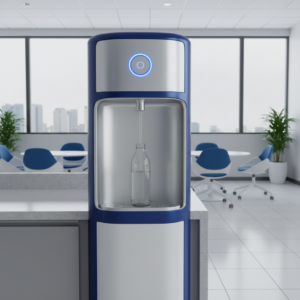
Dual-Action Dispensing: The Gulfstream offers both infrared sensors for cold water (completely hands-free) and a foot paddle for hot water. Why the distinction? Safety and accessibility. Hot water requires intent; you don’t want someone accidentally scalding themselves because they waved near the sensor. The foot paddle is intuitive and maintains the no-touch promise.
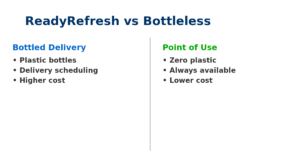
Bottleless Design: Unlike traditional dispensers that rely on water bottles, the Gulfstream connects directly to your building’s water line. This eliminates the handling, storage, and waste associated with water bottles. For a 50-person office, you’re eliminating 50+ bottles per month from the waste stream—that’s 600+ bottles annually. Sustainability and hygiene in one upgrade.
Self-Sanitizing Filtration: The Gulfstream includes a four-stage filtration system that removes chlorine, sediment, and contaminants before the water reaches the dispenser. The system self-sanitizes every 2 hours, meaning the water stored inside is always clean. It’s not just touchless; it’s protected.
The Gulfstream also offers hot, cold, and room-temperature water—flexibility that other models don’t provide. Perfect for offices that need hot water for tea/coffee without running a separate kettle.
Comparing Aqualume’s Touchless Lineup
Aqualume offers multiple dispenser options, each with different touchless capabilities:
The Gulfstream (Top Recommendation): Full touchless + foot paddle for hot water. Bottleless. Best for traditional offices prioritizing maximum hygiene and sustainability.
The Cascade: Touchless cold water, traditional lever for hot. Great for break rooms where employees are less concerned about absolute no-touch compliance.
Freestanding Options: If you need a dispenser that doesn’t require plumbing connections, Aqualume’s freestanding models include touchless cold water with bottleless or bottle-fed options.
All models are available on Aqualume’s standard rental plan: $75/month, no contracts, includes professional service and maintenance.
The Bottom Line: Touchless Is the Workplace Standard Now
The pandemic forced workplaces to confront a reality: shared surfaces are a hygiene liability. Three years later, that reality hasn’t faded; it’s crystallized into employee expectations and compliance best practices.
A touchless water dispenser isn’t a luxury upgrade anymore. It’s the baseline standard that modern workplaces should offer.
The investment is minimal ($75/month), the ROI is substantial (1,000%+ in most cases), and the message is clear: your employees’ health and safety matter.
The Aqualume Gulfstream is purpose-built for this moment. It’s touchless, bottleless, sustainable, and designed to exceed California health standards while maximizing employee confidence.
Ready to upgrade? Start with Aqualume’s 7-day free trial—completely risk-free. See the difference a modern touchless dispenser makes in your workplace. Call (833) 426-5863 to schedule your trial today.
$75/month. No contracts. No excuses.