The Science Behind Hydration and Brain Performance
Water makes up approximately 60% of the human body and is essential for virtually every physiological process — including the cognitive functions that drive workplace productivity. Research consistently shows that even mild dehydration significantly impairs cognitive performance, yet most American workers are chronically under-hydrated throughout the workday. For SoCal businesses exploring workplace wellness investments, understanding the hydration-productivity link is essential.
What Happens When Employees Are Mildly Dehydrated?
A landmark study published in the Journal of Nutrition found that a water deficit of just 1.36% in healthy adults caused measurable impairments in mood, increased perception of task difficulty, and reduced concentration (Armstrong et al., 2012). For a 150-pound employee, that’s less than 3 cups of water — a deficit easily reached by mid-morning in a warm office environment.
Research from the University of East London and the University of Westminster found that drinking water before cognitive tasks improved performance by up to 14% in tests of reaction time and attention. The mechanism involves water’s role in maintaining cerebral blood flow and neurotransmitter synthesis — both critical for sustained attention, decision-making, and memory.
Dehydration’s Effect on Specific Work Tasks
Different cognitive domains are affected differently by hydration status. Here’s what the research shows for typical office work scenarios:
Attention and Concentration
A 2011 meta-analysis by Adan published in Nutritional Neuroscience found that dehydration at 2% body weight loss significantly decreased vigilance, attention, and psychomotor speed. For knowledge workers whose jobs require sustained focus, this translates directly to errors, rework, and missed details — all of which cost businesses real money.
Short-Term Memory
Research published in Frontiers in Human Neuroscience (2013) demonstrated that mild dehydration impairs working memory — the cognitive system responsible for holding and manipulating information in the short term. Working memory is essential for tasks like writing, coding, data analysis, and customer service interactions. Even a 1-2% fluid deficit has measurable effects.
Decision-Making and Judgment
A study in PLOS ONE (2013) by Kempton et al. used neuroimaging to show that dehydrated participants required more brain activation to complete cognitive tasks at the same performance level as hydrated participants — a sign of cognitive strain. In high-stakes business environments where good judgment matters, this extra mental load increases the risk of poor decisions.
Mood and Team Dynamics
Dehydration consistently increases feelings of anxiety, fatigue, and irritability. A 2012 study in the Journal of Nutrition (Ganio et al.) found that even mild dehydration — below the threshold of feeling thirsty — increased negative mood states and feelings of tension. In collaborative work environments, individual mood directly impacts team cohesion and communication effectiveness.
Workplace Hydration and Productivity: The Bottom Line
Translating research findings into business outcomes, studies estimate that proper hydration can improve employee productivity by 14% or more. For a team of 20 employees earning an average of $60,000 per year, a 14% productivity gain represents approximately $168,000 in additional value annually — from a resource as simple as clean, accessible water.
The ROI calculation for a quality bottleless water cooler rental at $80*-150/month becomes straightforward: the investment is a rounding error compared to the productivity upside.
Hydration and Employee Health: Fewer Sick Days
Beyond cognitive performance, adequate hydration directly supports immune function, kidney health, and the body’s ability to regulate temperature — all of which affect employee absenteeism.
The kidneys require approximately 1.5 liters of water daily to filter blood and produce urine. When employees are chronically under-hydrated, kidney function is compromised, increasing susceptibility to urinary tract infections — a common cause of workplace sick days. Proper hydration also supports the mucosal linings that serve as first-line defenses against respiratory infections.
Chronic dehydration is also linked to increased risk of headaches — one of the most common reasons employees report reduced productivity or leave work early. Studies show that increasing water intake reduces headache duration and intensity for many chronic sufferers.
Workplace Wellness Programs: Hydration as a Foundation
Forward-thinking companies increasingly recognize that workplace wellness programs deliver measurable returns. The RAND Corporation’s analysis of workplace wellness programs found that for every $1 invested in employee wellness, companies save approximately $3.27 in healthcare costs and $2.73 in absenteeism costs.
Water access is one of the most foundational — and cost-effective — elements of any workplace wellness initiative. Unlike gym subsidies or mental health apps (which require individual behavior change), clean water availability produces benefits automatically: every employee who walks to the water cooler is engaging in wellness behavior.
Hydration Station Design Matters
Research on nudge theory and behavioral economics shows that environmental design heavily influences behavior. A study published in the International Journal of Behavioral Nutrition and Physical Activity found that making water more visually prominent and accessible significantly increased water consumption among employees.
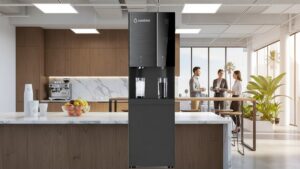
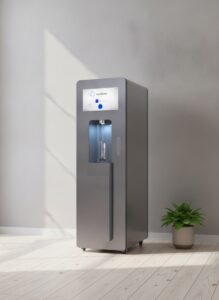
Practical implications: placing bottleless water dispensers in high-traffic areas (not tucked in break room corners), offering multiple temperature options (chilled, ambient, hot), and using sleek modern units that employees actually want to approach — all measurably increase consumption. Aqualume’s models are specifically designed with visibility and accessibility in mind.
Hydration, Employee Retention, and Workplace Culture
There’s a growing body of evidence connecting workplace amenities — including quality hydration access — to employee satisfaction and retention. A 2022 Gallup report found that employees who feel their employer cares about their wellbeing are 3.7x more likely to be engaged at work and significantly less likely to leave.
The quality of workplace amenities sends a signal about company culture. A high-quality bottleless water cooler — providing filtered, great-tasting water at multiple temperatures — communicates that the organization invests in employee wellbeing. This matters especially in competitive talent markets like Los Angeles, where skilled workers have options.
The Glacier model from Aqualume, for example, delivers chilled water and fresh ice in a premium form factor that employees notice and appreciate — a visible commitment to team wellbeing that costs far less than most other workplace perks.
California-Specific Considerations
Southern California presents specific hydration challenges that make workplace water access especially important:
- Climate: LA’s warm, dry climate accelerates water loss through respiration and perspiration even in indoor environments
- Air conditioning: Modern HVAC systems reduce indoor humidity, increasing insensible fluid losses
- Commute stress: Long commutes on LA freeways are physiologically stressful, and many employees arrive at work already mildly dehydrated
- Municipal water quality: LA and Orange County water often contains elevated chloramines and other treatment byproducts that affect taste, discouraging consumption of tap water
This last point is particularly important. If office tap water tastes poor, employees simply drink less of it — regardless of how much it’s available. Aqualume’s 7-stage filtration removes the contaminants and off-flavors common in LA municipal water, producing clean, great-tasting water that employees actually want to drink.
Implementing a Workplace Hydration Program
For HR and office managers looking to improve employee hydration, here are evidence-based recommendations:
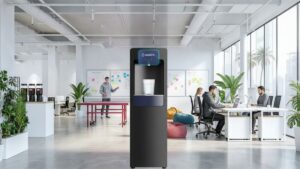
- Deploy quality dispensers in visible locations: Freestanding bottleless water coolers in main work areas outperform break room-only placement
- Offer multiple temperatures: Research shows that preferred temperature (chilled vs. room temperature) varies by individual; providing options increases overall consumption
- Provide reusable bottles or cups: Making it easy to carry water reduces friction and increases intake throughout the day
- Communicate the investment: Let employees know you’ve upgraded water quality as part of a wellness initiative — the announcement itself boosts engagement
- Track a simple metric: Ask employees to rate energy and focus levels monthly; many companies see measurable improvement within 60 days of improving water access
The Business Case in Summary
The evidence is clear: proper hydration improves cognitive performance by up to 14%, reduces absenteeism, supports employee retention, and signals organizational care for team wellbeing. For Southern California businesses, the combination of warm climate, air conditioning, and municipal water quality issues makes proactive hydration infrastructure especially important.
Aqualume’s bottleless water cooler solutions provide the filtered, great-tasting water employees need to perform at their best — starting at just $80/month* with a risk-free 7-day trial. Call (833) 426-5863 to learn how Aqualume can support your workplace wellness goals.
Frequently Asked Questions
How much water should employees drink during the workday?
General recommendations suggest 8–10 cups (64–80 oz) of water daily for adults, though individual needs vary based on body size, activity level, and environment. In warm Southern California offices, aiming for the higher end of this range is prudent. Making clean, great-tasting water easily accessible is the most effective way to achieve adequate intake.
Can dehydration really affect work performance?
Yes, significantly. Research shows that even mild dehydration (1–2% body weight loss) impairs concentration, working memory, reaction time, and decision-making. These are precisely the cognitive functions that knowledge workers rely on most. The effects are measurable and consistent across multiple peer-reviewed studies.
Is filtered water better for employee hydration than tap water?
Not inherently from a health standpoint — but from a consumption standpoint, absolutely. Employees drink more water when it tastes good. LA and Orange County tap water often contains chloramines and other treatment byproducts that create an off-taste. Aqualume’s 7-stage filtration removes these while retaining beneficial minerals, resulting in great-tasting water that employees choose to drink.
What’s the ROI of a workplace water cooler?
Using conservative estimates — a 10% productivity improvement for a team of 10 earning $55,000 average salary — a quality water cooler delivers approximately $55,000 in annual productivity value for a $80*–$150 monthly investment. The payback period is effectively instantaneous. Get a custom quote here.
How does Aqualume support workplace wellness programs?
Aqualume’s modern bottleless water dispensers integrate seamlessly into workplace wellness initiatives — providing filtered, multi-temperature water access without plastic bottle waste. Our 7-day free trial lets companies experience the difference risk-free, and 36-month term agreements mean no long-term commitment is required. Start your free trial here.
Ready for the next step? Compare the Glacier freestanding ice and water dispenser, see our program for Southern California offices, or check Los Angeles water dispenser service — the 7-day free trial applies either way.