Find the Perfect Large Ice Maker for Your Business Needs
High-Capacity Ice Solutions for Large Businesses: Choosing the Best Commercial Ice Maker UK for Large Volume Production
High-capacity ice solutions are purpose-built commercial systems that produce, store, and dispense large volumes of ice to meet continuous peak demand, improving reliability and reducing dependency on bagged ice. This guide explains how high-capacity ice machines work, the principal machine types and ice varieties, and why selecting the right commercial ice production system matters for hotels, large restaurants, healthcare facilities, and event venues. Many large operators face supply chain disruption, quality inconsistencies, and hidden labour costs when relying on delivered bagged ice; installing a tailored industrial ice machine reduces those pain points by delivering on-site volume, consistent ice type, and lower ongoing operating expense. You will learn how to calculate daily demand, size production and storage correctly, compare modular and self-contained machines, and evaluate energy, water filtration, and hygiene features that affect total cost of ownership. The article also covers dispensers and storage options for high-traffic locations, maintenance and hygiene regimes including filtration recommendations, and an ROI framework with a worked numeric example to aid procurement decisions for commercial ice production systems.
Selecting High-Capacity Ice Machines for Your Business

High-capacity commercial ice machines are specialised units designed to produce hundreds of kilograms to multiple tonnes of ice per day using either air-cooled or water-cooled refrigeration systems, delivering consistent ice types for their intended use. These systems range from modular machine heads paired with external storage bins to larger self-contained floor-standing units and dedicated flakers or nugget producers, each offering different production bands and installation footprints. Choosing the correct type improves uptime and serviceability while ensuring the right ice form for beverages, display, or clinical purposes. Understanding these machine classes enables accurate matching of production capacity, cooling type, and footprint to your operational requirements.
Which ice machine types suit different business needs: modular, self-contained, undercounter, and freestanding?
Modular ice makers are separate production heads that pair with external storage bins to scale production efficiently and are ideal where space permits and redundancy is required. Self-contained units combine production and storage in a single cabinet for compact installations and moderate volume needs, making them suitable for smaller satellite kitchens or back-of-house bars. Undercounter machines fit beneath counters for discrete service points and low-to-moderate throughput, while freestanding floor units deliver the largest single-unit capacities for centralised production. Choosing between these depends on available floor space, required daily kg output, and whether you need modular scalability or a single high-output footprint, which leads naturally to considerations of ice type and application.
What are the benefits of cube, nugget, flake, and bullet ice types for commercial use?
Cube ice provides slow melt and attractive clarity, making it the preferred choice for premium beverages and cocktail service where dilution control and presentation matter. Nugget ice compresses more surface area and delivers rapid cooling with chewable texture, favoured in high-volume soft drink service and patient care for its mouthfeel and ease of consumption. Flake ice is soft, malleable, and ideal for display and food preservation such as fish counters, while bullet ice offers fast chilling with compact storage efficiency for high-throughput drink stations. Selecting the right ice type influences machine choice because production technologies and evaporator designs are optimised for specific ice morphologies, which in turn affects capacity and maintenance needs.
How do industrial ice machine solutions vary by production capacity and application?
Industrial solutions are typically specified in daily production bands: small high-capacity units (100–500 kg/24h) suit busy bars and small hotels, mid-range machines (500–1,500 kg/24h) fit large restaurants and medium hotels, and large-scale systems (>1,500 kg/24h up to multiple tonnes) support resorts, hospital campuses, and event venues. Applications drive configuration choices such as redundancy (N+1 modular heads for peak events), continuous versus batch ice-making technologies, and whether water-cooled systems are justified by utility arrangements. Considering scalability and peak-hour throughput helps decide between adding an extra module or upsizing a single head, a decision that directly influences storage bin size and dispensing arrangements for operational resilience.
Different machine types are best matched to specific operational profiles, which we compare next to help select the proper capacity.
| Machine Type | Typical Production Capacity (kg/24h) | Ice Type | Typical Application | Cooling Type | Footprint |
|---|---|---|---|---|---|
| Modular ice maker + bin | 500–3,000 | Cube, Bullet | Large hotels, event venues | Air- or water-cooled | Medium–Large (multi-module) |
| Self-contained floor unit | 300–1,200 | Cube, Nugget | Restaurants, bars, medium hotels | Air-cooled | Medium |
| Undercounter ice maker | 50–300 | Cube, Nugget | Bars, service counters | Air-cooled | Small |
| Ice flaker (industrial) | 200–2,000 | Flake | Fish display, preservation, labs | Water-cooled | Variable |
How to Choose the Right High Capacity Ice Machine for Your Business?
Choosing the right high-capacity ice machine combines a quantitative capacity calculation with qualitative factors such as ice type, space, utilities, and hygiene protocols; in short, select by daily demand, peak-hour throughput, and operational constraints. The first step is to estimate daily ice need using simple rules of thumb or a seat/bed cover calculation, then add a contingency buffer for peaks and events; that calculated demand then guides production capacity and storage sizing. Other determinants include available power and water supply, ventilation clearances for air-cooled machines, drainage for meltwater, and whether modular redundancy is required to avoid service interruptions. Following a structured selection flow—demand calculation, ice type match, utility check, and redundancy planning—ensures the chosen system meets both steady-state and peak operational requirements.
What size ice machine do I need for a large restaurant or hotel?
Large restaurants commonly require machines in the 500–1,500 kg/day band depending on covers, beverage programme, and event spaces, while large hotels with banqueting and multiple F&B outlets often need 1,000 kg/day or more with modular expansion options for peak events. When sizing, allow for additional capacity for banqueting nights, conferences, or seasonal spikes and size storage to hold at least one shift’s peak demand to avoid shortfalls. It is prudent to select a machine that offers headroom or an easy modular add-on to accommodate growth without replacement. Properly sizing production reduces machine cycling and extends equipment life, which we explain next with a straightforward calculation method.
How to calculate daily ice demand and storage requirements for large volume ice production?
A basic calculation multiplies expected covers/guests by an ice-per-cover factor (for example, 0.3–0.6 kg per drink cover in beverage-led operations) and adds event allowances; hospitals use a per-bed factor (for patient hydration and clinical needs). For example, a 300-cover restaurant using 0.5 kg per cover requires 150 kg/day baseline; add a 30% buffer for peak service and you reach ~195 kg/day, so choose a production capacity >=250 kg/day and storage sized to buffer one peak service period. Storage turnover guidance: maintain 12–24 hours of storage capacity for predictable operations and larger buffers for event-driven businesses, which keeps machines from cycling excessively. This demand-led sizing directs whether to pick modular heads or a single larger self-contained unit.
What factors influence the choice between commercial ice makers and freestanding ice dispensers?
Commercial ice makers focus on production and storage, while freestanding dispensers prioritise controlled access and high-throughput self-service dispensing; choice depends on whether staff-operated back-of-house supply or guest-facing self-serve is required. Key factors include hygiene control (dispensers reduce manual handling), peak dispense throughput, cleaning regimes, and footprint; dispensers are often paired with a separate production machine and bin to centralise production and decentralise service. Operational scenarios such as corporate campuses or hotel lobbies favour freestanding dispensers for user convenience, whereas kitchens prefer direct machine-to-bin supply.
For businesses uncertain about model selection and on-site capacity assessment, contact specialist suppliers for tailored advice, comparative product specifications, and an on-site survey to validate utility and ventilation constraints.
| Business Type | Estimated Daily Ice Need (kg) | Recommended Production Capacity (kg/24h) | Recommended Storage Volume (kg) |
|---|---|---|---|
| Large restaurant (300 covers) | 150–250 | 250–500 | 150–300 |
| Large hotel (200 rooms + events) | 400–800 | 600–1,200 | 300–600 |
| Healthcare facility (100 beds) | 120–300 | 200–500 | 150–300 |
What Are the Key Features of Energy-Efficient Commercial Ice Machines?

Energy-efficient commercial ice machines combine advanced refrigeration components, optimised heat exchange, intelligent controls, and water-conserving features to reduce kWh/kg and litres/kg metrics, lowering operating costs and environmental impact. Look for technologies such as variable-speed compressors, improved evaporator design, and enhanced condenser surfaces that increase thermal efficiency; these features translate directly into lower electricity draw per kg of ice produced. Water efficiency matters too—air-cooled machines avoid condenser water use, while water-cooled units can be more efficient where condenser water is reclaimed, but they require appropriate water treatment. Smart controls and remote monitoring further optimise run schedules and reduce unnecessary cycling, delivering predictable operational savings.
How do ENERGY STAR® certified ice machines reduce operational costs?
ENERGY STAR® and equivalent efficiency ratings indicate machines that meet tested thresholds for reduced energy consumption through efficient compressors, heat exchangers, and control logic, translating to lower kWh/kg production. These machines typically incorporate improved insulation and intelligent defrost cycles that minimise unnecessary runtime and reduce energy waste. When comparing models, request kWh/kg or annual kWh figures and prefer lower values to quantify savings; over a multi-year horizon, efficiency differentials can significantly affect TCO. Comparing energy metrics is essential during procurement because energy is a major component of ongoing operational cost and impacts ROI projections.
What role do water filtration and self-cleaning functions play in maintenance and hygiene?
Water filtration improves ice taste and prevents scale formation on evaporator surfaces, which preserves heat transfer efficiency and reduces service frequency; common steps include sediment pre-filters and carbon filtration for chlorine and organics. Self-cleaning cycles and automated sanitisation reduce biofilm formation and lower manual labour for cleaning, improving compliance with hygiene standards—both features lengthen component life and sustain ice quality. Recommended practice is to match filtration specifications to local water quality and to replace cartridges at manufacturer-recommended intervals based on throughput. Effective filtration and self-clean cycles therefore protect both ice quality and machine longevity, enabling more predictable maintenance planning.
How do modern smart features and digital controls improve ice machine performance?
Digital controls, remote telemetry, and IoT connectivity allow operators to track production volumes, receive fault alerts, and schedule preventative maintenance based on actual usage rather than fixed intervals, improving uptime and lowering emergency service costs. Predictive analytics can flag declining performance (reduced kg/day or rising run times) before failures occur, while remote diagnostics speed fault resolution and reduce engineer visits. Scheduling production around off-peak electricity tariffs and staging defrost cycles remotely can further cut energy costs. These smart capabilities turn ice machines from static appliances into monitored assets that support data-driven maintenance and procurement decisions.
- Key energy-efficient features include variable-speed compressors, improved heat exchange surfaces, and intelligent controls.
- Water-saving approaches favour air-cooled designs where possible but consider local water reclamation options.
- Smart telemetry supports predictive maintenance and scheduling to reduce downtime and running costs.
Which Commercial Ice Dispensers and Storage Solutions Are Ideal for Large Businesses?
Commercial ice dispensers and storage bins act as the operational bridge between production and service, providing hygienic access, throughput control, and buffer capacity for peak periods; selecting the right configuration improves service speed and reduces handling. Storage bins should be sized to buffer typical peak demand and positioned to minimise transport distances from production heads, while dispensers must be matched for throughput (kg/min or serves/min) for lobby or staff areas. Installation considerations such as floor loading, drainage, clearance for ventilation, and access for cleaning influence bin placement and dispenser selection. Understanding these dispenser and storage roles ensures that production capacity is effectively translated into service-level outcomes.
What are the advantages of freestanding commercial ice dispensers for hotels and corporate campuses?
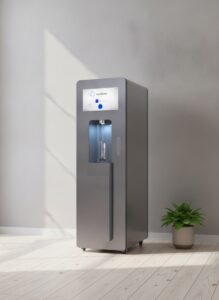
Freestanding dispensers enable convenient self-service in lobbies, meeting spaces, and staff kitchens, reducing staff handling and improving guest experience through controlled portioning and hygienic access. Dispensers can integrate with payment systems or access controls and are typically engineered for high dispense rates, making them suitable for high-traffic areas where continuous access is required. They also centralise cleaning points and reduce ad-hoc staff deliveries, which lowers labour costs and contamination risk. Properly specifying dispenser throughput and bin refill strategy is essential to avoid queues during peak periods, which leads to storage sizing best practices.
How does large capacity ice storage improve operational efficiency?
Adequate storage provides a buffer that smooths production cycles and absorbs peak demand without forcing machines to overcycle, thereby extending equipment life and reducing energy spikes. Storage also allows production to be scheduled during off-peak electricity periods and supports event-driven surges without emergency production. Rules of thumb suggest holding 12–24 hours of typical peak demand as buffer, scaling upward for venues with intermittent large events. Storage hygiene and controlled access ensure that stored ice remains fit for service and that turnover minimises hold times, linking directly to cleaning and filtration regimes discussed later.
What installation considerations are essential for ice dispensers and storage bins?
Critical installation requirements include adequate electrical supply with correct phase and breaker sizing, properly graded drainage for meltwater, ventilation clearances for air-cooled units, and floor loading assessments for heavy bins and modular assemblies. Access for maintenance and service must be factored into placement to allow bin emptying, filter changes, and mechanical access to machine heads; insufficient clearance increases service time and cost. Where water-cooled condensers are used, provision for condenser water and legal compliance for discharge must be confirmed. For complex sites or large installations, a specialist supplier site survey and engineer sign-off is recommended to verify utilities and compliance before procurement.
- Advantages of dispensers: hygienic self-service, reduced staff time, high throughput.
- Storage benefits: buffers for peak demand, allows off-peak production, lowers cycle frequency.
- Installation essentials: power, drainage, ventilation clearances, and service access.
How to Maintain and Ensure Hygiene for High-Capacity Ice Machines in Large Businesses?
Maintenance and hygiene are fundamental to consistent ice quality, asset longevity, and regulatory compliance; structured cleaning routines, filter replacement schedules, and documented service logs reduce contamination risk and extend component life. Cleaning frequency depends on throughput and environment, but large-capacity systems often require weekly visual checks, monthly sanitisation cycles for high-use areas, and quarterly professional servicing for condenser and refrigeration system checks. Water filtration replacement intervals should be aligned with throughput and local water quality—typical commercial cartridges need changing every 3–6 months depending on load. Clear SOPs, PPE for cleaning staff, and machine access records are essential, especially in healthcare environments where stricter documentation and sanitisation standards apply.
What are best practices for cleaning and maintaining commercial ice machines?
Best practice includes daily surface checks, weekly removal of visible deposits, monthly sanitisation of storage bins and contact surfaces using manufacturer-approved sanitiser, and quarterly full-service visits by certified technicians to inspect evaporators, compressors, and condensers. Keep a maintenance log that records filter changes, sanitisation dates, and technician visits to support traceability and regulatory compliance in foodservice and healthcare settings. Items such as scale build-up and biological film require chemical cleaning procedures and occasional deep descaling by trained engineers. Scheduling preventative maintenance based on runtime metrics rather than calendar-only intervals reduces unexpected downtime and improves reliability.
How does regular water filtration impact ice quality and machine longevity?
Regular filtration removes particulates, chlorine, and tastes/odours that compromise ice quality, and reduces mineral scale that impairs heat transfer on evaporators, thereby maintaining production efficiency and reducing energy consumption. Filter types commonly used include sediment pre-filters, carbon blocks, and scale-inhibiting media; selecting the right combination depends on local water hardness and microbiological profiles. Replacing cartridges at defined throughput thresholds prevents fouling and maintains consistent ice taste for guest-facing applications. Investing in adequate filtration often yields lower maintenance costs and fewer unplanned service events, improving overall lifecycle TCO.
What hygiene protocols are recommended for healthcare and food service industries?
Healthcare settings require higher cleaning frequency, validated sanitisation procedures, and comprehensive record-keeping to meet clinical hygiene standards; this includes daily visual inspections, more frequent sanitisation of bins and dispensers, and immediate action on any contamination indicators. Foodservice operators should maintain documented cleaning schedules, staff training on PPE and handling, and ensure traceability by logging service activities and filter replacements. In both sectors, an annual compliance audit by a specialist or third-party verifier helps maintain standards and provides evidence for audits. These protocols reduce infection risk and maintain trust in patient and guest safety.
- Cleaning best practices: daily checks, weekly cleaning, monthly sanitisation, and quarterly professional servicing.
- Filtration impacts: better taste, reduced scale, improved heat exchange, and energy efficiency.
- Healthcare protocols: higher frequency, documentation, and specialist compliance checks.
What Are the Latest Trends and Innovations in Industrial Ice Machine Solutions?
Innovations centre on connectivity, sustainability, and smarter controls: IoT-enabled ice machines deliver remote diagnostics and usage analytics, refrigerant and system improvements reduce energy and water consumption, and integrated filtration and touchscreen controls simplify compliance. Buyers should assess vendor roadmaps for firmware updates, open API telemetry, and warranty support for connected features to ensure future-proofing. Sustainability trends include lower-GWP refrigerants, improved heat exchanger efficiency, and water-saving condenser designs which reduce lifecycle environmental impact. Understanding the innovation landscape helps operators evaluate long-term value beyond headline production capacity.
How is IoT integration transforming commercial ice machine management?
IoT integration enables remote alerts for faults, automated production telemetry, and predictive maintenance models that reduce unplanned downtime by flagging component degradation early, improving mean-time-to-repair (MTTR). Usage analytics support optimisation of production schedules to match demand patterns and can feed into energy management systems to exploit off-peak tariffs. Remote access to operational KPIs—uptime, production kg/day, fault logs—allows facilities teams to prioritise service activities and reduce engineer call-outs. These capabilities shift maintenance from reactive to proactive, increasing uptime and lowering lifecycle costs.
What sustainability efforts are shaping the future of high-capacity ice solutions?
Sustainability improvements focus on energy efficiency, water conservation, and refrigerant selection, with manufacturers seeking lower-GWP refrigerants and more efficient compressors that reduce kWh/kg and litres/kg metrics. Lifecycle considerations also include recyclability of components, modular designs that allow upgrades without full replacement, and reclaim strategies for condenser water where feasible. Buyers should ask vendors for published energy and water performance data and lifecycle disposal guidance to make informed procurement choices. These measures reduce operating costs and align procurement with corporate sustainability targets.
Which leading brands are driving innovation in the UK commercial ice machine market?
A number of established international manufacturers and specialist industrial refrigeration firms contribute technological advances in energy efficiency, IoT telemetry, and filtration integration, each focusing on different aspects of performance such as evaporator design, control software, or modular scalability. Rather than selecting solely on brand, savvy buyers compare published efficiency metrics, warranty terms, and service network coverage and request specification sheets that include kWh/kg, water usage, and recommended maintenance intervals. Reviewing vendor roadmaps and requesting product lifecycle support ensures the chosen solution will remain serviceable and efficient over its operational life.
Continued innovation makes it important to validate specification claims and compare objective performance metrics when shortlisting equipment.
What Are the Benefits and ROI of Investing in High-Capacity Ice Solutions for Large Businesses?
Investing in on-site high-capacity ice production typically reduces recurring costs versus purchased bagged ice, improves supply reliability, and raises service quality; the ROI depends on production size, local electricity/water costs, and labour savings. Primary savings derive from eliminating bag purchases, reducing staff time spent handling deliveries, and lowered spoilage or inconsistent ice quality that can affect service and product consistency. A TCO comparison that includes capital cost, annual running cost, and expected savings versus delivered ice will show typical payback windows; many operators find payback within 2–5 years depending on usage intensity. Quantifying savings with a worked example helps procurement teams make objective decisions.
How do high-capacity ice machines reduce costs compared to bagged ice purchases?
On-site production replaces recurring bagged ice expenses and associated delivery costs, and reduces labour for delivery handling and storage management, which are often hidden costs in budget analysis. For instance, substituting a regular monthly bagged ice spend with on-site production avoids mark-up per kg and delivery fees while delivering consistent ice type and reducing contamination risk. Additional savings come from less storage space dedicated to bags and fewer emergency purchases. When calculating savings, include avoided labour, delivery, and disposal costs to capture the full economic benefit.
What operational advantages do large volume ice production systems offer?
Operational advantages include supply certainty during peak periods, improved beverage consistency because machine-produced ice has uniform size and clarity, and reduced staff handling allowing faster service turnaround. Large volume systems also enable decentralised dispensing strategies, improving guest satisfaction and reducing bottlenecks at service points. Reduced dependency on external suppliers mitigates supply-chain risk for events and seasonal spikes. These operational benefits often translate into measurable KPI improvements such as reduced service times and fewer stockouts.
Are there case studies demonstrating ROI for hospitality and healthcare sectors?
When real case studies are unavailable, a hypothetical scenario demonstrates methodology: assume a venue spends £2,400/year on bagged ice (approx. £200/month), labour handling costs of £1,200/year and chooses a machine with £8,000 upfront and £1,200/year running cost. Annual cost with machine = £1,200 running + amortised capital (£1,600 over 5 years) = £2,800 versus £3,600 for delivered ice and labour, yielding a simple payback slightly under five years and recurring annual savings thereafter. Tracking KPIs such as uptime, staff hours saved, and supply incidents pre- and post-installation quantifies the operational impact and supports procurement decisions.
| Option | Upfront Cost (example) | Running Cost per year (example) | Savings vs Bagged Ice per year (example) | Payback Period (example) |
|---|---|---|---|---|
| On-site machine | £8,000 | £1,200 | £800 | ~5 years |
| Continued bagged ice | £0 | £3,600 | £0 | n/a |
| Hybrid (rental/backup) | £2,000 deposit | £2,400 | £600 | ~3.3 years |
- Key ROI drivers: avoided bag costs, labour savings, reduced supply risk, and operational quality improvements.
- Operational KPIs to track: annual kg produced, staff hours saved, service incidents, and energy usage per kg.
For a tailored cost model and on-site capacity survey that accounts for local energy, water tariffs, and peak event profiles, consult specialist commercial ice equipment suppliers. Engaging a specialist for a site visit and quote helps validate assumptions, identify installation constraints, and quantify expected ROI so you can make a confident procurement decision.
Pair your ice maker with a premium bottleless water cooler for a complete office hydration station. See our rental pricing.