Seven tons. That is roughly how much drinking water a 30-person office in Irvine has trucked to its front door every year — hauled up the 405, wheeled through the lobby on a hand cart, five gallons at a time. Nobody sits down and decides to do this. It happens one delivery invoice at a time until it quietly becomes the way the office gets water.
If your business has been looking for somewhere to trim its environmental footprint, the water cooler is a strange blind spot. It is one of the few line items where the greener option is also the cheaper one, and where the math is simple enough to run on the back of a delivery receipt. So let’s run it.
Run the jug numbers on your own office
Start with one person. A typical employee drinks about four cups of water over a workday — call it 32 ounces, or a quarter of a gallon. Across 20 workdays, that is five gallons a month. Which means the arithmetic lands on a number that is almost too tidy: one 5-gallon jug, per employee, per month.
Scale that up and it stops being tidy:
- A 10-person startup in Costa Mesa: ~120 jugs a year
- A 30-person office in Pasadena: ~360 jugs a year
- A 60-person firm in Riverside: ~720 jugs a year
- A 100-person operation across two SoCal suites: ~1,200 jugs a year
And that is the conservative version. It counts drinking water only — not the coffee machine, not the tea kettle, not the pitcher someone fills for the conference room, and not the July afternoon when the AC struggles and everyone drinks twice as much. Most offices land well above the estimate.
The plastic is not actually the main problem
Here is where most sustainability pitches overstate their case, so we won’t. Those big polycarbonate jugs are not single-use. They get collected, washed, sanitized, refilled, and sent back out — often dozens of times before they’re retired. The jug itself is one of the better-behaved pieces of plastic in your building.
The footprint lives somewhere less obvious: you are paying a truck to drive water to you. Water weighs 8.34 pounds per gallon, so a full 5-gallon jug is about 42 pounds, and almost all of that weight is the thing already coming out of your tap. That 30-person Pasadena office at 360 jugs a year is roughly 15,000 pounds — about seven tons — of water moved by diesel through some of the most congested freeway miles in the country.
Stack up the rest of the cycle and it adds up:
- The delivery itself — a truck at your address every week or two, 26 to 52 stops a year, in SoCal traffic
- The wash-and-sanitize loop — every returned jug consumes water and energy before it can be refilled
- Retired jugs — bottles that fail inspection leave the loop and become waste
- The packaging around it — caps, seals, shrink wrap, and pallet film, every single delivery
- The gap-filler cases — the flat of single-use bottles someone runs out and buys when the jugs are late, which are the throwaway plastic everyone pictures
Bottleless service removes the trucking line entirely. The water is already in the building. It always was.
What bottled delivery actually costs a SoCal business
Jug pricing in Orange County, Los Angeles, and the Inland Empire generally runs somewhere around $8 to $12 per 5-gallon bottle depending on your contract and volume. Take the middle of that range and put it against the 30-person office:
- 360 jugs a year at roughly $9 each: about $3,240
- Cooler rental, billed separately by most delivery companies: a few hundred more
- Delivery fees, fuel surcharges, and bottle deposits: the part nobody reads
Want to go deeper? Compare the Glacier freestanding ice and water dispenser, learn about bottleless water dispensers for Southern California offices, or check bottleless water service in Los Angeles.
The savings are real, but honestly, the part clients mention first is usually the storage closet they got back.
Seven stages between the tap and the cup
“Already in the building” only counts for something if the water is genuinely good, and Southern California tap water is a real conversation. Depending on which district serves you, it may arrive hard, chlorinated, and carrying the mineral signature of a long trip from the Colorado River or the State Water Project. It is safe. It frequently does not taste like something you want to drink at 3 p.m.
Every Aqualume dispenser runs incoming water through 7-stage filtration — sediment capture, carbon stages that pull chlorine and the taste and odor riding along with it, and fine filtration that catches what the earlier stages let through. What reaches the cup is cold, clean, and consistent, glass after glass, without a hand cart involved.
Which dispenser fits your footprint
Sizing is mostly about headcount and counter space:
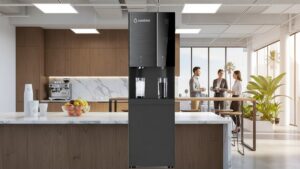
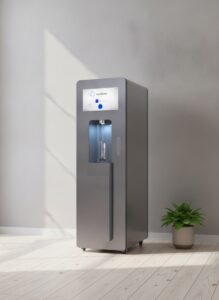
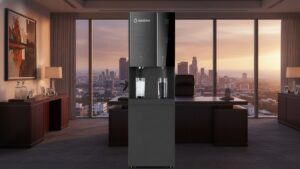
- Glacier — the flagship freestanding unit, built for high-traffic break rooms and the busiest floors
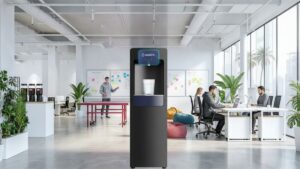
- Cascade — our best-seller and the default for most 10-to-100-person offices; freestanding, unfussy, gets it done
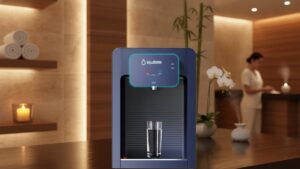
- Jetstream — tabletop, for suites where floor space is the scarce resource
- Avalanche, Gulfstream, and Blizzard — for teams with specific ice, capacity, or layout requirements
One dispenser generally serves a floor comfortably. Bigger or more spread-out teams do better with a unit per cluster than one heroic machine everyone walks to.
What to sort out before you switch
Bottleless is a plumbing decision as much as a water decision, so a few things are worth checking early:
- Water line access. The dispenser needs a connection. Most break rooms already have one nearby; if yours doesn’t, that is a conversation to have before install day, not during it.
- Your landlord. Some SoCal leases have opinions about plumbing work. Worth a quick email.
- Your existing delivery agreement. Check the end date and the return terms for the jugs and the rented cooler so the two don’t overlap.
- The term. Aqualume service runs on a 36-month agreement. It is what lets the monthly number stay flat and flat-rate, and you should know it going in.
- Placement. Put it where people already walk. A dispenser in a corner nobody visits is just furniture.
Frequently asked questions
How much plastic does a bottleless water cooler actually save?
Less than most marketing claims, and that is worth being straight about: 5-gallon jugs are washed and refilled many times, so they are not single-use. The bigger savings are the roughly seven tons of water a 30-person office no longer has trucked in each year, the 26 to 52 annual delivery trips, the packaging on every drop-off, and the cases of single-use bottles offices buy when deliveries run short.
How many 5-gallon jugs does an office use per year?
A useful rule of thumb is one 5-gallon jug per employee per month, based on an employee drinking about 32 ounces of water across a 20-day work month. A 30-person office therefore runs through roughly 360 jugs a year. Offices that also use water for coffee and tea typically exceed that estimate.
Is bottleless water cheaper than bottled delivery in Southern California?
For most small and mid-sized businesses, yes. Jug delivery in Orange County, Los Angeles, and the Inland Empire generally runs about $8 to $12 per 5-gallon bottle plus separate cooler rental and delivery fees, which puts a 30-person office in the $3,000-plus range annually. Aqualume dispensers start at $80 a month flat-rate, and most offices save between $1,000 and $3,000 a year.
Does bottleless water taste as good as bottled?
It should taste better, because it is filtered at the point of use rather than sitting in a warm jug in a storage closet. Aqualume runs every dispenser’s incoming water through 7-stage filtration, which removes chlorine, sediment, and the taste and odor compounds that make Southern California tap water unappealing.
Do I need a plumber to install a bottleless dispenser?
Not usually. The dispenser connects to an existing water line, and most break rooms and kitchenettes already have one within reach. If your preferred location has no nearby line, that gets identified during the site walkthrough before installation so there are no surprises.
What happens to our old water cooler and jugs?
Rented coolers and jugs go back to your delivery provider under your existing agreement’s return terms. Review those dates before scheduling your Aqualume install so you are not paying two vendors during the changeover.
Stop paying to have water driven to you
The clean water is already in the pipes. Everything else — the truck, the hand cart, the closet full of jugs, the surcharge line on the invoice — is logistics wrapped around a problem your building already solved.
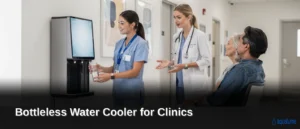
Aqualume serves offices, gyms, schools, and medical and senior-care facilities across Orange County, Los Angeles, and the Inland Empire. See what your own jug math looks like with a real dispenser in your break room. Start your 7-day free trial.