Most office water decisions get made in about four minutes, usually by whoever got stuck carrying the last 5-gallon jug up a flight of stairs. That is a shame, because the dispenser in your breakroom is one of the few pieces of office equipment every single employee touches, several times a day, for years. Pick the right one and nobody thinks about water again. Pick the wrong one and you get a standing complaint at every staff meeting.
Here is how Southern California businesses — offices, gyms, clinics, schools, senior-care facilities — should actually work through the decision, in the order that matters.
Step one: start with headcount, not with the machine
Every sizing conversation should begin with one number: how many people drink from this thing on a normal Tuesday. Not your total payroll — the people physically in the building.
A reasonable planning figure is roughly half a gallon of dispensed water per person per day once you account for water bottles being filled, coffee and tea being made, and the mid-afternoon ice run. A 20-person office is therefore looking at something in the neighborhood of 10 gallons a day. A 60-person office with a busy front desk and a gym-adjacent culture can run three times that.
This matters because bottleless dispensers are not limited by supply — they are plumbed into the building’s water line, so they never run out — but they are limited by how fast they can chill, heat, and produce ice. A tabletop unit serving 45 people will spend the entire lunch rush trying to catch up. The fix is not a bigger tank; it is the right class of machine, or a second unit on the far side of the floor.
Step two: freestanding or tabletop?
This is mostly a question about counters and traffic, and it is the single easiest way to get the decision wrong.
Planning an upgrade? Compare the Glacier freestanding ice and water dispenser, see water service plans for Southern California offices, or get details on water dispenser rental in Los Angeles to get started.
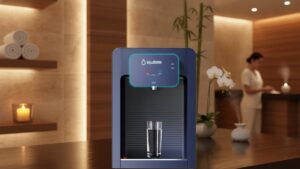
Go tabletop when you have counter space to spare and a smaller or more distributed team — a 12-person suite, a satellite office, a staff lounge, a treatment room, a second-floor pod that just needs its own point of access. The Jetstream is the tabletop model, and it is frequently the right answer for a second or third dispenser rather than a first.
One physical constraint worth checking before anything else: a bottleless dispenser needs a cold water line and a standard outlet within reach. In most SoCal offices that means the breakroom sink wall or the wall it shares with a restroom. If your preferred spot is 40 feet from the nearest plumbing, say so early — it changes the install, not the machine.
Step three: match the model to the room
Aqualume’s lineup runs seven models, and the differences are about capacity, dispensing options, and where the unit physically lives:
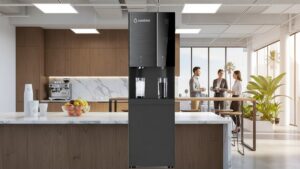
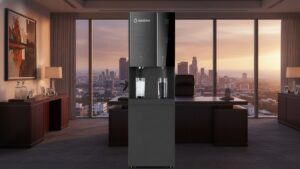
- Glacier — the flagship freestanding unit. The right call for larger offices, high-traffic lobbies, and facilities where the dispenser is on display as much as it is in use.
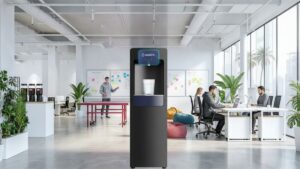
- Cascade — the best-seller, and the default recommendation for most 15-to-60-person SoCal businesses. Freestanding, dependable, and sized for real breakroom traffic.
- Jetstream — the tabletop model. Ideal for smaller teams, satellite suites, and secondary placements where floor space is the scarce resource.
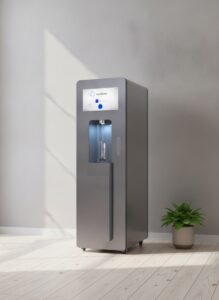
- Avalanche, Gulfstream, Blizzard, and Lightstream — additional configurations that cover the edge cases: different capacity classes, different dispensing setups, different aesthetics. Worth asking about specifically if your space has an unusual constraint.
A useful rule: for a single-location business between 10 and 100 employees, the Cascade is the safe center of the range, the Glacier is the upgrade when volume or visibility justifies it, and the Jetstream is what you add later when the far end of the floor gets tired of walking.
Step four: understand what the filtration is actually doing
Southern California tap water is safe to drink and, depending on your city, genuinely unpleasant to drink. Much of the region’s supply is imported through the Colorado River Aqueduct and the State Water Project, arrives hard with dissolved minerals, and gets chlorinated or chloraminated for the long trip. The result is water that passes every regulatory test and still makes your team buy single-use bottles at the corner market.
Every Aqualume dispenser runs a 7-stage filtration system — sediment capture, carbon stages that pull chlorine taste and odor, reverse osmosis for dissolved solids, and final polishing and sanitation stages before the water reaches the tap. The practical outcome is water that tastes like nothing, which is exactly what water is supposed to taste like.
Ask any vendor two questions about filtration: how many stages, and who changes the filters. The second question is the one that separates a service from a purchase.
Step five: read the monthly rate carefully
Aqualume prices as an flat monthly service, starting from $80 per month per dispenser and running up to roughly $150 per month for the Glacier flagship. That rate covers the equipment, the installation, and the maintenance, with scheduled filter changes billed separately — the recurring costs that quietly turn a cheap-looking water plan into an expensive one.
Compare that to jug delivery, where the invoice is a moving target: the water itself, plus bottle deposits, plus fuel surcharges, plus rental on the cooler, plus whatever the delivery schedule does when your usage spikes in August. Most Southern California offices that switch save somewhere between $1,000 and $3,000 a year, and the savings scale with headcount because bottleless costs do not rise every time someone refills a water bottle.
The service runs on a 36-month term, which is worth knowing up front and factoring into the comparison honestly. In exchange, the monthly number stays flat and predictable for three years — no per-gallon math, no surcharge line items, no quarterly renegotiation with a delivery rep.
Step six: count the plastic you stop buying
A 30-person office running on 5-gallon jugs cycles through hundreds of them a year, each one trucked in, trucked out, sanitized, and trucked back. Add the case of single-serve bottles somebody buys for the conference room and the number climbs.
Bottleless removes the entire logistics chain. No jugs stacked in the hallway, no empties in the corner, no delivery truck idling in the loading zone twice a month, no employee with a bad back doing an unpaid weightlifting session. For SoCal businesses chasing sustainability goals — or just trying to reclaim four square feet of storage — that is the quiet win that shows up in the first month.
Frequently asked questions
How much does a bottleless water dispenser cost per month in Southern California?
Aqualume’s Flat-Rate Service starts from $80 per month per dispenser and reaches about $150 per month for the Glacier flagship. That single rate covers the equipment, installation, and maintenance, with filter changes billed separately, so the invoice stays flat instead of fluctuating the way jug delivery does.
How many employees can one bottleless dispenser serve?
A freestanding unit comfortably serves most offices up to roughly 60 people on a single floor. Above that — or when the team is spread across floors, wings, or buildings — a second dispenser is usually the better answer than a larger single machine, because the real constraint is walking distance and lunch-rush throughput, not supply.
What does 7-stage filtration remove?
The 7-stage system handles sediment, chlorine taste and odor, dissolved solids through reverse osmosis, and final polishing and sanitation before dispensing. In practice it targets exactly the things that make imported Southern California tap water taste flat, metallic, or chemically treated.
Does a bottleless dispenser need special plumbing?
No. It connects to an existing cold water line and a standard electrical outlet, which is why breakroom and restroom-adjacent walls are the most common placements. Installation is handled as part of the service, and most units are running the same day they are set up.
How much can a SoCal office save by switching from bottled water delivery?
Most businesses save between $1,000 and $3,000 per year. The savings grow with headcount, because bottleless service is billed at a flat monthly rate per dispenser rather than per gallon consumed.
Can we try it before committing?
Yes. Aqualume offers a 7-day free trial so your team can put the machine through a real week — Monday coffee, Wednesday lunch rush, Friday ice — before you decide.
The short version
Count the people who will actually use it. Decide whether it sits on the floor or the counter. Check the wall for a water line. Confirm the filtration is 7-stage and that someone else changes the filters. Then compare one predictable monthly number against a jug invoice that has never been the same twice.
Aqualume installs and services bottleless water dispensers across Orange County, Los Angeles, and the Inland Empire, for businesses from 10 to 100 employees. If you want a straight recommendation on which model fits your space — and a week to prove it — start your 7-day free trial.