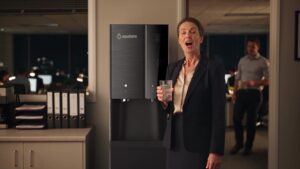
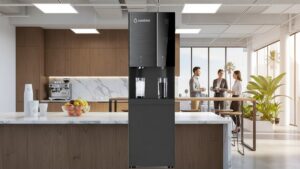
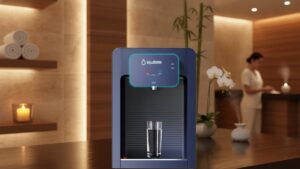
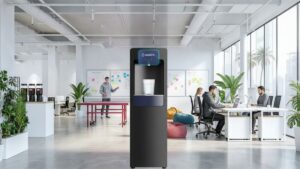
A coworking floor in Santa Monica has one thing a traditional office does not: nobody is quite sure whose job the water is. Members show up, plug in, drink, and leave. The community manager orders the jugs, the operations lead pays for them, and the guy who took the last cup at 4 p.m. is a freelance designer who signed a day pass. Multiply that across 150 members, three floors, and a July afternoon in Los Angeles, and the 5-gallon jug model stops being an amenity and starts being a staffing problem.
Shared workspaces across Orange County, Los Angeles, and the Inland Empire are switching to bottleless water dispensers for a simple reason: the water has to be there, all day, without anyone thinking about it. Here’s how the math and the logistics actually work.
Why jugs fail hardest in a shared workspace
A 25-person private office has predictable water consumption. A coworking space does not. Membership churns, day-pass traffic spikes on Tuesdays and Wednesdays, and event nights can double headcount for four hours. Delivery schedules are built around averages, which means a shared office is either sitting on a pallet of jugs it does not need or running dry during the exact hour that a member is touring the space with a prospective employer.
Then there is the physical footprint. Square footage in a coworking building is inventory — it is the product being sold. A closet full of 5-gallon jugs and empties waiting for pickup is roughly 15 to 25 square feet of storage that could be a phone booth, a locker bank, or a standing desk generating monthly revenue. In a Santa Monica or Irvine building at $50 to $70 per square foot annually, that closet is not free.
And someone has to lift the jugs. A full 5-gallon bottle weighs about 42 pounds. In an office, that task quietly falls to whoever is nearest. In a coworking space, it falls to a community manager whose actual job is member retention, tours, and events — not hoisting water onto a cooler six times a week.
What shared-office water actually costs in SoCal
Bottled delivery pricing looks reasonable per jug and unreasonable per year. Most Southern California providers land somewhere between $8 and $12 per 5-gallon bottle once you add delivery fees, fuel surcharges, cooler rental, and the seasonal rate adjustments that show up quietly on the invoice in August.
Planning an upgrade? Explore the Glacier freestanding ice and water dispenser, see bottleless water dispensers for warehouses and manufacturing facilities, or check water dispenser rental in Santa Monica.
The line item that disappears entirely is the variable one. A bottleless dispenser connects to the building’s existing water line, so a heat wave that triples consumption does not triple the bill. In a business where members pay a flat rate for unlimited access, matching that with flat-rate water is not a small operational win.
What 7-stage filtration removes from SoCal tap water
Southern California’s water is safe to drink and frequently unpleasant to drink. Most of it travels hundreds of miles from the Colorado River or the State Water Project, arrives hard, and gets chlorinated or chloraminated along the way. Members notice. Nobody renews a membership over water quality, but they absolutely complain about it in the member Slack.
Every Aqualume dispenser runs incoming tap water through a 7-stage filtration process before it reaches a cup. That sequence targets:
- Sediment, rust, and particulate picked up from older building plumbing
- Chlorine and chloramine — the primary source of the “pool water” taste in LA and OC tap
- Volatile organic compounds and dissolved contaminants
- Hardness minerals that leave scale in kettles and cloudy film in glassware
- Taste and odor compounds in the final polishing stage
The practical result for a coworking operator is that the water in the kitchen tastes the same on every floor in every season, which is not something a jug supply chain can promise when the plant, the truck, and the warehouse all change with the season.
Matching the dispenser to the floor plan
Shared workspaces rarely have one water location. They have a main kitchen, a second-floor kitchenette, and an event area that gets used twice a week. Aqualume’s product line is built to cover that mix rather than forcing one unit to do everything:
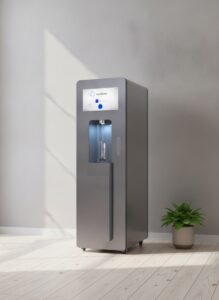
- Glacier — the flagship freestanding unit. Highest capacity, built for a main kitchen serving heavy all-day traffic on a busy floor.
- Cascade — the best-seller and the practical default for most shared offices. Freestanding, high throughput, sized for a primary breakroom.
- Gulfstream — a strong fit for open-plan tech and startup floors where the dispenser sits in the middle of the room and gets seen by every tour.
- Jetstream — tabletop. Ideal for a second-floor kitchenette or a small private-office suite where floor space is genuinely scarce.
- Avalanche and Blizzard — additional options for buildings that need coverage across multiple zones.
A typical 15,000-square-foot coworking building runs two freestanding units in the main kitchens and a tabletop in a satellite area. Because pricing is per dispenser, an operator can scale coverage one unit at a time as membership grows rather than renegotiating a delivery contract.
The hygiene question members actually ask
Shared workspaces are shared-touchpoint environments, and members have been paying attention to that since 2020. The jug cooler is one of the worst offenders in the building: an open-top bottle handled by a delivery driver, a warehouse worker, and whoever wrestled it onto the base, feeding a reservoir that gets cleaned when someone remembers.
A plumbed-in bottleless system removes the open bottle from the equation entirely — water goes from the building line through sealed filtration to the dispense point. Aqualume’s service includes technician-performed sanitization and scheduled filter changes (filters billed separately), so the maintenance actually happens on a calendar instead of on a good intention. For a community manager, that means one fewer recurring task and one fewer thing to defend during a tour.
What the monthly rate includes — and the term
Aqualume service is billed as one flat monthly rate per dispenser, starting from $80 per month and running up to about $150 per month for the Glacier. That rate covers the equipment, the 7-stage filtration, sanitization, and ongoing maintenance service, with scheduled filter replacement billed separately. Aqualume operates on a 36-month service term, which is what keeps the monthly rate flat and predictable across the life of the agreement — worth knowing up front if you are budgeting a multi-year lease alongside it.
Service covers Orange County, Los Angeles, and the Inland Empire, so operators running multiple buildings across SoCal are dealing with one provider rather than three regional bottled-water accounts with three different invoice formats.
Frequently asked questions
How much does a bottleless water dispenser cost for a coworking space?
Aqualume dispensers start from $80 per month per unit, with the Glacier flagship at approximately $150 per month. The rate covers filtration, sanitization, and maintenance, with scheduled filter changes billed separately. Most Southern California businesses save $1,000 to $3,000 per year compared to 5-gallon bottled delivery.
Does a bottleless dispenser need plumbing work in a leased building?
Bottleless dispensers connect to an existing cold water line, typically the one already serving a kitchen sink or ice machine. Most coworking kitchens and breakrooms already have a usable connection point nearby, which keeps installation straightforward in a leased space.
How many dispensers does a coworking space need?
Plan for one freestanding unit per primary kitchen or high-traffic common area, plus a tabletop unit for satellite kitchenettes. A 15,000-square-foot building with 100 to 150 members typically runs two to three units total. Because Aqualume prices per dispenser, coverage can be added one unit at a time as membership grows.
What is 7-stage filtration and why does it matter in Southern California?
7-stage filtration is a sequential process that removes sediment, chlorine and chloramine, volatile organic compounds, dissolved contaminants, and hardness minerals before a final taste-and-odor polishing stage. It matters in SoCal because most local tap water is imported, hard, and heavily treated — the taste complaints members raise are usually chlorine and mineral content, both of which the filtration process targets.
How much plastic waste does switching eliminate?
A shared workspace consuming 30 jugs a month cycles roughly 360 five-gallon bottles a year, each one requiring a delivery truck trip across LA or OC traffic. A plumbed-in dispenser eliminates the bottles and the associated delivery mileage, which is a straightforward sustainability metric to report to members and to any landlord tracking building-level environmental goals.
Can I try it before committing?
Yes. Aqualume offers a 7-day free trial so you can put a dispenser on your busiest floor and see how it handles real member traffic before making a decision.
Put it on the busiest floor first
The fastest way to evaluate bottleless water in a shared workspace is to install one unit in the kitchen that generates the most complaints and watch what happens for a week. Consumption data in a coworking space is unusually honest — if members use it, they use it constantly, and the community manager stops fielding messages about the empty cooler.
Aqualume serves coworking spaces, shared offices, and executive suites across Orange County, Los Angeles, and the Inland Empire. Start your 7-day free trial and see how your floor actually drinks.