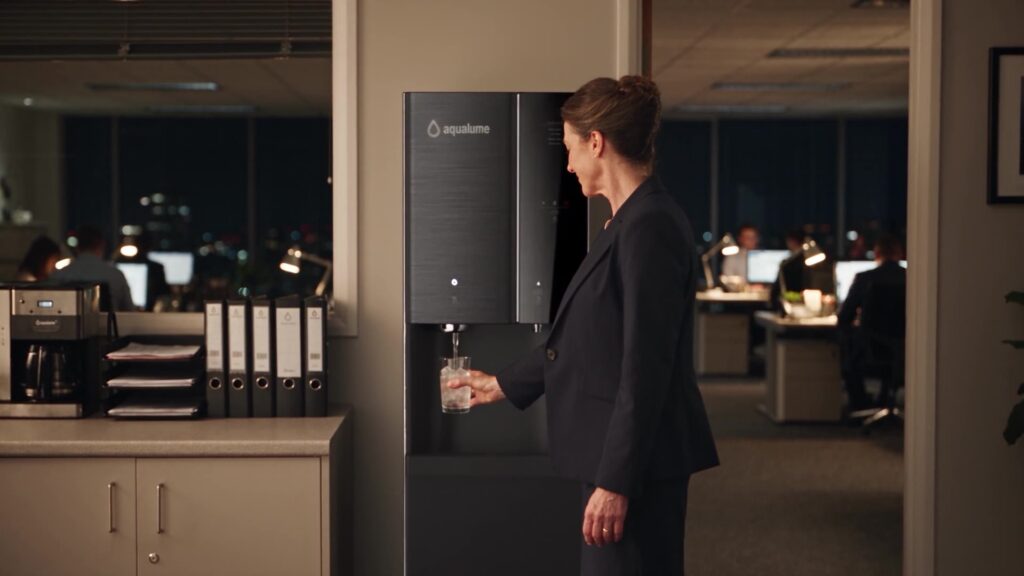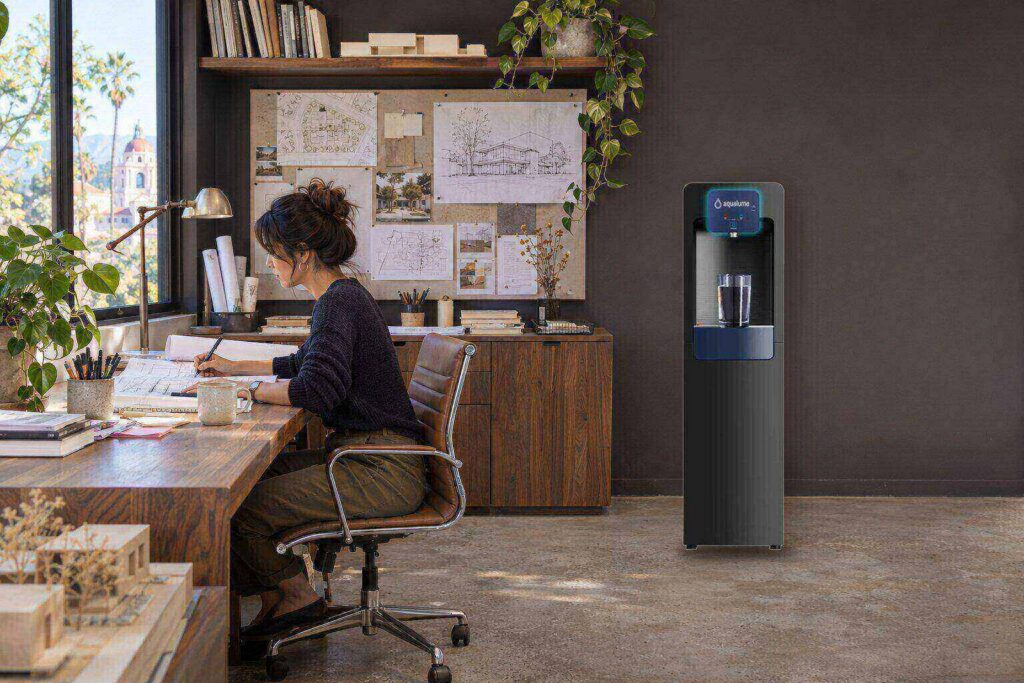
Spend an afternoon at a trade show for commercial water dispensers and you’ll see “self-cleaning” printed on something like half the machines. Ask a few reps how it actually works and the answers won’t match. Now and then two reps from the same brand will tell you different things.
Strip the label away and you find three technologies that actually do something in commercial water dispensers: UV sterilization, ozone injection and hot-water (thermal) sanitization. Plenty of machines pair two. And then there are cheap units with none of them that call the filter “self-cleaning,” which isn’t how filters work.
We’ll take them one at a time, starting with the most common.
The problem self-cleaning is trying to solve
Any water dispenser, filtered or not, has a handful of spots where bacteria will happily settle in:
- The reservoir, where water can sit for hours at a time in a plastic or stainless tank
- The dispense area, open to the air and to every finger, cup rim or splash
- The internal lines, narrow plastic tubing where biofilm builds if nobody checks
- Filter housings, wet plastic in the dark and close kin to a petri dish
You could keep all four in check by hand (sanitizing regularly, changing filters on time, a bit of care at the tap), but in an office of 30, 50 or 80 people that job belongs to everyone, so nobody does it. A self-cleaning water dispenser is the engineering answer to people forgetting.
Method 1: UV sterilization (254-nanometer ultraviolet)
UV sterilization is the one you’ll run into most, and the best understood.
The lamp is a UV-C tube putting out light at 254 nanometers. That wavelength scrambles the DNA of bacteria, viruses and protozoa, which sounds dramatic, and they don’t even die right away. They just can’t reproduce anymore, and in a glass of water that’s as good as dead.
There are two places to put the UV lamp:
Inline UV. The lamp sits in the flow path, after the filters and just before the tap, so each glass gets a dose of light on its way out. Simple, and it covers every pour. The catch is the UV bulb, which fades over time and has to be swapped on a schedule by somebody.
Reservoir UV. Here the UV lamp lives in the cold or ambient tank and switches on every few hours, treating the water that’s just sitting there. It’s the cycle brochures love to print in bold and call “self-cleaning.”
“What does the unit filter out of the water?” comes up in our chat, and it’s fair to ask of any self-cleaning feature. A UV lamp filters out nothing. Lead, chlorine, hardness: all of it sails through, so it sits behind filters. It’s there for germs, where hospitals and labs trust UV.
And the light has to actually hit the germs. Biofilm already coating the inside of a tube sits in UV’s shadow, so UV works as a preventive step on water that’s been through the filters. It won’t rescue a dirty machine.
On our dispensers, stage five of seven is sanitization, aimed at bacteria and pathogens.
Method 2: Ozone (O₃)
Ozone is O₃, oxygen with one atom too many, and that spare atom is why it’s so keen to react with things: bacteria, some organic compounds, whatever it meets. It also dissolves into the water and rides along with it, so ozone gets into corners a UV lamp can’t see.
The gas is made on the spot. A small generator in an ozone self-cleaning water dispenser takes in room air, turns some of it into O₃ with a bit of electricity, and pushes it into the reservoir or the dispense path. Give it a few minutes and it’s plain O₂ again. Set up right, there’s none left by the time you fill a cup (no taste, no smell).
That’s ozone’s selling point in dispensers: it gets the lines and surfaces too, and anyone who’s seen the tubing in a neglected cooler gets why.
The catch is the seals. Ozone is hard on rubber and gaskets when it isn’t contained well, and on a cheaply built unit they can go early. Decent ones use ozone-resistant parts wherever the gas travels, so if you’re being sold an ozone unit, ask which parts are rated for it. It’s worth the awkward question.
Where do you actually see ozone? Mostly in higher-end commercial dispensers, plus a few brands that put it front and center. For a regular office, UV handles it. Ozone makes sense for food service, healthcare or anywhere with a real microbial risk, and anywhere else you’re paying for more than you need.
Method 3: Hot water (thermal) sanitization
Heat is the oldest trick, older than UV or ozone, and the simplest: get water hot enough and most bacteria are dead within minutes. Go hotter still and the tougher strains and most viruses follow.
A thermal self-cleaning dispenser does it on a timer. Once a week or once a month, normally overnight when nobody’s around to get scalded, it sends very hot water through the internal lines, lets it circulate, and drains it.
With heat there’s nothing to replace: no UV bulb, no ozone generator. But it only happens when the timer says so rather than with each pour, and it never reaches the dispensing area or the outside of the nozzle.
So in a dispenser it works better next to UV or ozone than on its own.
Method 4 (sort of): Silver-ion coatings and antibacterial plastics
You’ll also see “antibacterial materials” on some dispensers’ spec sheets, which in practice means a silver-ion coating inside the reservoir or the filter housing. Silver ions slow bacteria down on whatever they coat, and that’s about it.
Does it help? A little. Silver-ion technology is real enough to be used in medical settings, but in a water dispenser it backs up UV or ozone rather than standing in for them. We wouldn’t pick a dispenser because the brochure says “antibacterial plastic.”
What “self-cleaning” should mean (and what it often actually means)
When a manufacturer tells you its dispensers are “self-cleaning,” ask which of these it means. A real answer sounds like this:
- “Inline UV at 254nm, plus a hot-water sanitization cycle every 30 days.” ← Real.
- “Ozone injection into the cold reservoir, 5-minute cycle every 12 hours.” ← Real.
- “The advanced filter is naturally self-cleaning.” ← Marketing.
- “Silver-ion antibacterial liner.” ← Supporting feature, not primary.
If the rep can’t name the technology (UV, ozone or heat), the wavelength or how often the cycle runs, assume it’s one of the last two.
What our machines actually have
Every Aqualume machine, Glacier, Cascade and Jetstream included, has:
- A sanitization stage. Stage five of the seven filtration stages every one of our machines runs, there to deal with bacteria and pathogens in the water.
- Scheduled service visits. They’re part of the plan, so a technician checks the dispenser on a set schedule and nobody in the office has to remember.
- Filter changes by our technicians. Nobody in your office has to open the cabinet. Replacement filters are billed separately, and they get changed about once a year, which is the part “self-cleaning” never covers.
- A 7-day free trial before anything is signed, and if it isn’t right for you we take the machine back at no charge.
What we don’t do is tell anyone the dispenser cleans itself from end to end, and we say so to prospects before they sign. The drip tray and nozzle sit outside the water path, as do the buttons or touchscreen, so somebody still has to wipe them every week, and we’d much rather the office manager hears that on day one than finds a pink ring in the tray a month later.
Self-cleaning isn’t a replacement for service
Product brochures tend to skip this bit. Even a very good self-cleaning system, UV or ozone or heat, has parts that get used up and parts that need servicing:
- UV bulbs dim as they age and get replaced on whatever schedule the maker sets
- Filters wear out with the water that runs through them
- Ozone generators, like UV lamps, don’t last forever
- Seals age and need looking at now and then
A “self-cleaning” dispenser that nobody services stays self-cleaning for about a year and is a glorified jug after that. That’s why our plan includes scheduled service visits, and when someone asks in our chat, “Do I change the filter myself or does a technician have to come out to do this?”, the answer is the technician.
Quick FAQ
Is a self-cleaning water dispenser worth it? For an office of ten or more, generally yes: compared with a non-self-cleaning unit it takes a chore off somebody’s list and makes a neglected tank less likely. In a home with one or two people, cleaning it by hand is fine.
Is UV water dispenser radiation safe? Yes. The UV lamp is sealed away inside the dispenser, so nobody using it gets any exposure, and nothing stays in the water afterwards either, since light doesn’t linger. Only what it did to the microbes does.
Does an ozone water cooler taste different? Not if it’s built properly, because the ozone has turned back into oxygen within minutes and what comes out of the spout is just filtered water. Taste or smell ozone in yours? Then something’s off, and whoever services it should take a look.
Can I skip cleaning the outside if it’s self-cleaning? No. Wipe the drip tray and spout weekly, the touchpad too. Self-cleaning only looks after the water path inside the dispenser, never the bits people touch.
How often does the UV bulb need replacing? Roughly once a year for a standard UV-C bulb, but go by the maker’s rating, and ask whoever services it whether UV bulb changes are in the plan.
The bottom line
So what does a self-cleaning water dispenser mean, in the end? It should mean sanitizing the water path inside the machine automatically, by UV light, ozone, heat or a mix, and the maker should be able to tell you which. “The filter is self-cleaning” isn’t an answer.
Ours, for what it’s worth: we rent bottleless dispensers to commercial offices across Southern California, plumbed into your water line, and every model runs the same seven stages with sanitization at stage five. Our technicians come out on a schedule for service, and replacement filters are billed separately, about once a year. From $80/month*, 7-day free trial. *Starting price; final pricing depends on the machine and site.
If your dispenser shows build-up or a pink ring in the drip tray and you’re tired of being the one who cleans it, try our bottleless water coolers for a week. With no water line near the break room, or a small team happy with cases, keep what you have.
Call 833-426-5863 or start the 7-day trial at aqualume.com.
Comparing quotes?
Get Aqualume's price for your office in one call.
Plans from $80/mo*. Seven models, one 7-stage filtration system, service across LA, Orange County and the Inland Empire.
Free 7-day trial
Try a bottleless cooler in your office before you sign.
- 7-day free trial, we take it back if it isn't right
- Plumbed in: no jugs to lift, store or reorder
- A local technician, not a national call centre
Rather talk? (833) 426-5863
*Starting price; final pricing depends on the machine and site.