I’ll be upfront: most “benefits of purified water” articles online read like they were written by somebody who’s never tasted tap. They list “hydration” as a benefit, which is true of literally any water. They claim purified water cures everything from headaches to bad relationships.
Let’s do this differently. Here are eight benefits of purified water that hold up if you actually read the studies — and the few common claims that don’t.
1. Better taste, which actually drives people to drink more
This sounds soft, but it’s the most measurable benefit. A study published in Appetite (2017) found that participants drank 17–28% more water when the taste was rated as “clean” versus “noticeable chlorine” or “metallic.”
The reason is simple: chlorine, chloramines, and dissolved solids change the perceived flavor. Most municipal water in Southern California runs 0.5–1 ppm of free chlorine after treatment — enough to taste. Purified water — RO + carbon — drops that to undetectable.
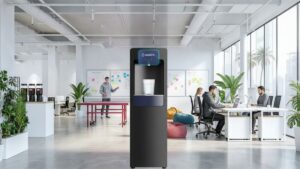
For an office, this matters more than people admit. The cooler isn’t there for hydration in the abstract; it’s there because dehydrated employees get headaches by 3 p.m. and reach for soda instead. Better-tasting water moves the needle on actual intake.
2. Removal of disinfection byproducts (DBPs)
When chlorine reacts with organic material in source water, it forms trihalomethanes (THMs) and haloacetic acids (HAA5s). These have been associated with long-term exposure risks, and the EPA regulates them in drinking water — but the limits are “acceptable for lifetime exposure,” not “ideal.”
Carbon filtration cuts THMs by 80–95% depending on the carbon and the contact time. RO + carbon stacks the effect. If you live in an area where your CCR lists THMs near the upper limit (some parts of the LA Basin and Inland Empire qualify), this is a meaningful reduction.
3. Reliable lead protection (when the filter is certified)
Lead doesn’t show up in your water at the treatment plant — it gets there from older plumbing on the way to your tap. The EPA banned new lead pipes in 1986, but anything installed before that is still in service, and a surprising number of older office buildings in LA County have brass fittings that contain trace lead.
NSF/ANSI 53-certified filters reduce lead by more than 99%. Most decent commercial RO systems are certified to this. Our 7-stage system is — and we run a UV final stage on top of it for redundancy.
This is the one purified-water benefit that genuinely shows up in pediatric guidelines. The American Academy of Pediatrics recommends using a certified filter if your home or office plumbing is from before 1986 and you have kids under six, pregnant women, or immunocompromised individuals on site.
4. Lower microbial load for vulnerable populations
Municipal water in the U.S. is generally safe, but “safe for healthy adults” and “safe for chemotherapy patients” are not the same standard. People with compromised immune systems are advised to drink water that’s been through a 1-micron absolute filter or a UV stage — neither of which is standard in tap.
For most offices this isn’t a daily concern, but the moment you have a coworker on immune-suppressing medication, it becomes one. A purification stack with UV (we use 254nm UV in our Glacier and Cascade models) handles it without anyone needing to ask.
5. Real cost savings vs. bottled water
This is the benefit nobody talks about in health articles, but it’s the one that pays for itself.
A 50-person office drinking bottled water at the recommended 64 ounces per person per day burns through roughly 100 5-gallon jugs a month. At an average delivery cost of $10/jug, that’s $1,000/month, or $12,000/year — before tip, fuel surcharges, and the rental fee on the cooler itself.
A bottleless commercial dispenser plumbed into the water line costs about $45–$85/month. We charge from $80/month for our Glacier and Cascade units, service included, filters billed separately. The math: an office of 50 saves $11,000+/year by switching. That’s a real number, not a “studies have shown” number.
The break-even point is usually inside the first 60 days.
6. Massive reduction in plastic waste
The 5-gallon jugs are technically reusable, but the single-use bottles that proliferate when a cooler runs out, or when employees grab a bottle on the way out, are not. The average American uses 156 plastic water bottles per year, per Earth Policy Institute data.
For a 50-person office, switching to a bottleless dispenser and a few stainless-steel reusables eliminates an estimated 7,800 single-use bottles per year. The 5-gallon jug logistics — and the diesel truck that delivers them — also vanish.
This isn’t a moral argument; it’s a procurement one. Most of the corporate sustainability targets we see from clients (we work with offices for BMW, Sony Pictures, and Red Bull, among others) have a single-use plastics line item. A bottleless dispenser closes it.
7. Convenient access encourages consumption — and hot, cold, sparkling on demand
Studies consistently show that people drink more water when it’s within 20 feet of their desk. A dispenser at the kitchen end of an office hits that distance for most layouts. A bottled cooler that only delivers cold doesn’t help the tea drinker, the oatmeal-at-9-a.m. crowd, or the “I want a sparkling water at 3 p.m.” contingent.
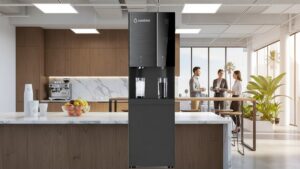
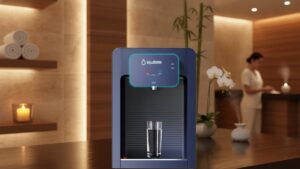
Our higher-tier dispensers (Glacier, Cascade, Avalanche) deliver four temperature/style options: cold, ambient, hot, and sparkling. Anecdotally, the offices we install in for clients in LA and OC report a noticeable drop in coffee shop “lunch break” runs once the sparkling line is operational.
8. Mineral preservation when the system is designed right
Here’s the one that gets misreported all over the internet: “RO water strips minerals.” Technically true. RO is so fine that it removes calcium and magnesium along with everything else.
The fix is mineral re-addition — a stage that adds back beneficial minerals and brings the pH back into the slightly-alkaline range that most people find pleasant. Every commercial-grade RO dispenser worth installing does this. Ours is the sixth stage in our seven-stage stack.
So the benefit is “minerals on demand at the level you want,” not “no minerals.” Drinks like tea and coffee taste better because the mineral profile is consistent — no chasing the variability of tap.
Claims I’m leaving off the list (because they don’t hold up)
A quick honest audit of claims you’ll see in other articles:
- “Alkaline water cures acid reflux.” The data is mixed at best. One study, very small sample, modest effect. Don’t switch dispensers for this.
- “Purified water boosts metabolism.” Drinking more water might, slightly. The purification step has nothing to do with it.
- “Removes microplastics.” Some filters do, some don’t. The science on microplastic health effects is still being written. Honest answer: probably reduces them; don’t claim “removes” without certification specific to that.
- “Purified water hydrates better.” Hydration is a function of volume, electrolytes, and timing. Purification doesn’t change the hydration efficiency.
So what does this mean for your office?
If you’re an office manager evaluating whether to switch from bottled to bottleless — or from “nothing” to “anything” — the strongest reasons are:
- People drink more (better taste)
- Lower contaminant exposure (DBPs, lead, microbes)
- Real cost savings vs. bottled (often 5x cheaper)
- Less plastic, easier sustainability reporting
- Hot/cold/sparkling on tap moves behavior
The weaker reasons are anything in the “miracle hydration” space. Be skeptical of those, regardless of who’s selling.
How Aqualume’s purification works
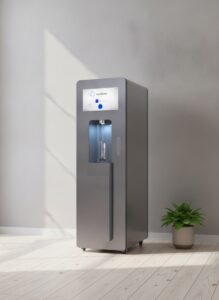
Our 7-stage system: sediment → granular activated carbon → carbon block → reverse osmosis → UV disinfection → mineral re-addition → final polishing.
The output: under 10 ppm TDS, undetectable chlorine, no measurable lead or coliform, with calcium and magnesium re-added to a target pH of 7.2–7.4. We install it across the Glacier, Cascade, and Jetstream lines.
If you’re tired of jug deliveries, sustainability reporting headaches, or just want better water in the office without thinking about it — start your 7-day free trial. No contract, no install fee. Most offices we set up for break even on bottled spending in under two months.
Call 833-426-5863 or book a free walkthrough at aqualume.com.