Fill a glass from the tap and hold it up to the light. Sometimes a faint cloud drifts through it and clears from the bottom in about ten seconds. That is usually just air that was dissolved under pressure in the pipe, and it is harmless. It still makes you wonder what else is in there that you can’t see.
Plenty of office managers wonder the same thing. A utility can run a clean plant and still deliver water that picks up something on the last stretch, because the service line and the plumbing inside your building belong to the owner, not to the utility. That last stretch is yours to check.
Here is how to test your office tap water: what each kit can and cannot tell you, how to collect a clean sample, and what the numbers mean.
Why Test Your Water in the First Place
People usually start for one of a few reasons:
- The water tastes or smells off: metallic, like a pool, swampy or earthy
- The building went up before 1986, when the U.S. banned new lead pipes
- The business just moved into the space and nobody knows what is upstream
- A pregnant employee, or small children drinking from the tap at a clinic or school
- The utility’s annual Consumer Confidence Report (CCR) arrived with a few asterisks nobody could explain
Southern California adds one more reason: hardness. A lot of our water is imported from the Colorado River and from Northern California through the State Water Project, and the Colorado River supply in particular runs hard. Local groundwater shifts the mix from one district to the next. Hardness is not a health problem, but it leaves a chalky film on a stainless sink, scales up coffee machines and ice makers, and flattens the taste of coffee. A test tells you how hard yours is.
Step 1: Start with your utility’s annual report
Before you spend anything, look up your utility’s Consumer Confidence Report. Water utilities have to publish one every year. Search for your city’s name plus “water quality report” and it will turn up. Look for:
It’ll list:
- Which contaminants were detected, and at what levels
- Whether any result went over the Maximum Contaminant Level (MCL)
- Where the water comes from: groundwater, surface water or a blend
- Disinfection byproducts such as THMs and HAA5s
Two limits. The report describes the water as it leaves the treatment plant, not what reaches your tap. And anything the utility did not test for does not appear. PFAS, microplastics and pharmaceutical residues generally stay off these reports unless the utility chose to test for them.
Read the report, then test your own tap anyway.
Step 2: Pick a test kit
This is where people get stuck. Search for a kit and you get a wall of listings that are not all measuring the same thing.
In practice most offices end up with one of four kinds of kit.
Test strips The cheapest option. Dip, wait about 30 seconds, compare the colors. Most read hardness, chlorine and pH, and some add lead, copper or nitrates. They are fine for screening and not for decisions. Use them to see whether anything looks way off, then step up.
Liquid reagent kits A step up in accuracy for hardness and chlorine. You add drops, match a color chart and keep a steady hand. They are still thin on the contaminants that worry people most.
Digital TDS meter It reads Total Dissolved Solids in parts per million. That is not a safety test, because TDS says nothing about bacteria or lead, but it shows how much dissolved material is in the water. Take a reading at the tap, then at any filtered source you want to compare. Reverse osmosis is built to bring that number down sharply.
Mail-in lab kits The serious option. You collect a sample, ship it back, and a certified lab runs a panel that can cover dozens of analytes, such as heavy metals, volatile organic compounds, bacteria and sometimes PFAS. Tap Score by SimpleLab is one service that sells these. Pick the panel that matches your question, and choose a targeted kit if you suspect a specific problem such as lead.
A practical plan for many offices: start with a strip kit to confirm nothing is badly wrong, then send one mail-in sample to a lab each year. If you are on a well or already know of a problem, go straight to the lab.
Step 3: Take the sample the right way (do not skip this)
Most invalid tests are the sampler’s fault. A few rules:
- Use a first-draw sample for lead. Do not run the tap first. Lead leaches while water sits in the pipe, so the first water out of the cold tap in the morning is the honest reading.
- For everything else, run cold water for 30 seconds. That flushes the pipe, so you are testing the supply and not the plumbing.
- Never sample from the hot tap. Hot water picks up more metal from pipes and the water heater, so the reading misleads.
- Use the bottle the lab sent. Some come pre-treated with preservative. Do not rinse them.
- Skip taps downstream of a softener or filter unless that is what you are testing. To learn what the city delivers, sample before any treatment.
A common mistake is sampling from the fridge dispenser, then worrying about a result the fridge filter was supposed to catch. Test the raw source, the filtered output or both, and write down which one you collected.
Step 4: Read the results without panicking
A few reference numbers:
- Lead: The EPA action level is 15 ppb (parts per billion) and the health goal is zero. The American Academy of Pediatrics says no level is safe for children, so any detectable result deserves a follow-up.
- Chlorine: The EPA limit is 4 ppm. Most people taste it well below that.
- Hardness: 0 to 60 ppm is soft, 60 to 120 is moderate, 120 to 180 is hard and anything over 180 is very hard. Your result shows which end your coffee machine is living at.
- TDS: The EPA’s secondary standard is 500 ppm. That is a guideline about taste and appearance, not a health limit.
- pH: The EPA’s secondary range is 6.5 to 8.5. Outside it you may be dealing with corrosive or scale-forming water.
- Nitrates: Over 10 ppm (as nitrogen) is dangerous for infants. Mostly a well-water issue.
If you find a real problem, such as measurable lead, coliform bacteria or nitrates over 10, do not just buy a filter and move on. Call your local health department. They can advise on next steps and help you trace the source.
Step 5: Decide what happens next
Test kits stop at the numbers. The decision about what to do with them is yours.
Results that come up often for Southern California tap water:
- Chlorine you can smell or taste
- Hardness in the hard to very hard range
- TDS in the hundreds of ppm
- Trace disinfection byproducts
- Sometimes a little copper from interior plumbing
None of that is poisonous. It is also not the water you want in a coffee brewer, an ice machine or a glass for a client in a meeting. So the decision turns on time and upkeep more than on safety.
A pitcher filter (Brita, ZeroWater) handles taste and chlorine for one or two people. An under-sink reverse osmosis system covers one kitchen, but it needs installing and its membranes eventually need replacing.
For a busy office, neither works well. A pitcher cannot keep up, an under-sink RO unit serves one tap, and bottled delivery means someone hauling heavy 5-gallon jugs across the floor.
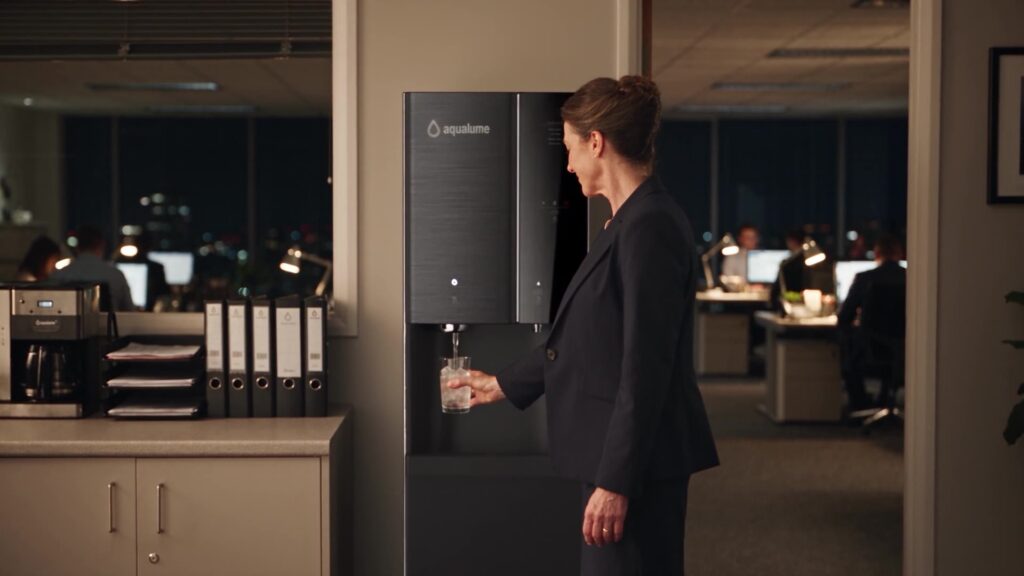
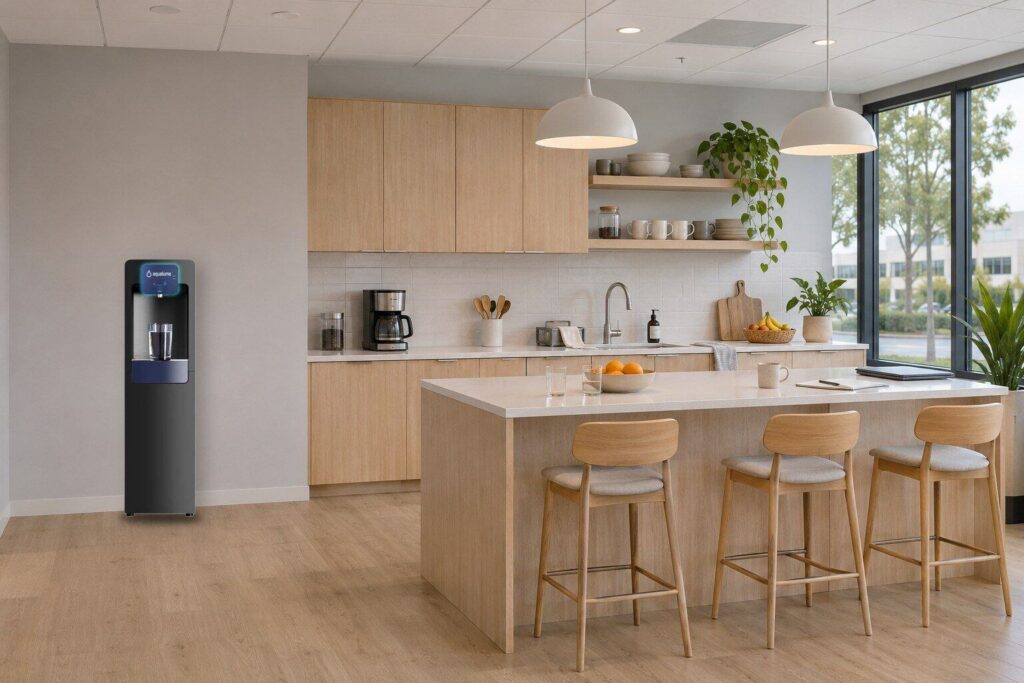
Aqualume rents bottleless dispensers to businesses for that gap. The unit connects to your existing water line and runs the supply through seven stages: sediment, pre-carbon, an RO/UF membrane, pH balance, sanitization, nutrient boost and a taste and odor polish. A model like the Cascade freestanding water dispenser gives hot, cold and ambient water on demand, and the Jetstream is the one that also does sparkling. Replacement filters are billed separately, about once a year.
Check it yourself with the meter you used on the tap and compare readings during the trial. We rent to offices across Southern California, including water dispenser service in Irvine.
Quick FAQ
How often should I test? Once a year works for most situations. Test twice a year if you are on a well, if young children use the tap, or if the taste or odor changes.
Can I drink tap water in Southern California? Generally yes. Large utilities here test constantly and publish what they find. Hardness and chlorine are quality issues, not safety issues, and your utility’s report is the place to confirm.
Are the TikTok “boil the water and a film appears” tests real? The film is mostly calcium and magnesium, which are minerals and not contamination. It points to hard water, not poisoned water.
What about PFAS? The EPA finalized enforceable limits in April 2024, and utilities are still phasing in monitoring. To learn your number you need a PFAS-specific test, and panels differ in what they cover.
The bottom line
Test once and take the result seriously. Putting the test off is the usual mistake, and it leaves a lot of businesses paying for bottled water out of vague worry. A strip kit and one lab sample will tell you where you stand.
If your results leave you wanting filtered water that someone else manages, that is what we do. Start your 7-day free trial and we will install a dispenser at your business with no install fee, and remove it free of charge if it is not a fit. Test the water before and after.
Call us at 833-426-5863 or ask for a site visit at aqualume.com.
Comparing quotes?
Get Aqualume's price for your office in one call.
Plans from $80/mo*. Seven models, one 7-stage filtration system, service across LA, Orange County and the Inland Empire.
Free 7-day trial
Try a bottleless cooler in your office before you sign.
- 7-day free trial, we take it back if it isn't right
- Plumbed in: no jugs to lift, store or reorder
- A local technician, not a national call centre
Rather talk? (833) 426-5863
*Starting price; final pricing depends on the machine and site.