Walk into any modern office, gym, or school and you’ll encounter what most people casually call a “water cooler.” But here’s the thing: that machine might actually be a water dispenser, a hydration station, or something entirely different. The terminology is so muddled that even industry professionals get tangled up. This isn’t just semantic hair-splitting—understanding the difference between water coolers and water dispensers matters when you’re choosing the right hydration solution for your space.
Terminology: Let’s Clear This Up
The confusion starts with language. Historically, a “water cooler” referred specifically to machines that chilled water using a refrigeration system. A “water dispenser,” on the other hand, is the broader category encompassing any machine that dispenses water—whether hot, cold, or at room temperature. However, in casual American English, people use “water cooler” as an umbrella term for all of these devices. It’s like calling all facial tissues “Kleenex” regardless of the brand. Everyone knows what you mean, but technically you’re being imprecise.
Add “water fountain” (a public drinking fixture) and “hydration station” (a modern wellness-focused term for advanced dispensing systems) to the mix, and suddenly you’ve got four different names describing what might be the same piece of equipment. For clarity in this guide, we’ll use precise terminology: water cooler for refrigerated units and water dispenser as the broader category.
The Rise of Both Terms
Water dispensers emerged in the late 19th century as a public health solution. After the 1906 ban on communal drinking cups, companies developed individual dispensing systems to prevent disease transmission. Early models were simple—a water fountain with a spout you’d drink directly from. The term “water cooler” became popular after electric refrigeration made ice-cold water accessible beyond wealthy homes in the 1940s and 1950s.
The modern water cooler industry exploded during the office boom of the 1970s and 1980s. Office managers embraced them not just for hydration, but as informal gathering spots where employees could chat—thus “water cooler conversation” entered the cultural lexicon. Meanwhile, the broader “water dispenser” market expanded to include machines that offered flexibility: hot water for tea, cold water for summer days, and ambient temperature options for those who preferred neither extreme.
By the 2000s, environmental concerns sparked innovation. Bottleless (or point-of-use) dispensers connected directly to water lines, eliminating plastic bottle waste. This shifted the conversation from simple cooling devices to sophisticated hydration ecosystems. Both terms continue coexisting because both represent valid categories of equipment—some emphasizing the cooling function, others emphasizing the dispensing versatility.
Water Cooler Types: The Specialized Category
When someone refers to a “water cooler,” they’re typically describing one of these specific types:
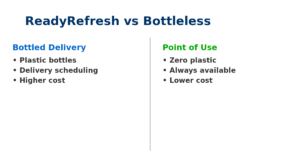
Bottle-Fed Water Coolers: These machines accept replaceable water bottles (usually 3-5 gallons) that sit inverted on top or load into a side compartment. The water runs through cooling coils, delivering chilled water on demand. They’re portable, require no plumbing, and work anywhere—perfect for temporary installations or places without access to water lines. The trade-off: you’re responsible for ordering, storing, and replacing bottles.
Bottleless Water Coolers: Also called point-of-use (POU) coolers, these tap directly into your water supply. They include filtration systems to purify the water before cooling it. No bottles mean no waste, no delivery logistics, and no recurring bottle costs. The upfront installation cost is higher, but they’re significantly cheaper long-term. Our comprehensive bottleless water cooler guide dives deeper into this technology.
Point-of-Use (POU) Coolers with Advanced Features: Modern POU coolers do far more than cool. They filter, heat, carbonate, and dispense in multiple temperatures. These are increasingly what separates a “water cooler” from a premium “water dispenser.”
Water Dispenser Types: The Broader Category
Water dispensers encompass a wider range of machines with varied functions and form factors:
Countertop Models: Compact dispensers designed to sit on kitchen counters, desks, or office break rooms. Our tabletop water dispensers are perfect for smaller spaces where floor real estate is premium. They typically offer hot and cold water, sometimes with ice capabilities.
Freestanding Models: Floor units that stand independently, usually 40-50 inches tall. These are the workhorses of office buildings, gyms, and public spaces. Freestanding dispensers accommodate higher volume use and often feature multiple temperature zones, ice dispensers, and refill cup holders. They’re what most people picture when they hear “water cooler.”
Built-in Models: Integrated directly into cabinetry or walls, these premium options create seamless aesthetics in modern offices and homes. They’re elegant but require professional installation.
The Features Comparison: Side-by-Side
| Feature | Bottle-Fed Cooler | Bottleless Cooler | Water Dispenser (General) |
|---|---|---|---|
| Temperature Options | Cold water (35-55°F), some offer hot | Cold, hot, and ambient options | Cold, hot, ambient; some add ice or sparkling |
| Installation | Plug into any outlet; no plumbing needed | Requires water line connection; professional install recommended | Varies; countertop needs outlet only; freestanding often needs water access |
| Maintenance | Bottle logistics, periodic cleaning of dispenser | Filter replacements (typically quarterly), annual professional service | Regular cleaning; maintenance varies by type and features |
| Initial Cost | $200-$500 (rental) or $150-$400 (purchase) | $500-$2,000 plus installation ($300-$800) | $300-$3,000+ depending on features and form factor |
| Monthly Operating Cost | $35-$80 (bottled water service) | $30-$60 (water and filters) | $30-$100+ depending on usage and features |
| Best For | Temporary spaces, locations without plumbing, low daily volume | Permanent installations, eco-conscious spaces, high-volume use | Flexible needs, aesthetic preferences, specific temperature requirements |
Which Solution for Which Environment?
Office Spaces: Offices benefit most from bottleless water coolers or advanced water dispensers. Employees appreciate hot water for tea and coffee, cold water for hydration, and the convenience of a always-available refill station. No bottle delivery logistics means one fewer management headache. Browse our complete water dispenser lineup for office-specific models.
Gyms and Fitness Centers: High-volume, cold-water demand makes ice-equipped dispensers essential. Members expect immediate access to ice-cold hydration pre-workout and post-exercise. Durability matters since gym equipment gets harder use. Bottleless systems handle the volume without constant bottle replacement.
Schools: Educational institutions need robust, durable systems that handle thousands of daily users. Refill cup-friendly designs prevent messes. Most schools appreciate the economics of bottleless systems—over a school year, the savings add up significantly compared to bottled alternatives.
Healthcare Facilities: Hospitals, clinics, and medical offices need sanitization-focused systems. Hot water capability matters for cleaning protocols. Bottleless systems with advanced filtration align with healthcare standards and eliminate single-use plastic bottles—increasingly important for environmental responsibility.
How Aqualume Bridges Both Categories
At Aqualume, we’ve designed our product line to cover the full spectrum of hydration needs. For those who want classic water cooler performance with modern features, our Gulfstream hot-cold bottleless water dispenser delivers instant hot and cold water without the bottle logistics. It’s efficiency meets sustainability.
For spaces demanding specialized features, our Cascade water ice dispenser provides crushed and cubed ice alongside hot and cold water—the ultimate sports facility or high-volume office solution. The Blizzard water dispenser offers the same advanced ice capability in a sleeker countertop format.
Need something that does it all? The Jetstream water ice dispenser combines cutting-edge filtration, ice production, and premium design in one powerhouse unit. These aren’t just coolers or dispensers—they’re hydration ecosystems designed for modern expectations.
We’ve eliminated the need to choose between cooling and dispensing. Our systems do both, filtered, efficient, and without plastic bottle waste. A typical business using our bottleless systems eliminates 260+ bottles annually from landfills while saving 40% on water costs compared to traditional bottled services.
The Bottom Line: Same Function, Different Names
The distinction between water coolers and water dispensers matters less than finding the right hydration solution for your specific space. What matters: Does it provide the temperatures you need? Can you install and maintain it practically? Does the cost align with your budget and usage? Will it serve your population reliably?
The terminology debate continues because both terms describe real products that solve real hydration challenges. Whether you call it a water cooler, dispenser, or hydration station, the goal remains unchanged: providing safe, accessible, refreshing water to your space.
Ready to upgrade your hydration setup? Explore our pricing options and discover which Aqualume model fits your needs. Better yet, experience the difference firsthand with a 7-day free trial. Starting at just $75/month with no contracts, you’ll eliminate bottled water delivery forever—and your wallet will thank you. Need to discuss your specific setup? Call us at 833-426-5863. We’re here to hydrate your space the right way.