Bottleless water filter systems: which one fits your space
Bottleless water systems give an office clean drinking water from the building’s own line, so nobody orders, stacks or lifts plastic jugs. Filtration quality comes first here, because it is the question people ask before anything else: what does the unit take out of the water? After that come freestanding and countertop units, who changes the filters, what going bottleless does and does not save, and whether to lease or buy. Aqualume rents these bottleless coolers and systems to businesses only and does not sell them. Where one of the alternatives to renting from us is the better call, we say so.
Bottleless coolers by shape: floor unit or countertop unit
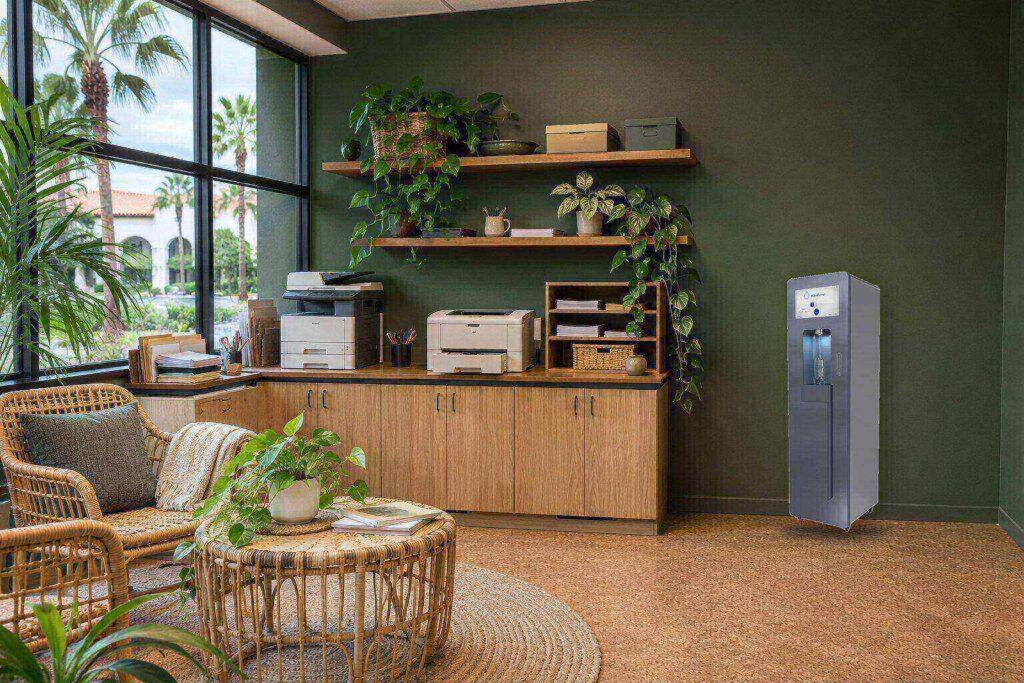
Bottleless water systems come in two shapes: freestanding bottleless coolers that stand on the floor, and countertop bottleless units for a counter or table. Which one fits is decided by how much room you have and how many people use it each day.
- Floor units suit break rooms and lobbies.
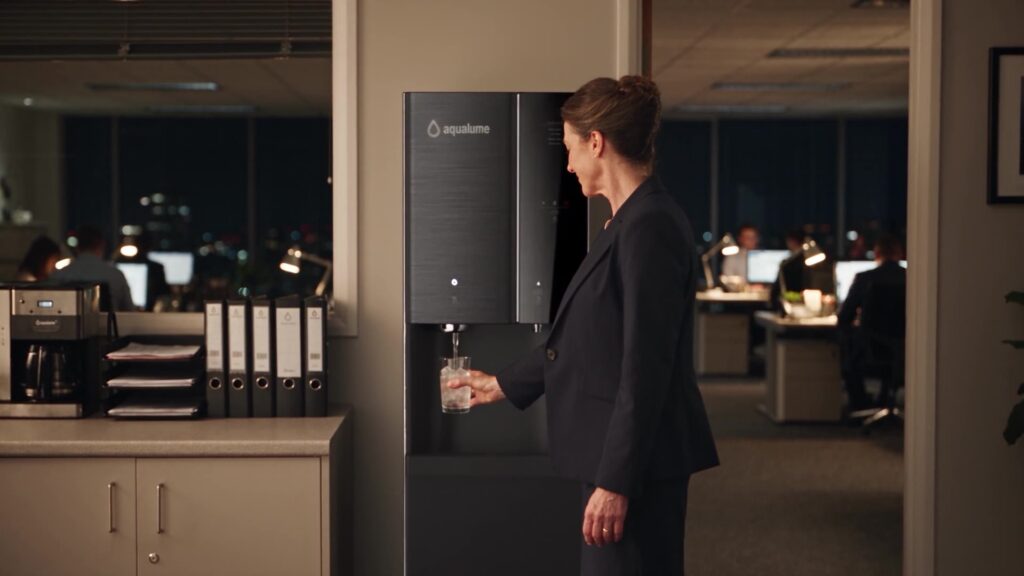
Anywhere many people fill up. Ours are the Glacier (hot, cold, ambient and ice), the Cascade (no ice) and the slim Gulfstream, hot and cold.
- Countertop units need only a counter or table.
The Lightstream is our narrowest at 11.8 inches wide, hot and cold and touchless, and it runs the same seven stages as the floor models.
If you’re not sure which shape suits your room, tell us the headcount and where the water line runs, and we’ll suggest one. For the rental side,
see how renting from Aqualume works
for offices of different sizes.
Carbon vs RO filtration: what each one removes
Carbon filtration and reverse osmosis (RO) are the two filter types you’ll see most often in bottleless water systems, and they do different jobs.
- Carbon takes out chlorine and many chemicals, VOCs among them,
which is what fixes the taste and smell of tap water. It does not catch dissolved solids, so carbon alone is not a complete system.
- Reverse osmosis pushes water through a membrane
that holds back far more dissolved solids, heavy metals and salts included. Every Aqualume machine has an RO/UF membrane stage aimed at metals, dissolved solids and arsenic.
Which one matters more depends on the quality of your incoming water. Neither replaces the other; in our systems they are separate stages.
What each of the seven filtration stages does to the water
Carbon and RO are two of the seven filtration stages in every Aqualume machine, and each one hands cleaner water to the next:
- The first two stages protect the membrane.
Sediment catches particles, then pre-carbon takes chlorine and chemicals, so the RO/UF membrane meets cleaner water.
- What comes after the membrane is the polish.
The water gets pH balance, sanitization, a nutrient boost that adds calcium, potassium and magnesium, and a final taste and odor polish.
- Ask any provider for its stage list.
If it cannot give you the stages for the exact model you are quoted, that tells you something about its filtration.
To compare bottleless coolers by filtration quality, put two stage lists side by side, ours included.
Comparing quotes?
Get Aqualume's price for your office in one call.
Plans from $80/mo*. Seven models, one 7-stage filtration system, service across LA, Orange County and the Inland Empire.
How often a bottleless water cooler filter gets replaced
Filters wear out, and a tired one shows in the taste, the water quality and the flow before anyone thinks to check the system.
Who tracks filter changes on a bottleless system: you or the provider
How long a filter lasts depends on how much water your people use and what is in the incoming supply. On Aqualume machines our technicians change the filters about once a year, billed separately from the plan.
- If you own the system, the dates are yours to track.
Follow the manufacturer’s intervals and write the change dates where people will see them. If you rent, ask who tracks them.
What a late filter change does to water quality
A filter past its life slows the flow, the water starts to taste flat or off, and the filtration quality drops because it removes less than it did when new. The slow tap is usually the first sign.
- Waiting for a complaint is the expensive way to learn a filter is due.
A scheduled change is a known cost. A late one tends to show up as slow flow, bad taste or poorer water quality.
Pros and cons of going bottleless: plastic, cost and plumbing
The pros of bottleless water coolers are less plastic and no delivery bill. The cons of bottleless systems: a water line near where people drink, plus filters and a term.
Bottle-based drinking water at work adds up to more plastic than most people guess, and one case study counted it on job sites:
Plastic bottles on construction sites
A Cal Poly case study of a midsize Bay Area construction company surveyed 15 employees about drinking water on 11 project sites and estimated about 130,416 plastic bottles a year. The author notes that bottles are cheap, easy and meet OSHA requirements, but raise concerns about resource use and microplastic pollution. Employees were only moderately open to central hydration stations and reusable bottles, and some worried that changing would slow work down. That last point is a fair one for any workplace: a refill point only works if it’s close to where people are.
Consumption and Waste for Hydrating Workers with Single Use Plastic Bottles, 2024
How a bottleless cooler cuts plastic at the workplace
Without single-use bottles there’s less plastic to throw away, which helps workplaces that report on sustainability targets. A bottleless system on the water line is also an easy place for people to refill their own bottles.
A University of Chicago study looked at what happens when refill stations are easy to find on campus:
Water bottle filling stations on a campus
Research at the University of Chicago counted every filling station on campus, recorded two weeks of meter data, surveyed students and watched how people used the stations. Students used them a lot and rated them well. The cost-benefit analysis found a large net benefit from installing more stations, and the recommendations were to keep better station records, add more filling points and sell fewer single-use bottles. It’s a campus, not an office, so treat it as a direction rather than a forecast for your break room.
The Use and Efficacy of Water Bottle Filling Stations as a Sustainability Initiative for Reducing Environmental Impact, 2018
- Plumbed-in systems need no delivery truck and have no full jugs,
no empties to send back and no bottles made in the first place.
- People bring their own bottle.
They fill it at the cooler instead of grabbing a single-use one. Whether they drink more is up to them.
Cost against bottled water: what the saving depends on
Do bottleless water coolers cost less? Any saving depends on what you pay now.
- Most of the saving comes from the bottles themselves:
you stop paying for cases or jugs, and for someone to bring them. That is the saving.
- Filters are the one extra.
On our plan scheduled service and repairs are included and filters are billed about once a year. Bottled water has no filters but does have a delivery bill.
- A water-line cooler system does not run out,
so nobody finds the jug empty at the worst moment, and nobody has to restock.
A very small team on a few cases a week may see no saving, since bottles can be cheaper than any rental.
On energy, the closest research we found is a 2023 prototype by Verma (not a unit you can rent), described below:
A low-energy water cooler prototype
Conventional water coolers use electricity and refrigerants, which makes them costly to run where power is unreliable. This study built a natural water cooler (NWC) for that problem: solar PV powers a DC fan over copper coils wrapped in viscose fabric, and the design lowers water temperature by about 6 to 10 °C through heat exchange. The authors add a filtration system so the water is safe to drink as well as cool. It’s a research design for places without steady power, not an office machine, and it says nothing about the energy use of the coolers we rent.
Natural Water Cooler: An Innovative, Energy-Efficient, and
Low-Cost Solution for Cooling Water, A Verma, 2023
Free 7-day trial
Try a bottleless cooler in your office before you sign.
- 7-day free trial, we take it back if it isn't right
- Plumbed in: no jugs to lift, store or reorder
- A local technician, not a national call centre
Rather talk? (833) 426-5863
*Starting price; final pricing depends on the machine and site.
Lease or buy a commercial bottleless water cooler system
We rent machines, so weigh what follows with that in mind. Leasing and buying each suit someone: it comes down to budget, whether you have staff to maintain a cooler, and how long you will be in the building.
Where leasing wins, and where buying does
Leasing works best when nobody on your team wants to own a water system:
- There is no machine to buy.
The capital stays in your budget, and with us installation is free. That is the saving up front.
- When a part fails, the provider comes out.
A broken system gets repaired instead of ending up in a dumpster, and the same machine keeps serving your office.
- Service gets booked for you.
Ask whether filters are in the fee. Ours are not; they are billed separately.
Our plan covers the water system, its installation, scheduled service and repairs, on a term confirmed in writing. Aqualume also runs a
7‑day free trial
with free removal if it isn’t a fit.
- Checkups and filter swaps are scheduled.
On leased systems the provider books them, so water quality is not on anyone’s to-do list.
- For service, call (833) 426-5863.
Monday to Friday, 8 AM to 5 PM, with a technician on site within 2 business days.
- A scheduled visit catches problems early.
A technician usually spots a worn filter or a slow tap before you do.
Buying makes more sense if you have facilities staff who will maintain the system and you want to own it outright; we do not sell machines, so that means another provider. If you would rather hand maintenance off,
here’s what our water dispenser service covers
on the bottleless systems we rent, and our water cooler plans for offices show how a rental is set up.
Which one to pick
Pick the shape from your space and headcount, and let the incoming water tell you how much filtration you need. Every Aqualume machine runs the same seven stages, so with us it comes down to features: ice, sparkling or a touchscreen. Rent a bottleless system from us if you’re in Los Angeles, Orange County or the Inland Empire with a water line near where people drink. Skip us if there is no line nearby, or if a few cases a week cover your team; bottled delivery or another bottleless provider may suit you better. Keep filters on schedule either way, and compare systems by stage list and filtration quality. Plans start at $80 a month per dispenser*. *Starting price; final pricing depends on the machine and site.