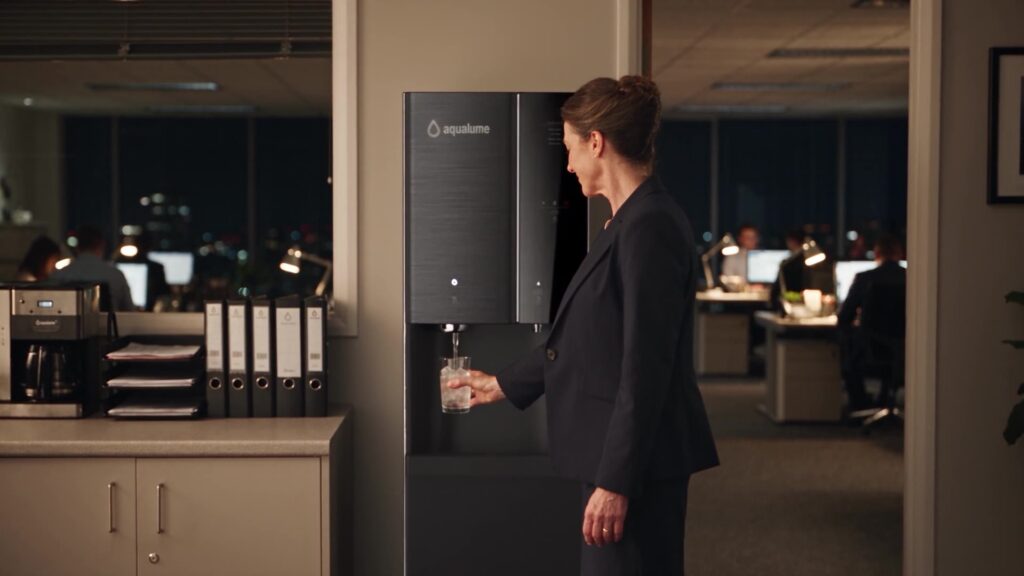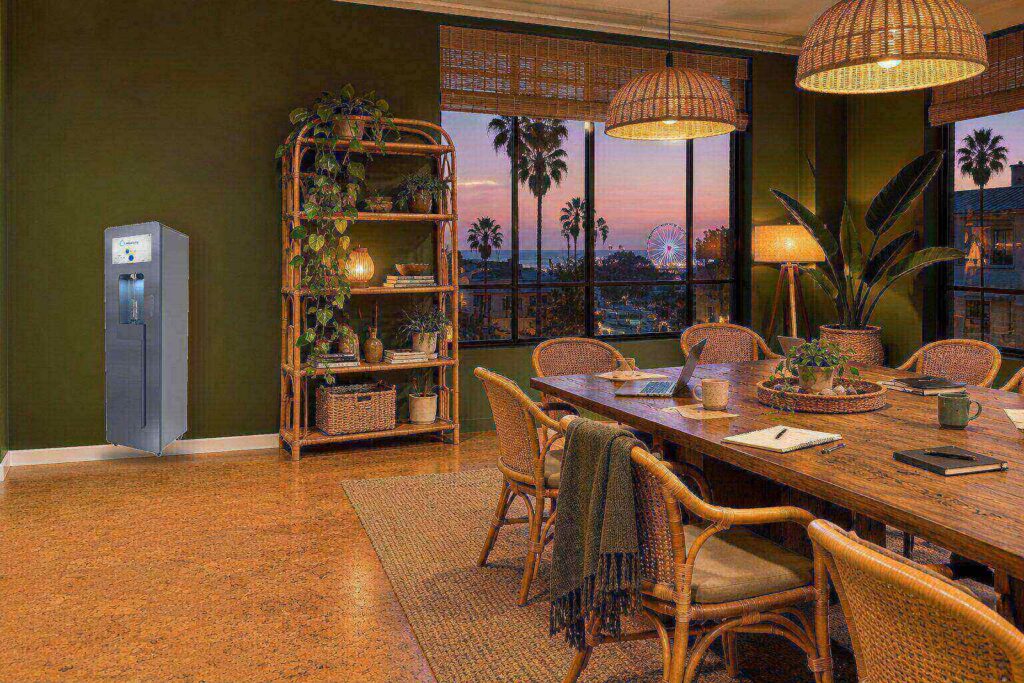
Your Water Deserves Better Than a Plastic Bottle
Plenty of bottled water starts out as municipal tap water, so a good part of what you pay for is the container and the truck. We built Aqualume around a different idea: filter your own tap water at the point of use, in a machine on your wall. That is the 7-stage water filtration system inside every Aqualume water dispenser. This page goes through the stages in order, what each one is for, and what we will not claim for it.
Each stage has one job, and each one protects the next. Where a stage has limits, we say so. The lines headed “Why it matters” are plain descriptions, not health claims, because we rent water coolers and we are not a laboratory. If a number is missing from this page, it is because we cannot source it.
Stage 1: Sediment filter, the first line of defense
What it takes out: Dirt, silt, rust and pipe residue carried in from the water line.
This is the first stage because everything after it is more delicate. Grit that reaches a carbon block or a membrane clogs it early. A sediment stage catches it at the door, so the finer stages downstream can spend their life on chemistry instead of dirt. It also keeps the water from looking cloudy when your building’s pipes are old.
Why it is there: Particles shorten the life of every filter behind them, and they can cloud the water and dull the taste. It is the least glamorous stage in the machine and one of the most useful, cheap insurance for everything behind it.
What you will notice: Mostly nothing, which is the point. If a sediment filter is overdue at the start of the line, the flow at the spout drops first, and that is the cue to call us. Replacement filters are billed separately, about once a year.
Comparing quotes?
Get Aqualume's price for your office in one call.
Plans from $80/mo*. Seven models, one 7-stage filtration system, service across LA, Orange County and the Inland Empire.
Stage 2: Pre-carbon, taking chlorine and chemicals out of the glass
What it takes out: Chlorine and other chemicals that the water treatment plant leaves in the water.
Water utilities add chlorine to keep tap water safe on its way through the pipes, and some of it is still there when the water reaches your building. At tap levels it is harmless to most people, but you can taste it and sometimes smell it. A carbon stage is the standard answer: chlorine and many organic chemicals cling to the carbon as the water passes through. It sits ahead of the membrane because chlorine can wear a membrane down over time.
Why it is there: Two reasons. The first is taste, since chlorine is the main cause of that swimming-pool edge. The second is protection: taking it out here lets the membrane in the next stage work as designed. If your building has a specific concern, ask us what the stage is rated for.
What you will notice: Water that tastes and smells like water. It is also the stage people spot first when it is overdue, because the chlorine taste creeps back. Replacement is part of the yearly filter change, billed separately.
Stage 3: The RO/UF membrane, the heavy lifter
What it takes out: Metals, dissolved solids and arsenic: the things a sediment filter and a carbon block cannot catch, because they are dissolved in the water.
A membrane stage works at a far finer scale than the two before it. Water is pushed against a semi-permeable barrier that lets water molecules through and holds back most of what is dissolved in it, such as salts and metals. For most people it is the biggest single change in taste. We list this stage as RO/UF on our product pages, and we do not break the two down further here or quote a pore size.
Why it matters: Dissolved solids and metals are the part of tap water that a sediment filter and a carbon block leave alone. How much of either is in your water depends on your local supply and your building’s pipes, so we do not put a number on it here. Your water utility publishes a quality report, and it is worth reading next to this page.
What it does not do: A membrane takes minerals out along with everything else, which is why two stages later the machine puts some back. We do not claim it removes every contaminant, and we do not name specific ones beyond the ones above.
Stage 4: pH balance, correcting the acidity
What it does: Corrects the acidity left behind after the membrane.
Water that has been through a membrane comes out with little mineral content and tends to be slightly acidic, which is a big part of why membrane-only water can taste flat or sharp. The pH stage brings the water back toward balance, so it tastes right rather than thin. It is a taste stage first. We do not claim health effects for it, and you will see pH talk elsewhere online that we are not repeating.
Why it matters: If the water tastes off, people go back to bottles or to the tap. A pH stage is there so the filtered water is something they actually want to drink. That is the whole case for it.
What you will notice: A rounder, less sharp taste than membrane-only water. This is a judgement about taste, and yours could differ, which is exactly what the 7-day trial is for, so try it before you decide.
Stage 5: Sanitization, aimed at bacteria and other pathogens
What it targets: Bacteria and pathogens that can get past chemical filtration.
Filters remove particles and chemicals. Living organisms are a separate problem, and this is the stage where the machine deals with them before the water reaches the tap. We list it as sanitization on our product pages and we do not describe the method here. If you need to know exactly how a unit is sanitized, for example in a healthcare setting, ask our technicians before you sign.
Why it matters: A dispenser is a sealed unit that sits in a warm building and is used by many people, and anything that holds water can grow a film if it is not kept clean. Scheduled service is included in the plan, so keeping the unit clean is our job and not yours.
What you will notice: Nothing, and that is the idea. If the water ever tastes or smells wrong, tell us the same day; do not wait for the next scheduled visit. Support is Monday to Friday, 8 AM to 5 PM.
Stage 6: The nutrient boost, putting minerals back in
What it adds: Calcium, potassium and magnesium, to replace some of what the membrane took out. We do not publish a milligram figure for them, and we would not trust a page that did without a lab report.
Water with no minerals in it is safe to drink, but it tastes flat, and that is what plain RO water is like. This stage adds minerals back so the water has some body and behaves more like good spring water on the tongue. People sometimes ask whether this is the same as alkaline water. It is not how we describe it: we call it a nutrient boost, and the aim is flavor, not a health claim.
Why it matters: Taste decides whether a water machine gets used. A team that finds the water flat goes back to the tap, to bottles or to the corner shop. Putting minerals back is how the machine avoids that. One Google reviewer, Steve Lavaeddin, wrote: “Great service and amazing tasting water!”
What you will notice: A fuller taste than plain RO water, and that is the whole claim. We do not say the added minerals replace your diet, support bone health or do anything medical, because we cannot back that up and neither can a water cooler. Taste it during the 7-day free trial and judge for yourself.
Stage 7: Taste and odor polish, the last step before the tap
What it does: Polishes taste and odor one last time before the water reaches the tap. It is a polish, not an infusion of anything.
This is a short stage with an easy job. After the membrane, the pH stage and the mineral stage, water can still carry a trace of taste or smell, and the final polish takes that out so what comes from the spout tastes of nothing in particular. You will find it on the spec of every Aqualume machine, next to the rest of the water filtration solution we use in every machine.
Why it matters: This is the stage that decides what the last sip tastes like, so it matters more to the drinker than its place in the list suggests. Earlier copy on this page claimed an antioxidant infusion of molecular hydrogen, with a count of studies behind it. That is not something the machine does, and we have removed it.
What you will notice: Clean water with no aftertaste. If you ever do notice one, the filters are the first suspect, so tell us and we will check them rather than leave you guessing. Replacement filters are billed separately, about once a year.
A note on the number: it is seven stages, not eight
The short answer: The web address says eight, but the machine has seven stages.
The address and some older copy on this site counted eight, with an extra polish filter and two steps the machines never had. The machines have the seven stages above: sediment, pre-carbon, RO/UF membrane, pH balance, sanitization, nutrient boost and a taste and odor polish.
Why it matters: If a competitor, or an old page of ours, promises an eighth stage or an extra step, check it against the machine you are being offered. We would rather you hold us to seven.
What to do: If anyone at Aqualume has quoted you a different stage list, call (833) 426-5863 and we will correct it in writing before you sign. Support is Monday to Friday, 8 AM to 5 PM, and we would rather clear it up now than after install day.
How the seven stages work together in one machine
The seven stages run in a fixed order, and each one prepares the water for the next: coarse particles first, chemicals second, dissolved solids third, then the stages that fix balance and taste. A pitcher filter or a whole-house cartridge does one or two of these jobs. Our bottleless water cooler systems do all seven at the point of use, and we install and service them.
Ready for the next step? Explore the Cascade freestanding water dispenser or learn about bottleless water dispensers for Southern California offices. The 7-day free trial applies either way.
What the switch means for your office budget
Bottled delivery bills you in pieces: the water, deposits, delivery fees and a cooler lease if you rent one. An Aqualume plan starts from $80/month* on a service agreement with the term set for your site, and it covers the machine, installation, scheduled service and repairs. Filters are billed separately, about once a year. We will not put a savings figure on this page, because it depends on how much your team drinks and what you pay now. The honest way to find out is to put a quote next to your last invoice. *Starting price; final pricing depends on the machine and site.
If you are comparing water filtration for office options, look at the stage list first. Ours is the same on every machine we rent, so the choice between models is about size and features, not 7-stage water filtration quality. That holds whether you are serving 5 people or 50.
What About Reverse Osmosis Exactly?
People ask whether a reverse osmosis water cooler is the whole story. For us it is not: the RO/UF membrane is the centerpiece, but it is one stage of seven. Membrane water on its own tends to taste flat, so we follow it with the pH balance, sanitization, nutrient boost and polish stages. We say “tends to” because taste is personal, and the free trial exists so you can judge for yourself.
Free 7-day trial
Try a bottleless cooler in your office before you sign.
- 7-day free trial, we take it back if it isn't right
- Plumbed in: no jugs to lift, store or reorder
- A local technician, not a national call centre
Rather talk? (833) 426-5863
*Starting price; final pricing depends on the machine and site.
Ready to Ditch the Plastic?
Your team deserves water that has been through a process you can read in plain terms, which is what this page is for. Seven stages, in order, each with a job, and none we cannot explain. If a question is not answered here, ask.
Start with a 7-day free trial. A site visit is part of it, and if the machine isn’t right for you, we remove it at no charge. If you’re in Orange County, we serve water cooler rentals throughout the region.
Questions? Call us at (833) 426-5863, Monday to Friday, 8 AM to 5 PM, and we will walk through the stages with you. Plans start from $80/month*, on a service agreement with the term set for your site and confirmed in writing before you sign anything. If this page raised more questions than it answered, call and say so.
Questions we get about the 7-stage water filtration
What does 7-stage water filtration remove that a basic filter misses?
A basic three-stage filter handles sediment, chlorine and taste. Ours adds an RO/UF membrane for metals, dissolved solids and arsenic, then pH balance, sanitization and a nutrient boost that puts calcium, potassium and magnesium back, and it finishes with a taste and odor polish. We do not publish percentage removal figures for the whole system, and you should be wary of anyone who gives one without a test report. If you need results for a specific contaminant, have your water tested and compare.
Is reverse osmosis water safe for daily drinking?
Yes. RO water is safe to drink; the usual complaint is taste, because the membrane removes minerals along with the contaminants. That is why our machines follow the membrane with pH balance and a nutrient boost that adds calcium, potassium and magnesium back. We make no health claim for the added minerals beyond flavor, and we would be wary of anyone who does.
Why does the page address say 8 stages?
It is an old address, and some older copy on this page counted eight. The machines have seven stages: sediment, pre-carbon, an RO/UF membrane, pH balance, sanitization, a nutrient boost and a taste and odor polish. The earlier copy also listed an ultraviolet step and a hydrogen infusion, and neither is part of the machine. If you need to confirm how a unit is sanitized, call (833) 426-5863, Monday to Friday, 8 AM to 5 PM, and ask before you sign.
How often do the 7-stage filters need to be replaced?
Filter replacements are billed separately from your monthly Aqualume plan, and they come about once a year. Scheduled service and repairs are part of the plan, with no extra charge for the visits. We do not publish a replacement interval for the membrane here, since it depends on your water and how much the machine pours, so tell us how many people use it and we will plan the schedule with you. Support is Monday to Friday, 8 AM to 5 PM.
How does Aqualume’s filtration compare with Culligan or Sparkletts?
We have not tested their equipment, so we will not rank it. What we can describe is the difference in approach. Bottled delivery, from Sparkletts and others, brings filled jugs to your door on a schedule. Our machine filters your own tap water at the point of use and has no jugs. That removes the bottle handling and the stored water, but not the need for scheduled filter changes. Culligan sells a range of products, including filtered systems, so when you compare, ask any provider for its full stage list, what each stage removes, and the term in writing. Ours is seven stages and a term set for your site, with plans from $80/month*.