Elevate Office Hydration with a Sparkling Water Dispenser
Elevate Your Office Hydration with Sparkling Water: Choosing the Best Commercial Sparkling Water Dispenser for Workplace Wellness
Sparkling water dispensers provide on-demand carbonated and filtered water directly from the mains, combining carbonation, chilling, and filtration into a single office amenity that supports workplace wellness and sustainability. This guide explains what a commercial sparkling water dispenser is, how office sparkling water systems work, and why they can be an effective perk for staff wellbeing and employer branding. Many workplaces struggle with high bottled-water spend, recycling burdens, and low employee water consumption; mains-fed sparkling options offer a practical solution by increasing uptake and reducing single-use plastics. The article maps the product landscape—from freestanding sparkling water dispensers to integrated sparkling water taps—and walks procurement teams through key features, installation and maintenance, rental versus purchase decisions, and 2025 trends such as touchless dispense and smart connectivity. Throughout, target keywords like sparkling water dispenser, office sparkling water, mains-fed sparkling water system, and commercial fizzy water machine are used to help buyers find practical, comparison-led guidance for selecting the right office water solution.
Why Choose Sparkling Water for Your Office Hydration Needs?
A commercial sparkling water dispenser delivers chilled, carbonated, and filtered water on demand, improving employee hydration, supporting sustainability targets, and reducing long-term beverage costs. The mechanism combines mains-fed filtration with CO₂ carbonation and refrigeration to create a consistent, palatable beverage that encourages repeat use. Providing sparkling water as part of office hydration solutions boosts perceived amenity value, helps reduce single-use plastic bottles, and can contribute to measurable cost savings versus bottled procurement. The next paragraphs explain specific wellbeing, environmental, and financial benefits and then outline how procurement routes can be approached by facilities teams.
How Does Sparkling Water Improve Employee Well-being and Productivity?

Sparkling water improves employee well-being by making hydration more appealing, which in turn supports concentration and cognitive performance through better fluid balance. Carbonated options often increase voluntary consumption because taste and novelty drive more frequent refills, and higher intake helps reduce fatigue and maintain task focus. Employers who position water as an accessible perk see behavioural changes: clearer desks, fewer off-site beverage purchases, and more micro-breaks that support mental reset. The increased adoption that sparkling options deliver also ties into workplace wellness initiatives, encouraging staff to choose healthier hydration habits over sugary drinks.
Recent research highlights how innovative hydration solutions can positively impact office worker well-being.
Data Physicalisation for Office Worker Hydration and Well-being
Hydration plays a crucial role in maintaining an individual’s health and well-being. To gain insights into the hydration behaviour of office workers, a mixed-method survey was conducted (N=32). Three artefacts were developed, named Splash Active, H2Ovation, and AquAchieve, employing various modalities of data physicalisation such as sonification, light, and bubbles, to motivate individuals to stay hydrated and adopt healthy work styles. The evaluation of these artefacts utilised the Physecology Framework, assessing data representation, information communication, interaction mechanisms, spatial input-output coupling, physical setup, and audience involvement. Reflecting on the evaluation, this study identifies challenges for future research in developing and utilising hydration-focused data physicalisation artefacts. Additionally, it examines the role of data physicalisation in enhancing hydration well-being and the social impact of these artefacts in the office environment. The findings
What Are the Environmental Benefits of Using Sparkling Water Dispensers?

Mains-fed sparkling water systems cut dependence on bottled beverages by supplying drinkable water without single-use plastic packaging, reducing plastic waste and logistics-related emissions. By tracking the number of bottles avoided, procurement teams can report direct CSR wins and calculate CO₂-equivalent savings for sustainability reporting. These systems also often use recyclable cartridges or refillable modules, and newer designs prioritise lower energy use during standby and chilling cycles. Reducing deliveries and packaging waste simplifies building waste streams and aligns hydration provisioning with corporate environmental commitments.
How Does Office Sparkling Water Reduce Costs and Deliver ROI?
Switching from bottled water to a commercial carbonated water cooler guide typically reduces recurring purchase and logistics costs by eliminating per-bottle procurement and delivery overheads, while concentrates (filters, CO₂) represent predictable consumables. To estimate payback, include initial capex or rental fees, ongoing consumables, routine servicing, and the baseline bottled-water spend your business currently incurs. A simple template is: Payback period = Initial cost ÷ (Annual bottled-water spend avoided − Annual consumables & service cost). Running this calculation with internal figures highlights scenarios where a mains-fed sparkling water system pays back quickly and where rental models may be preferable for short-term needs.
How Can Sparkling Water Enhance Your Office Aesthetics and Culture?
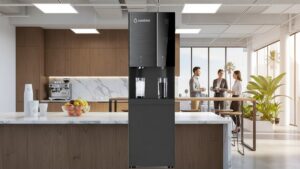
A discrete integrated sparkling water tap or a polished freestanding sparkling water dispenser becomes a visible, design-led amenity in break areas and kitchenettes, signalling care for employee comfort and modern workplace standards. Choice of finish, footprint, and placement affects both usability and visual impact; sleek taps blend into high-end pantries while compact countertop units suit satellite spaces. Visible access to quality water choices supports a culture of wellbeing and can be used in onboarding and tours to communicate employer investment in staff experience. These aesthetic and cultural advantages help attract and retain talent when paired with broader wellness programmes.
For organisations ready to source equipment, specialist suppliers offer commercial sparkling water dispensers under rental and purchase models, and procurement teams should evaluate both options against usage, installation needs, and service levels. Choosing between rental and purchase is covered in detail later in this guide so teams can match commercial terms to their workplace plans.
What Types of Commercial Sparkling Water Dispensers Are Available for Offices?
Commercial options fall into three primary categories—freestanding sparkling water dispenser, countertop sparkling water dispenser, and integrated sparkling water tap—each using filtration, CO₂, and chilling to deliver sparkling water suited to different office sizes and footprints. Selection depends on throughput needs, installation complexity, and whether a mains-fed plumbed-in system or cartridge-based countertop solution is preferable. The descriptions below define each type, illustrate typical features, and prepare buyers to match unit types to their space and usage profile. After these definitions, a compact comparison table summarises ideal office sizes, installation types, and typical features for quick decision-making.
| Dispenser Type | Ideal Office Size / Installation | Typical Features |
|---|---|---|
| Freestanding sparkling water dispenser | Large offices / communal kitchens; professional installation | High throughput, multiple water temperatures, large refrigeration, multiple dispense points |
| Countertop sparkling water dispenser | Small to medium offices or satellite kitchens; low-complexity install | Compact footprint, cartridge or plumbed options, moderate throughput, portable |
| Integrated sparkling water tap | All sizes seeking minimal footprint; plumbed-in under-sink installation | Discreet tap, under-sink filtration and CO₂ modules, seamless design, continuous supply |
This comparison clarifies which dispenser type aligns with daily demand and available installation resources, helping facilities teams shortlist appropriate models before assessing features in depth.
What Are the Features and Benefits of Freestanding Sparkling Water Dispensers?
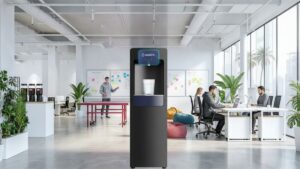
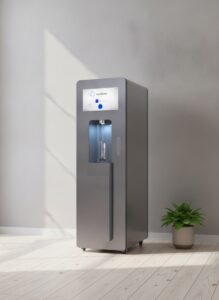
Freestanding sparkling water dispensers provide high-capacity service with multiple water options—sparkling, chilled, ambient, and sometimes hot—making them ideal for large communal areas. They typically include larger refrigeration reservoirs and higher throughput per hour, which reduces queuing and meets peak demand in busy offices. Installation can require professional water and electrical connection and periodic servicing to maintain filtration and carbonation performance. Because they serve many users efficiently, freestanding units are cost-effective for medium-to-large offices and teams seeking a durable, centralised solution that supports workplace hydration programmes.
How Do Countertop Sparkling Water Dispensers Suit Different Office Sizes?
Countertop sparkling water dispensers suit small and medium offices where footprint and installation simplicity matter, delivering a balance of portability and mains-fed or cartridge-based filtration. Their lower installation requirements make them especially useful in satellite meeting rooms, small kitchenettes, and flexible workspaces where a full plumbed installation is impractical. Capacity considerations include cartridge life or internal reservoir size and expected peak usage, so selecting a model with the right throughput for user counts avoids service interruptions. Countertop units are also attractive for trial deployments to evaluate uptake before committing to permanent freestanding or integrated solutions.
What Advantages Do Integrated Sparkling Water Taps Offer for Modern Workplaces?
Integrated sparkling water taps deliver a sleek, minimal footprint by combining an elegant deck-mounted or bench-mounted tap with under-sink filtration and a CO₂ module, preserving kitchen aesthetics while offering continuous sparkling water. They are preferable when design cohesion matters and when space for a freestanding unit is limited, providing an almost invisible drinking-water solution that complements modern pantries. Integration requires plumbing and often a site survey to confirm water pressure and access for CO₂ and service, but the result is a high-quality guest and staff experience with discreet maintenance access. For headquarters and design-led fit-outs, integrated taps often represent the premium choice.
Are Flavoured Sparkling Water Dispensers a Healthy Alternative for Offices?
Flavoured sparkling water dispensers expand beverage choice while reducing reliance on sugary drinks, but selection should prioritise sugar-free or naturally flavoured systems to align with workplace health goals. Ingredient transparency is important: choose options with natural extracts and no-added-sugar formulations; ensure allergen labelling is clear for staff with dietary constraints. Flavoured options can increase adoption among employees who would otherwise purchase soft drinks, supporting wellness programmes and reducing vending-machine spend. When deploying flavoured systems, place clear signage and rotate flavours responsibly to balance variety with simple allergen management.
What Key Features Should You Consider When Choosing an Office Sparkling Water Machine?
Key features determine water quality, hygiene, and operational suitability: advanced filtration, configurable carbonation, throughput capacity, hygiene controls, and serviceability all influence long-term performance and user satisfaction. Evaluating filter types, chill capacity, CO₂ module access, and touchless technologies helps procurement select systems aligned with workplace priorities.
Different filtration and hygiene features translate directly into quality assurance and lower operational risk:
| Feature | What it Does | Business Benefit |
|---|---|---|
| Activated carbon filter | Removes chlorine and organics | Improves taste and odour for higher adoption |
| UVC LED / Firewall® | Microbial inactivation at dispense point | Reduces contamination risk and maintenance issues |
| CO₂ carbonation module | Controls carbonation level | Consistent sparkling quality and user preference control |
| Smart telemetry | Remote monitoring of usage and consumables | Predictive servicing, lower downtime, optimised reorder cycles |
This feature mapping helps buyers prioritise which specifications deliver measurable benefits for their office environment and maintenance workflows.
How Does Advanced Filtration Technology Ensure Pure and Safe Sparkling Water?
Advanced filtration technology combines mechanical and chemical stages—sediment pre-filters, activated carbon, and sometimes membrane filtration—to remove particulates, chlorine, and organic contaminants, while UVC LED or Firewall®-style technologies target microbial risk at the dispense point. These mechanisms work together: pre-filtration protects downstream components, carbon improves taste, and UVC provides an additional hygiene layer that mitigates biofilm or microbial growth between services. Scheduled cartridge replacement and professional servicing preserve performance and ensure compliance with food-safety expectations. Facilities teams should request maintenance interval guidance and service plans to maintain consistent water quality.
What Water Options Are Typically Offered by Commercial Sparkling Water Systems?
Commercial sparkling water machines commonly dispense sparkling, chilled still, and ambient water, and some models add hot water for tea and coffee applications; each option serves a different workplace need. Sparkling water promotes hydration and staff preference, chilled still water suits general drinking, ambient supports kitchen prep, and hot dispenses integrate beverage stations. Energy and safety considerations matter for hot water features, including insulation and child-safety controls. Buyers should match configuration to usage profiles—for example, offices with high beverage-station traffic may prioritise higher chilled capacity, while smaller offices may opt for sparkling plus ambient only.
How Do Capacity and Usage Requirements Affect Dispenser Selection?
Sizing a system requires estimating daily serves per user and identifying peak periods to ensure throughput meets demand without lengthy queues or service disruptions. A practical heuristic is to estimate 1–2 serves per person per workday for offices actively promoting hydration, then scale for peak meeting times and communal spaces; add a 20–30% buffer for events or visitors. Choosing pumps, reservoirs, and refrigeration capacity that match peak throughput prevents service bottlenecks and reduces strain on CO₂ modules and filters. For larger sites, smart-monitoring features help track consumption and inform optimal locations for additional units.
What Hygiene and Safety Features Are Essential in Office Sparkling Water Dispensers?
Essential hygiene features include touchless dispense, antimicrobial surfaces on high-contact areas, and UVC or Firewall® treatments at the outlet to reduce microbial risk and cross-contamination. Safety considerations extend to secure CO₂ handling, clear labelling for flavoured products, and child-safe hot-water controls where relevant. Regular professional servicing and documented cleaning schedules are required to protect warranty and ensure food-safety compliance. Facilities should request service-level agreements that specify cleaning frequencies and parts replacement to maintain safe operation.
The development of touchless technologies, particularly those enhanced by AI, is revolutionizing hygiene standards in water dispensing systems.
A Touchless AI-Powered Water Dispenser for Enhanced Hygiene and Sustainability in Office Environments
In recent years, the imperative for contactless and sustainable systems has grown significantly. Traditional water dispensers, which necessitate physical contact and often rely on single-use plastic cups or bottles, present both hygiene concerns and contribute to environmental pollution. This paper introduces a touchless water dispenser system that leverages artificial intelligence (AI) to regulate the dispensing of water or other liquid beverages. The system is engineered to fill a container positioned beneath the nozzle, dispense liquid upon detecting container alignment with the flow, and cease dispensing once the container is full, all without requiring any physical interaction. This methodology ensures adherence to hygiene standards and fosters environmental sustainability by obviating the need for plastic bottles or cups, thereby establishing it as a ‘plastic-free’ and ‘zero waste’ solution. The prototype is predicated on a computer vision approach, incorporating an RGB camera and a Raspberry Pi board, which facilitates real-time image processing and machine learning operations. The system employs image processing techniques to ascertain the presence of a container under the nozzle and subsequently utilises AI algorithms to govern liquid flow. The system is trained using machine learning models and optimised for accuracy and efficiency. We detail the development and implementation of this touchless water dispenser system, encompassing the hardware and software components, the algorithms employed, and the comprehensive testing and evaluation procedures. Experimental results demonstrate that the touchless water dispenser system exhibits high accuracy and efficiency, offering a secure and sustainable alternative to conventional water dispensers. The system holds potential for deployment across diverse settings, including public spaces, healthcare facilities, educational institutions, and offices, where hygiene and sustainability are paramount considerations.
How Is a Mains-Fed Sparkling Water System Installed and Maintained in the Workplace?
A mains-fed installation integrates the building water supply with under-sink filtration, a CO₂ carbonation module, and commissioning steps to ensure safe and reliable operation, followed by routine servicing to sustain performance. The process requires a site survey, confirmation of water pressure and routing for CO₂ and waste lines, and a commissioning phase that includes water-quality checks and staff induction. After installation, scheduled servicing for filters, CO₂ replenishment, and hygiene checks maintains water quality and preserves equipment life. The following HowTo-style overview outlines the typical installation flow and maintenance checkpoints to prepare facilities teams for engagement with installers.
What Is the Process for Integrating Mains-Fed Sparkling Water Dispensers?
Integration begins with a site survey to assess water quality, pressure, and space for under-sink modules, followed by plumbing and electrical work to connect filtration, chillers, and CO₂ modules. After mechanical installation, commissioning includes flushing lines, verifying carbonation levels, and performing taste and microbial checks as appropriate, then delivering staff training on operation and basic troubleshooting. Professional installers typically handle CO₂ cylinder changes and safety checks; facilities should ensure access planning for regular service visits. Clear handover documentation and simple user instructions help staff adopt the new amenity quickly.
Why Is Regular Servicing and Filtration Maintenance Important?
Regular servicing and timely filter replacement preserve water quality, protect component longevity, and ensure the system meets hygiene expectations over time, while also protecting any warranty terms that require scheduled maintenance. Neglecting filter changes or ignoring microbial-control systems can reduce taste, cause reduced flow, and introduce sanitary risks that are avoidable with routine care. Service frequency depends on usage, filter type, and water quality at the site; facilities should work with suppliers to set appropriate intervals and include these in procurement agreements. A documented maintenance plan also simplifies compliance reporting and reduces unplanned downtime.
What Are Common Troubleshooting Tips for Office Sparkling Water Systems?
Common issues include low carbonation, reduced flow, and intermittent dispensing; simple checks often resolve these: confirm CO₂ cylinder pressure and connections for carbonation issues, inspect filters and lines for flow constraints, and ensure power and refrigeration are functioning for chill problems. Encourage staff to report symptoms early and provide a basic quick-check checklist so minor issues are identified before they escalate. For safety-critical problems such as suspected CO₂ leaks or electrical faults, escalate immediately to professional service providers and follow emergency protocols. Clear escalation paths minimise downtime and maintain user confidence in the system.
Should Your Business Rent or Purchase a Commercial Sparkling Water Dispenser?
Deciding to rent or buy depends on capital constraints, expected usage, required service levels, and upgrade preferences; renting converts a capital expense into predictable OPEX often with included maintenance, while buying can be more economical for long-term, high-utilisation sites. A structured comparison examines upfront costs, monthly fees, included consumables, and service response times to determine total cost of ownership versus rental over a chosen period. The tables and checklist below make that comparison tangible and help procurement teams estimate which model fits their financial and operational strategy.
| Option | Costs / Support | Implication |
|---|---|---|
| Rent | Monthly fee, often includes service & consumables | Predictable OPEX, quick upgrades, lower upfront cost |
| Buy | Upfront capital purchase, separate service & consumables | Potential long-term savings if utilisation is high, ownership responsibility |
| Hybrid (Lease-to-own) | Structured payments, sometimes partial service included | Balance of OPEX predictability and eventual ownership |
This side-by-side view helps clarify trade-offs and prepares teams to run a simple ROI calculation using their internal usage and budget figures.
What Are the Benefits of Renting Versus Buying Office Sparkling Water Machines?
Renting offers lower initial outlay, bundled maintenance, and the ability to upgrade or replace equipment quickly as needs change, which suits short-term offices, test deployments, or fast-scaling teams. Buying transfers predictable long-term costs to the purchaser and may yield lower total cost if utilisation is high and the equipment has a long service life, but ownership requires planning for servicing, consumables, and eventual replacement. For decision-makers, consider contract flexibility, included SLAs, and the forecasted timeframe for the workspace when choosing between rental and purchase models. The next section explains how to map these choices into a financial comparison.
How Do Rental and Purchase Costs Compare Over Time?
Total cost comparison should include initial purchase price or deposit, periodic service and consumable costs, and any rental payments over the analysis period; populate a simple spreadsheet with expected annual bottled-water spend avoided to calculate net savings. A typical framework is: Total cost = Initial cost + Cumulative service + Consumables − Bottled-water spend avoided. Break-even or payback occurs when avoided bottled-water spend offsets the purchase and running costs; rental often produces a longer but more predictable outflow, while purchase can front-load costs and produce savings over many years. Sensitivity testing—varying utilisation and service costs—helps identify which model is robust under different scenarios.
Which Option Offers Better Support and Upgrades for Your Workplace?
Rental agreements commonly include proactive service, faster replacement, and agreed response times in their SLAs, while purchased systems rely on separate service contracts which may vary in responsiveness and cost. When evaluating suppliers, request clear SLA terms such as guaranteed response windows, parts availability, and consumable delivery schedules to reduce operational risk. Upgrade paths differ: rental often allows straightforward swaps for newer models, while buyers may negotiate upgrade clauses or trade-in options as part of procurement. Facilities teams should prioritise response times and consumable logistics for high-utilisation locations to maintain continuous service.
What Are the Latest Trends and Innovations in Office Sparkling Water Systems for 2025?
Recent innovations centre on touchless dispensing, smart connectivity, improved sustainability of consumables, and expanded flavoured or functional water options, reflecting both hygiene priorities and data-driven facility management. Telemetry-enabled machines now report consumption patterns, filter life, and CO₂ levels to help optimise service scheduling and reduce emergency visits. Manufacturers are also investing in recyclable cartridge programmes and energy-saving refrigeration modes to lower lifecycle impact. The following subsections detail how these trends affect buyers and how to incorporate them into procurement specifications.
How Are Touchless and Smart Connectivity Features Enhancing Office Hydration?
Touchless dispense reduces surface contact and perceived infection risk, increasing user confidence and making sparkling water a safer communal amenity. Smart connectivity provides real-time telemetry on consumption, service alerts, and stock levels for filters and CO₂, enabling facilities teams to schedule maintenance proactively and prevent supply interruptions. Data from connected units also supports workplace reporting—showing uptake, pinpointing high-traffic locations, and informing decisions to deploy additional units. These capabilities convert hydration infrastructure into an accountable service with measurable operational benefits.
What Role Does Sustainability Play in New Sparkling Water Dispenser Designs?
Sustainability drives design choices for energy-efficient refrigeration, recyclable or refillable cartridges, and reduced-plastic supply chains, enabling companies to demonstrate tangible reductions in packaging and lifecycle emissions. Buyers should request vendor transparency on cartridge materials, recyclability programmes, and embodied energy to support corporate reporting. Supplier schemes that reclaim and recycle consumables or offer circular models reduce end-of-life waste and can form part of a broader sustainability procurement strategy. Evaluating these claims against verifiable metrics helps procurement align dispenser choices with corporate environmental targets.
How Are Flavoured and Healthier Alternatives Shaping Workplace Beverage Choices?
Flavoured, low-calorie, and functional water options allow organisations to offer variety while discouraging sugary-drink choices, supporting workplace nutrition goals and reducing vending-machine dependency. Systems that provide sugar-free natural flavourings encourage healthier consumption patterns and can be integrated into wellness campaigns or meeting-room offerings. Ingredient transparency, allergen management, and clear labelling are required to ensure employee safety and confidence. As demand for healthier alternatives grows, flavoured dispensers become a strategic tool to nudge better hydration and reduce overall caloric beverage consumption.
What Are the Most Frequently Asked Questions About Office Sparkling Water Dispensers?
This FAQ-style section answers common buyer questions about operation, value, and selection in concise, actionable terms, helping procurement staff and facilities managers quickly resolve common uncertainties. Short, direct responses explain fundamentals, guide decision-making, and point teams back to the more detailed sections above for deeper analysis.
How Do Sparkling Water Dispensers Work in an Office Environment?
Sparkling water dispensers typically connect to the mains water supply, pass water through filtration stages to remove particulates and taste issues, chill the water via a refrigeration unit, and add CO₂ from a cartridge or cylinder to create carbonation at dispense. The system architecture includes under-sink or internal filtration, a CO₂ module, and a refrigerated reservoir or heat-exchange mechanism for chilled water. Many models include options for still, ambient, and hot water as well, expanding their utility across beverage needs. Regular servicing and filter replacement preserve performance and ensure consistent taste and hygiene.
Are Sparkling Water Dispensers Worth the Investment for Businesses?
Yes, for many organisations the investment is justified when usage is sufficient to replace bottled procurement or to deliver measurable sustainability and wellbeing benefits; value depends on office size, consumption patterns, and the chosen procurement model. Use the payback template earlier in this guide to compare your current bottled-water costs against projected running costs for mains-fed systems under rental or purchase scenarios. Non-financial benefits—improved employee experience, reduced waste, and employer-brand signals—should also be factored into the decision. Running a short pilot deployment can provide real-world data to inform a full-scale roll-out.
What Factors Should You Consider When Choosing a Carbonated Water Dispenser?
Key selection factors include expected daily serves and peak throughput, filtration and hygiene technologies, installation constraints (plumbed-in vs cartridge), maintenance arrangements, and supplier SLAs. Additional considerations are available water options, footprint, energy efficiency, and whether smart monitoring is required for telemetry or reporting. Prioritise features that directly address business needs: hygiene for high-traffic sites, high throughput for large offices, and compact footprint for satellite locations. Use the feature-benefit table above to match technical specifications to operational priorities.
How Much Does a Commercial Sparkling Water Dispenser Cost to Buy or Rent?
Costs vary depending on unit type, capacity, included service and consumable packages; purchase includes upfront capital expense plus separate service costs, while rental typically bundles service and consumables into a monthly fee. To obtain accurate pricing, request itemised quotes that separate equipment cost, installation, consumables, and SLA details so you can compare total cost of ownership versus rental over your intended contract period. When comparing quotes, ensure CO₂, filters, and parts availability are included or clearly priced to avoid unexpected ongoing costs.